Passage Study
The Courtyard: A People Gathered Around God’s Dwelling
Exodus 27:9–27:19
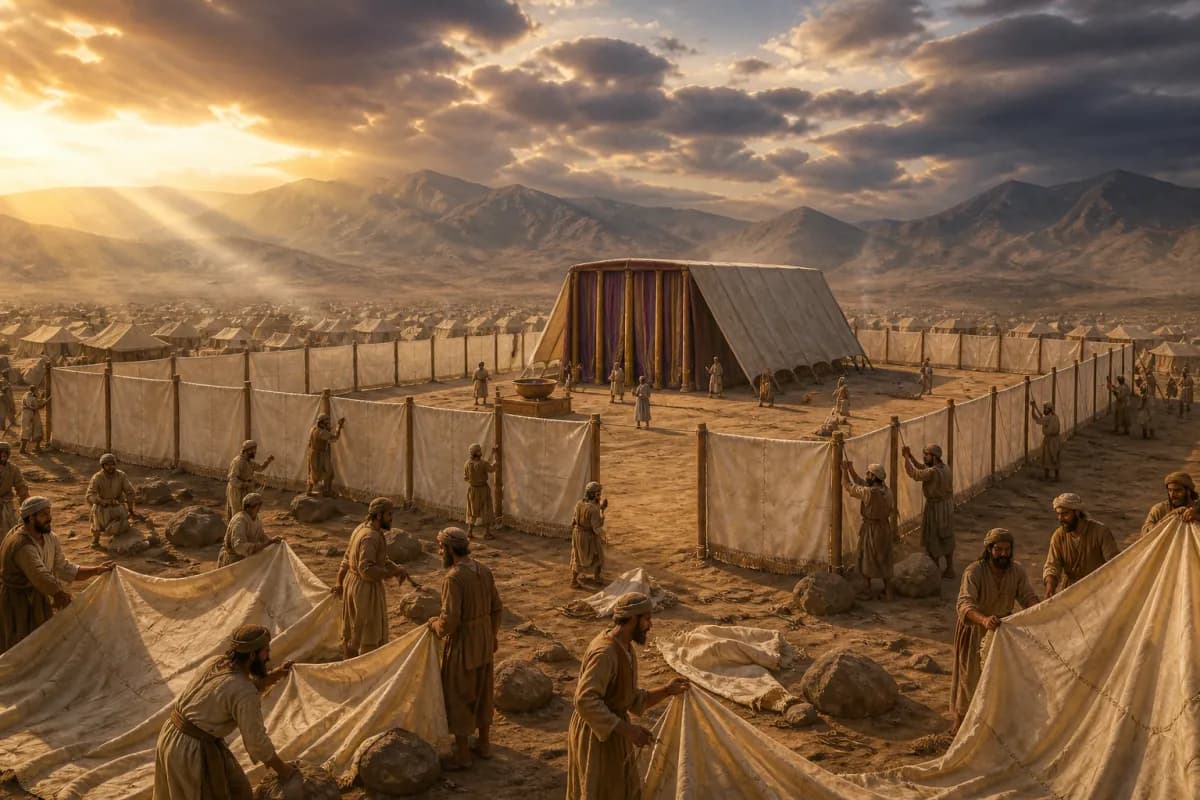
Exodus 27:9–19 sets linen hangings, bronze bases, silver hooks, and one eastern entrance around the tabernacle court. The boundary creates a real place of approach around the holy dwelling while distinguishing it from ordinary camp space. In Jesus, God gathers a people from every nation to draw near through grace and to display His holy welcome before the world.
- In this study
- 11 verses · 5 movements
Exodus 27
27:9“You shall make the court of the tabernacle: for the south side southward there shall be hangings for the court of fine twined linen one hundred cubits long for one side.
27:10Its pillars shall be twenty, and their sockets twenty, of bronze. The hooks of the pillars and their fillets shall be of silver.
27:11Likewise for the length of the north side, there shall be hangings one hundred cubits long, and its pillars twenty, and their sockets twenty, of bronze; the hooks of the pillars, and their fillets, of silver.
27:12For the width of the court on the west side shall be hangings of fifty cubits; their pillars ten, and their sockets ten.
27:13The width of the court on the east side eastward shall be fifty cubits.
27:14The hangings for the one side of the gate shall be fifteen cubits; their pillars three, and their sockets three.
27:15For the other side shall be hangings of fifteen cubits; their pillars three, and their sockets three.
27:16For the gate of the court shall be a screen of twenty cubits, of blue, and purple, and scarlet, and fine twined linen, the work of the embroiderer; their pillars four, and their sockets four.
27:17All the pillars of the court around shall be filleted with silver; their hooks of silver, and their sockets of bronze.
27:18The length of the court shall be one hundred cubits, and the width fifty throughout, and the height five cubits, of fine twined linen, and their sockets of bronze.
27:19All the instruments of the tabernacle in all its service, and all its pins, and all the pins of the court, shall be of bronze.
CONTEXTUAL OVERVIEW
These measurements form the open-air court around the tabernacle. The court is neither the Most Holy Place nor ordinary ground. It gives Israel a visible setting for altar worship and priestly service, teaching that God’s dwelling has a center and that approach to Him is a covenant gift.
The long linen boundaries might sound like administrative detail, but they shape Israel’s imagination. The Lord is present among a whole camp, yet His presence reorders that camp. Worship cannot be reduced to private feeling because God is forming a people around Himself.
HISTORICAL AND LITERARY CONTEXT
The courtyard’s pillar-and-hanging structure is suited to a people on the move. Bronze bases give the posts footing, and silver hooks and bands suspend the linen. The text lets ordinary materials serve a holy purpose without treating them as magical in themselves.
Its single entrance faces east. Exodus does not explain the direction as a symbol to be decoded, so interpretation should begin with the plain fact: God gives a defined entrance to a defined sacred space. The boundary protects the distinction between God’s holy dwelling and the people’s common life while keeping worship in the camp’s midst.
SECTION-BY-SECTION ANALYSIS
- A bounded court · Exodus 27:9The enclosure marks a real sphere of holy approach around the tabernacle.
- One marked entrance · Exodus 27:11God provides access, but access is received according to His gracious direction.
- Pegs and cords · Exodus 27:16Humble support work serves the worshiping life of the whole people.
CHRIST IN THIS PASSAGE
The courtyard does not directly foretell a particular moment in Jesus’ ministry. It does establish the sanctuary pattern of a people gathered around God’s dwelling through an entrance He provides. Jesus identifies Himself as the way to the Father and, by His death, creates access that extends beyond Israel’s camp to the nations.
The New Testament also calls the church God’s household and temple by the Spirit. This is not a claim that a building or Christian community replaces God’s holiness. It means that Jesus’ saving mission gathers people who were far off, makes them one family, and sends them to embody God’s welcome and truth in the world.
REFLECTION
Boundaries can sound harsh when they are used to exclude or control people. Exodus teaches a different lesson: God’s boundaries protect the reality of holy communion and locate mercy in a place He provides. Let Jesus correct both your prideful gatekeeping and your desire to define God on your own terms.
Look for an unnoticed way to strengthen your church’s shared life: prepare a room, greet a newcomer, carry a practical burden, or help make the gospel intelligible to someone who feels outside. The courtyard’s cords and pegs remind us that quiet service can help a whole people gather around God.
Original Hebrew Word Study
Exodus 27:9
חָצֵר
chatser · H2691
Usually translated: court or enclosed courtyard
Chatser is an enclosed court. The courtyard marks a real place of approach around the sanctuary, teaching Israel that God’s dwelling is open by His provision yet never casual or unbounded.
Follow the Scripture trail
The Courtyard: A People Gathered Around God’s Dwelling in the larger story
The connection: The courtyard gives Israel a visible place to gather around God’s dwelling and approach through His provision. Jesus brings strangers near to the Father and forms a holy, welcoming people whose common life bears witness to His saving mission.
Respond to the passage
Ask Jesus to show you where you treat church as a consumer space rather than a people gathered around God. Choose one practical act this week that helps another person draw near, hear the gospel, or belong in faithful community.
- Why does the court need both an enclosure and an entrance?
- What is gained by noticing the pegs, cords, and bases?
- How does Christ’s welcome avoid both self-made access and human gatekeeping?
Prayer
Lord Jesus, You bring people far off near to the Father. Make me grateful for Your welcome, faithful to Your holiness, and willing to serve quietly so others may encounter Your saving grace. Amen.