Passage Study
The Breastpiece: Israel Carried Before the Lord
Exodus 28:15–28:30
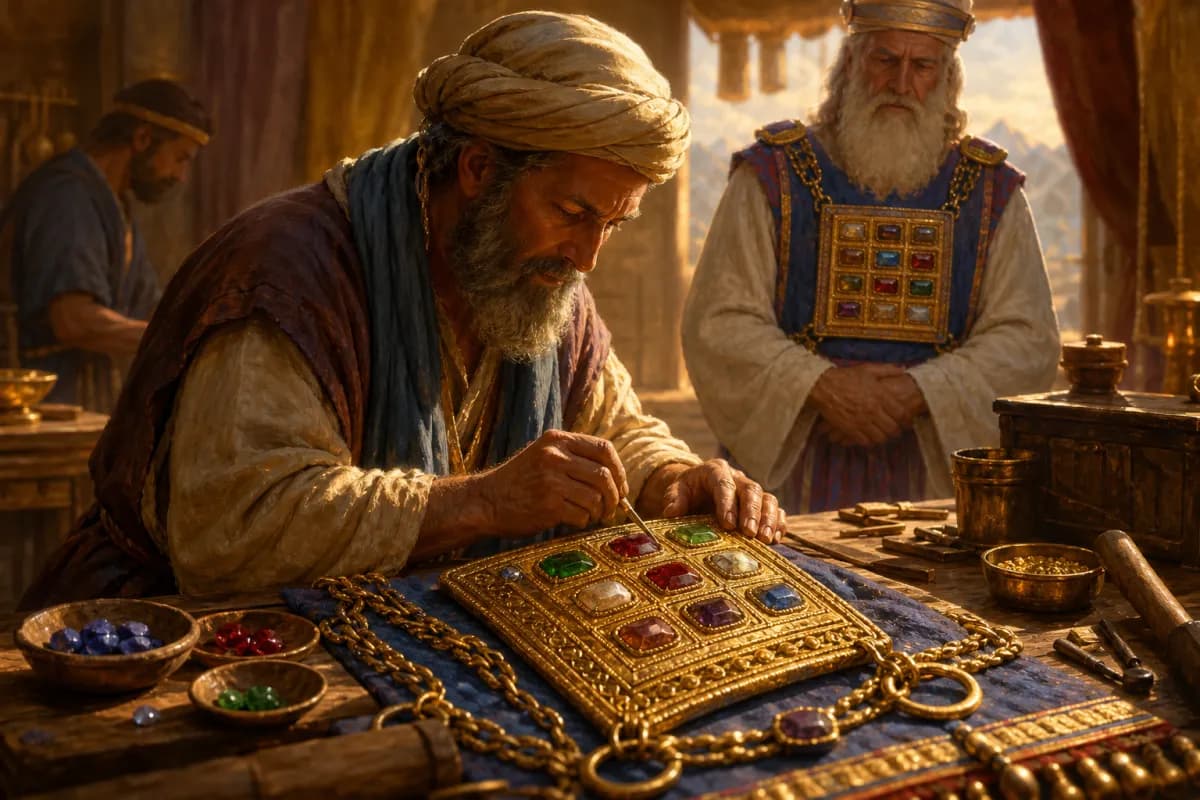
Exodus 28:15–30 gives Aaron a jeweled breastpiece fastened to the ephod, bearing the names of Israel’s tribes over his heart when he enters the holy place. The garment makes priestly representation visible: God’s people are remembered before Him through the mediator He appoints. Jesus is the greater High Priest who brings His people to the Father and gives them the saving guidance they need.
- In this study
- 16 verses · 5 movements
Exodus 28
28:15“You shall make a breastplate of judgment, the work of the skillful workman; like the work of the ephod you shall make it; of gold, of blue, and purple, and scarlet, and fine twined linen, you shall make it.
28:16It shall be square and folded double; a span shall be its length, and a span its width.
28:17You shall set in it settings of stones, four rows of stones: a row of ruby, topaz, and beryl shall be the first row;
28:18and the second row a turquoise, a sapphire, and an emerald;
28:19and the third row a jacinth, an agate, and an amethyst;
28:20and the fourth row a chrysolite, an onyx, and a jasper. They shall be enclosed in gold in their settings.
28:21The stones shall be according to the names of the children of Israel, twelve, according to their names; like the engravings of a signet, everyone according to his name, they shall be for the twelve tribes.
28:22You shall make on the breastplate chains like cords, of braided work of pure gold.
28:23You shall make on the breastplate two rings of gold, and shall put the two rings on the two ends of the breastplate.
28:24You shall put the two braided chains of gold in the two rings at the ends of the breastplate.
28:25The other two ends of the two braided chains you shall put on the two settings, and put them on the shoulder straps of the ephod in its forepart.
28:26You shall make two rings of gold, and you shall put them on the two ends of the breastplate, on its edge, which is toward the side of the ephod inward.
28:27You shall make two rings of gold, and shall put them on the two shoulder straps of the ephod underneath, in its forepart, close by its coupling, above the skillfully woven band of the ephod.
28:28They shall bind the breastplate by its rings to the rings of the ephod with a lace of blue, that it may be on the skillfully woven band of the ephod, and that the breastplate may not swing out from the ephod.
28:29Aaron shall bear the names of the children of Israel in the breastplate of judgment on his heart, when he goes in to the holy place, for a memorial before the LORD continually.
28:30You shall put in the breastplate of judgment the Urim and the Thummim; and they shall be on Aaron’s heart, when he goes in before the LORD. Aaron shall bear the judgment of the children of Israel on his heart before the LORD continually.
CONTEXTUAL OVERVIEW
The ephod has already placed Israel’s tribal names on Aaron’s shoulders. The breastpiece brings the same names over his heart as he enters the holy place. This is not private religious clothing; it visually declares that the priest appears before God as a representative of a named covenant people.
The passage calls it the breastpiece of judgment. In this setting judgment does not chiefly mean condemnation. It concerns God’s just direction for His people, made visible in the mysterious Urim and Thummim. Israel’s future is not to be decided by royal instinct, tribal rivalry, or divination borrowed from its neighbors, but by the Lord’s appointed means.
HISTORICAL AND LITERARY CONTEXT
The twelve stones correspond to Israel’s twelve tribes, each engraved like a signet. Their differing colors and names preserve both the unity and particularity of the people. Before the Lord, Israel is not an undifferentiated crowd, nor are its tribes free to treat one another as expendable.
Exodus does not explain the exact physical form or operation of the Urim and Thummim. Later texts show them associated with priestly inquiry, but responsible readers should leave their mechanics uncertain. Their clear literary function here is to locate decisive guidance in God’s holy presence and priestly mediation.
SECTION-BY-SECTION ANALYSIS
- Twelve named stones · Exodus 28:21Each tribe is remembered individually within the one covenant people.
- Fastened to the ephod · Exodus 28:15God provides a secure, appointed ministry of representation.
- Urim and Thummim · Exodus 28:30Israel’s decisive direction belongs before the Lord, not to manipulation or human control.
CHRIST IN THIS PASSAGE
The breastpiece does not give a detailed prediction of Jesus, but it establishes the need His priesthood fulfills: God’s people need a faithful representative before His holy presence. Hebrews presents the risen Jesus as the permanent High Priest who intercedes for those who come to God through Him.
Jesus carries His people to the Father more deeply than Aaron could, because He offers Himself to deal with sin and remains alive to intercede. His mission does not reduce guidance to private intuition. Through His word and Spirit He forms a redeemed people able to seek God’s wisdom and to point others to the reconciling mercy they have received.
REFLECTION
Believers may feel like anonymous needs in a vast world. The engraved names resist that fear. God’s covenant care is not vague, and in Christ no repentant sinner comes to the Father without a faithful advocate. Bring specific burdens to Jesus rather than trying to carry your standing with God alone.
When decisions are difficult, refuse both self-reliant certainty and superstitious shortcuts. Ask God for wisdom, submit to Scripture, seek mature counsel, and move honestly. A church that knows it is carried by Christ can help others without pretending to replace Him as their guide.
Original Hebrew Word Study
Exodus 28:15
מִשְׁפָּט
mishpat · H4941
Usually translated: judgment, justice, or decision
Mishpat is judgment in the sense of a just decision. The breastpiece of judgment reminds Israel that their approach to God includes His righteous guidance, not merely religious ceremony.
Follow the Scripture trail
The Breastpiece: Israel Carried Before the Lord in the larger story
The connection: Aaron bears Israel’s names and need for judgment into the holy place. Jesus fulfills the hope of this representation as the sinless High Priest who brings His people to the Father and sends them to invite others into His mercy.
Respond to the passage
Name one burden or decision you have been carrying as if you had to secure your own standing before God. Bring it specifically to Jesus, then take one wise next step shaped by His word rather than fear.
- Why are the tribal names placed over Aaron’s heart as well as on the ephod?
- What can and cannot be claimed about the Urim and Thummim from this passage?
- How does Christ’s intercession change the way you seek God’s wisdom?
Prayer
Lord Jesus, thank You for bringing me before the Father as my faithful High Priest. Give me humility to receive Your wisdom, courage to obey Your word, and love to point others toward the mercy You have secured. Amen.