Passage Study
Holy to the Lord: The Priest’s Garments of Service
Exodus 28:31–28:43
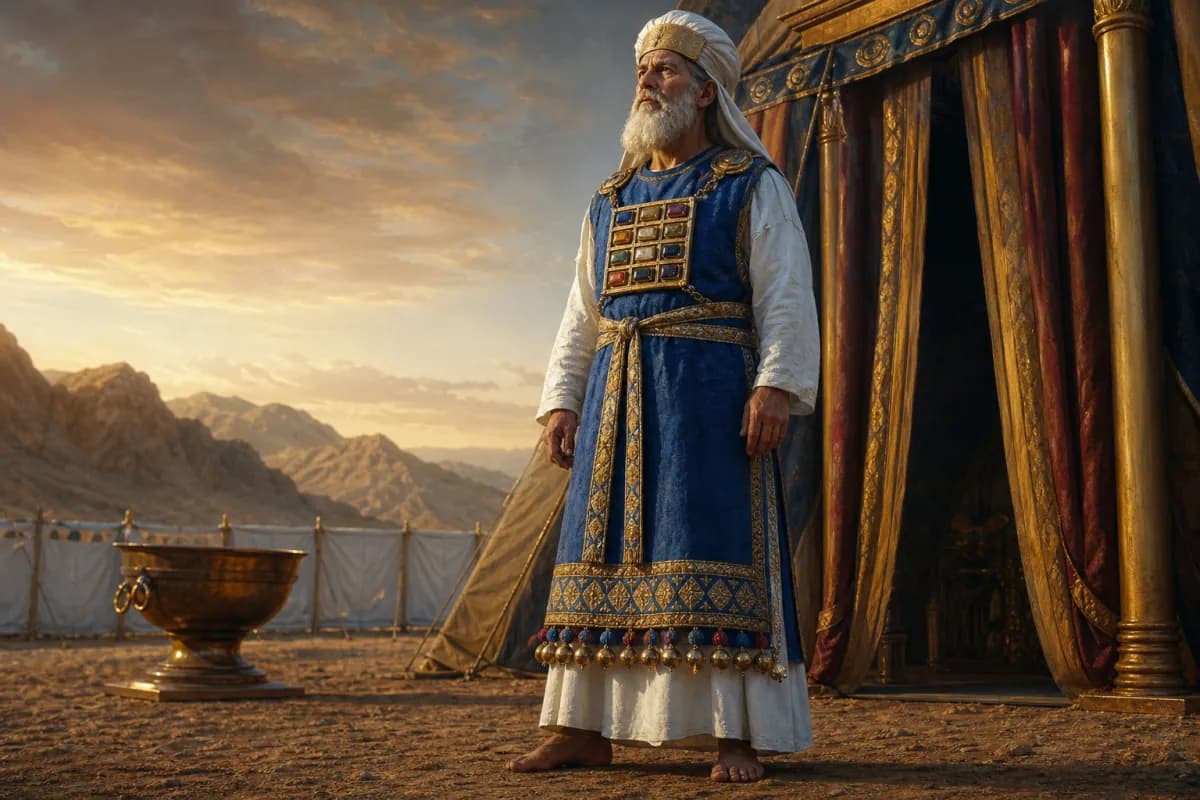
Exodus 28:31–43 completes the priestly garments with a blue robe, bells and pomegranates, a gold forehead plate inscribed “Holy to the Lord,” a tunic, turban, sash, and linen undergarments. These garments teach that drawing near to God requires holiness, atonement, and a mediator God Himself appoints. Jesus fulfills this priestly calling as the Holy One who bears sin and brings His people into consecrated service.
- In this study
- 13 verses · 5 movements
Exodus 28
28:31“You shall make the robe of the ephod all of blue.
28:32It shall have a hole for the head in the middle of it. It shall have a binding of woven work around its hole, as it were the hole of a coat of mail, that it not be torn.
28:33On its hem you shall make pomegranates of blue, and of purple, and of scarlet, all around its hem; with bells of gold between and around them:
28:34a golden bell and a pomegranate, a golden bell and a pomegranate, around the hem of the robe.
28:35It shall be on Aaron to minister: and its sound shall be heard when he goes in to the holy place before the LORD, and when he comes out, that he not die.
28:36“You shall make a plate of pure gold, and engrave on it, like the engravings of a signet, ‘HOLY TO THE LORD.’
28:37You shall put it on a lace of blue, and it shall be on the sash. It shall be on the front of the sash.
28:38It shall be on Aaron’s forehead, and Aaron shall bear the iniquity of the holy things, which the children of Israel shall make holy in all their holy gifts; and it shall be always on his forehead, that they may be accepted before the LORD.
28:39You shall weave the tunic with fine linen. You shall make a turban of fine linen. You shall make a sash, the work of the embroiderer.
28:40“You shall make tunics for Aaron’s sons. You shall make sashes for them. You shall make headbands for them, for glory and for beauty.
28:41You shall put them on Aaron your brother, and on his sons with him, and shall anoint them, and consecrate them, and sanctify them, that they may minister to me in the priest’s office.
28:42You shall make them linen pants to cover their naked flesh. They shall reach from the waist even to the thighs.
28:43They shall be on Aaron and on his sons, when they go in to the Tent of Meeting, or when they come near to the altar to minister in the holy place, that they don’t bear iniquity, and die. This shall be a statute forever to him and to his offspring after him.
CONTEXTUAL OVERVIEW
The garments in these verses are not a costume added after priesthood is established. They are part of the way Israel learns what priestly approach means. Aaron must wear what God commands because the one who comes near to the holy God carries the people’s offerings and needs atonement himself.
The clearest inscription is “Holy to the Lord.” It rests on Aaron’s forehead, where it publicly names the claim of God upon him. Holiness is not a mood of religious intensity. It is belonging to the Lord in a way that affects worship, responsibility, and the people represented by the priest.
HISTORICAL AND LITERARY CONTEXT
The pomegranates and bells create a striking hem around the robe. The text states that the sound is heard when Aaron enters and leaves the holy place so that he does not die. It does not ask readers to invent a superstition about whether the priest is alive; it marks his ministry as a dangerous privilege governed by God’s command.
The linen undergarments address bodily exposure in sanctuary service. Israel’s worship does not treat the body as shameful, but neither does it turn nearness to God into casual display. The detailed clothing dignifies priestly service while making clear that no representative may approach on self-chosen terms.
SECTION-BY-SECTION ANALYSIS
- Bells at the hem · Exodus 28:33The priest’s entry is audible and ordered, not casual access to holy space.
- Holy to the Lord · Exodus 28:36Aaron’s ministry is publicly marked by God’s claim and by the need for accepted offerings.
- Garments for the sons · Exodus 28:41Priestly holiness is an office-wide calling, not merely one leader’s personal distinction.
CHRIST IN THIS PASSAGE
Aaron bears the guilt of Israel’s holy gifts, which means the old priesthood itself cannot assume sinless access. Jesus is different: the New Testament calls Him holy, innocent, and undefiled. He does not need atonement for Himself, yet He bears the sins of others to make them acceptable before God.
Christ’s holiness is not a barrier that leaves repentant people outside. By His death He consecrates a people for God, and by His Spirit He teaches them to offer their ordinary lives in grateful service. His mission sends holy people into the world with humility, not superiority, because their welcome rests on His sacrifice.
REFLECTION
“Holy to the Lord” confronts the habit of offering God only the parts of life that cost little. Bring your work, speech, body, money, relationships, and hidden motives under Jesus’ cleansing authority. Holiness grows from belonging to Him, not from performing a more impressive religious identity.
Do not use holy language to separate yourself from people who need grace. Jesus’ holiness moved toward the unclean to heal and restore. Let reverence for God make you truthful about sin and tender toward those who fear they cannot be received.
Original Hebrew Word Study
Exodus 28:36
קֹדֶשׁ
qodesh · H6944
Usually translated: holiness; what belongs to God
Qodesh means holiness, what belongs to God. “Holy to the Lord” is placed on the priest’s forehead, making plain that the representative who bears Israel before God must be marked by God’s own claim.
Follow the Scripture trail
Holy to the Lord: The Priest’s Garments of Service in the larger story
The connection: Israel’s priest must carry its offerings under the public claim of God’s holiness. Jesus, the truly holy Priest, bears sin rather than needing sacrifice for Himself and forms a consecrated people to display His mercy among the nations.
Respond to the passage
Ask Jesus to show you one part of life you keep outside His holy claim. Confess it without hiding, receive His cleansing mercy, and choose one concrete act of service that reflects His welcome to others.
- Why does the gold plate say “Holy to the Lord” rather than celebrate Aaron?
- What does Aaron’s bearing of the guilt of holy gifts reveal about worshipers?
- How does Christ’s perfect holiness make humble service possible?
Prayer
Holy Lord Jesus, thank You for bearing sin and making Your people acceptable before the Father. Consecrate my ordinary life to You, keep me reverent without pride, and make me a merciful witness to Your cleansing grace. Amen.