Passage Study
The Ephod: Bearing God’s People Before Him
Exodus 28:6–14
The ephod joins Aaron visibly to both the sanctuary and the people he serves. Its woven splendor belongs to the holy dwelling place, while its two onyx shoulder stones carry Israel’s engraved names before the Lord. God appoints a mediator who bears the covenant community into His presence—a priestly pattern fulfilled decisively in Jesus Christ.
- In this study
- 9 verses · 5 movements
Exodus 28
28:6“They shall make the ephod of gold, blue, purple, scarlet, and fine twined linen, the work of the skillful workman.
28:7It shall have two shoulder straps joined to the two ends of it, that it may be joined together.
28:8The skillfully woven band, which is on it, shall be like its work and of the same piece; of gold, blue, purple, scarlet, and fine twined linen.
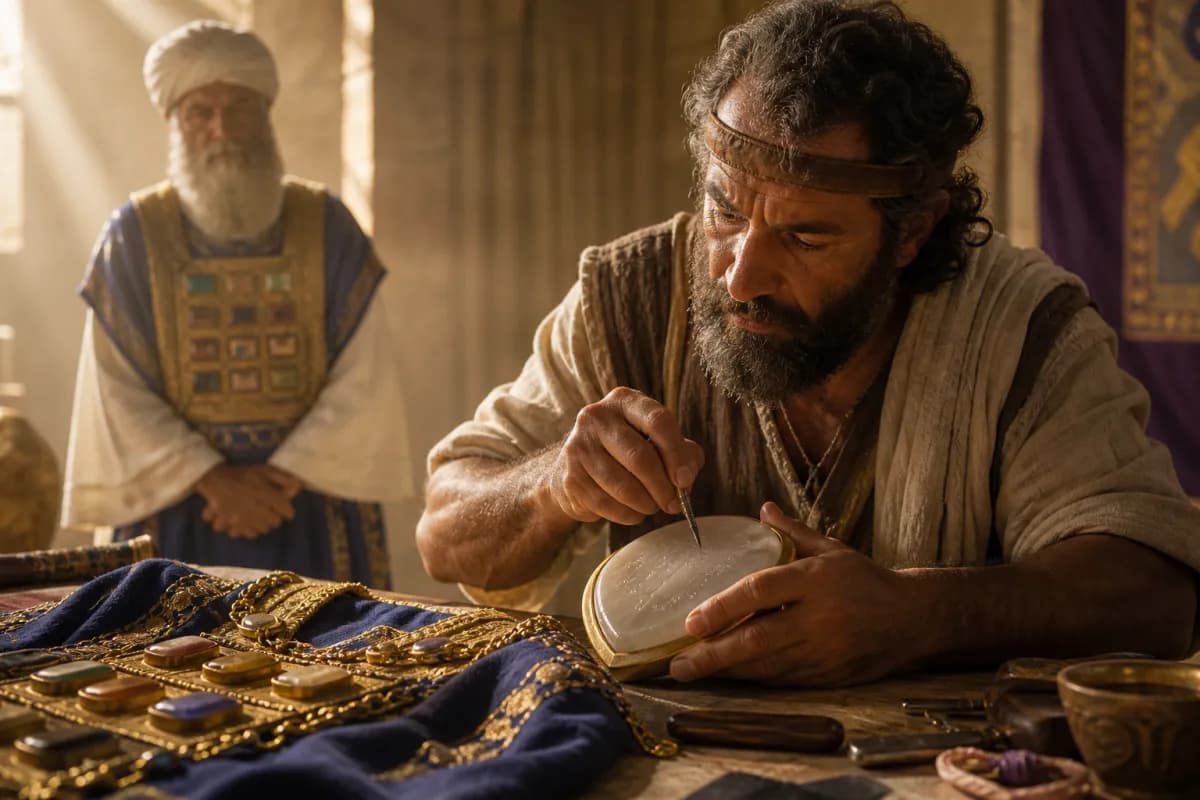
28:9You shall take two onyx stones, and engrave on them the names of the children of Israel.
28:10Six of their names on the one stone, and the names of the six that remain on the other stone, in the order of their birth.
28:11With the work of an engraver in stone, like the engravings of a signet, you shall engrave the two stones, according to the names of the children of Israel. You shall make them to be enclosed in settings of gold.
28:12You shall put the two stones on the shoulder straps of the ephod, to be stones of memorial for the children of Israel. Aaron shall bear their names before the LORD on his two shoulders for a memorial.
28:13You shall make settings of gold,
28:14and two chains of pure gold; you shall make them like cords of braided work. You shall put the braided chains on the settings.
CONTEXTUAL OVERVIEW
Exodus 28 follows the instructions for the tabernacle itself (Exodus 25–27) and begins the clothing of Aaron and his sons for their service. The ephod is not an isolated religious costume. It belongs to the same holy pattern as the sanctuary, because the priest who enters God’s presence must do so by God’s appointment and on behalf of the people God has redeemed.
Verse 6 gives the ephod the same costly blue, purple, crimson, gold, and fine linen associated with the sanctuary’s curtains and veil. The garment therefore marks Aaron’s work as bound to the place where the Lord chooses to dwell among Israel. The concern of the passage is neither fashion nor decoration, but mediated access to the holy God.
HISTORICAL AND LITERARY CONTEXT
The passage is set at Sinai, after the Lord has brought Israel out of Egypt and entered covenant with them. The immediate literary setting matters more here than debates about Exodus’s final composition: Israel is being taught how a sinful people may live near the God who has already rescued them. The high priest’s garments make that covenant order visible.
The text itself gives the controlling meaning of the shoulder stones. Each stone receives six names, ordered by birth, and Aaron bears those names “for remembrance before the Lord” (v. 12). The passage does not explain every artistic detail symbolically, so this study does not turn the colors, gold settings, or measurements into separate predictions. It emphasizes the meaning Scripture explicitly assigns: representative remembrance before God.
SECTION-BY-SECTION ANALYSIS
Verses 6–8 describe the ephod’s materials and the skillful woven band that holds it together. The same materials used around the tabernacle surround the priest’s service, showing that Aaron’s approach is ordered by the God who dwells with Israel, not invented by the priest or the people.
Verses 9–11 specify two onyx stones, six names on each, engraved like a seal in birth order. Verses 12–14 then place those stones in gold settings on Aaron’s shoulders. Israel’s tribes are not merely remembered in the priest’s mind; their names are made visible as he appears before the Lord on their behalf.
CHRIST IN THIS PASSAGE
This is strong biblical typology rather than an explicit prediction. Hebrews identifies Jesus as the greater High Priest who has passed through the heavens and lives permanently to intercede for His people (Hebrews 4:14–16; 7:23–28). Aaron’s ministry was repeated and limited; Christ’s priesthood is final, sinless, and enduring.
The Messiah also carries the weight of His royal mission. Isaiah 9:6 says that authority rests on His shoulders; that royal image does not directly explain the ephod, but it fittingly echoes the One who bears His people before God as priest and rules them as the promised King. Jesus brings the covenant people to the Father and sends them out as witnesses of His reconciling kingdom.
REFLECTION
The engraved names confront the fear that we are lost in the crowd or left to make our own case before God. The gospel gives a stronger answer than self-assertion: the risen Jesus knows His people and represents them before the Father. His intercession steadies repentance, worship, and endurance because access to God rests on His faithfulness.
Those entrusted with spiritual care receive a sober pattern from Aaron’s shoulders. Christian leaders do not own people or use them to build importance. They carry people before God in prayer, speak the truth for their good, and serve under the Shepherd who gave Himself to gather and send His flock.
Original Hebrew Word Study
Exodus 28:6
אֵפוֹד
ephod · H646
Usually translated: ephod, a priestly garment
The ephod is the high priest’s distinctive outer garment. In these verses its shoulder pieces become the place where Israel’s names are borne before the Lord, so the garment visibly joins priestly service, sanctuary access, and covenant representation.
Exodus 28:12
זִכָּרוֹן
zikkaron · H2146
Usually translated: remembrance or memorial
Zikkaron names a memorial that brings a covenant reality before God. The stones do not supply information God lacks. They are God’s appointed sign that Aaron appears before Him as Israel’s representative, bearing the names of the people the Lord has claimed.
Follow the Scripture trail
The Ephod: Bearing God’s People Before Him in the larger story
The connection: The ephod belongs to the Bible’s priestly pattern: God provides a mediator who bears His people before Him. Jesus fulfills that pattern as the true and lasting High Priest, bringing His people into the Father’s presence through His once-for-all sacrifice and continuing intercession.
Respond to the passage
The names on Aaron’s shoulders meet a deep fear: being overlooked before God. In Christ, the answer is not that believers make themselves memorable through spiritual performance. The crucified and risen High Priest knows His people, represents them before the Father, and keeps them near. This also gives spiritual leaders a sober calling: they are to carry people in prayer and care, never use them for status or control.
- Why does the passage place the tribes’ engraved names on Aaron’s shoulders, and what does that reveal about the priest’s task?
- Where do you feel forgotten, unseen, or left to carry your own case before God? How does Christ’s continuing intercession address that fear?
- If you lead or care for others, what would it mean this week to carry their names before God in concrete prayer rather than treating them as a responsibility to manage?
Prayer
Father, thank You that You have not left me to approach You on my own. Thank You for Jesus, my faithful High Priest, who represents and intercedes for His people. Teach me to rest in His finished work, to bring others before You in prayer, and to serve them with the care He has shown me. Amen.