Passage Study
Morning and Evening: God Meets His People Continually
Exodus 29:38–29:46
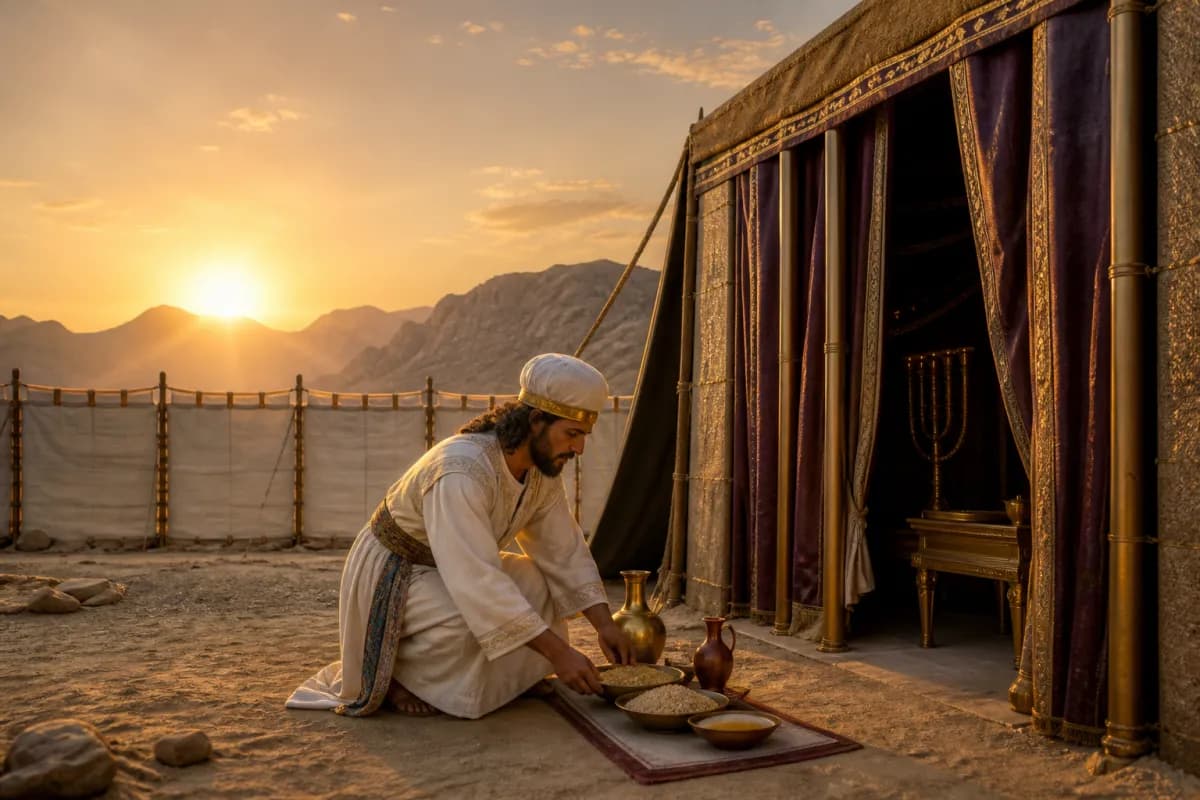
Exodus 29:38–46 commands two daily lamb offerings, morning and evening, with grain, oil, and wine, at the entrance of the tent of meeting. The rhythm teaches Israel that covenant life is sustained by God’s ongoing provision for worship and by His promise to dwell among them. Jesus fulfills the sacrificial hope through His once-for-all death and gathers a people whose whole lives answer His saving presence with worship.
- In this study
- 9 verses · 5 movements
Exodus 29
29:38“Now this is that which you shall offer on the altar: two lambs a year old day by day continually.
29:39The one lamb you shall offer in the morning; and the other lamb you shall offer at evening;
29:40and with the one lamb a tenth part of an ephah of fine flour mixed with the fourth part of a hin of beaten oil, and the fourth part of a hin of wine for a drink offering.
29:41The other lamb you shall offer at evening, and shall do to it according to the meal offering of the morning and according to its drink offering, for a pleasant aroma, an offering made by fire to the LORD.
29:42It shall be a continual burnt offering throughout your generations at the door of the Tent of Meeting before the LORD, where I will meet with you, to speak there to you.
29:43There I will meet with the children of Israel; and the place shall be sanctified by my glory.
29:44I will sanctify the Tent of Meeting and the altar. I will also sanctify Aaron and his sons to minister to me in the priest’s office.
29:45I will dwell among the children of Israel, and will be their God.
29:46They shall know that I am the LORD their God, who brought them out of the land of Egypt, that I might dwell among them: I am the LORD their God.
CONTEXTUAL OVERVIEW
The lengthy priestly consecration concludes by turning to the daily rhythm of public worship. Two lambs, one at morning and one at twilight, mark each day at the tent of meeting. Israel’s relationship with God is not sustained by a single dramatic memory of Sinai or the sea; it is ordered around His continuing gift of approach.
The end of the passage gives the aim of the offerings: God will meet, speak, sanctify, dwell, and be known. Sacrifice is never merely a transaction that keeps a system operating. It belongs to the Lord’s purpose to live among the people He redeemed from Egypt and to make them know that He is their God.
HISTORICAL AND LITERARY CONTEXT
The daily offering is called continual, meaning regular and ongoing rather than an uninterrupted physical act. Morning and evening give Israel a shared calendar of dependence. Grain, oil, and wine join the lamb to the ordinary produce of the land and work of the people, all offered before the God who gives them.
The tent entrance is the meeting place, not a platform for priests to display devotion. God says He will meet the Israelites there. The order matters: His presence is gracious initiative, and the sacrifices are part of the covenant means by which a sinful people receives rather than manufactures fellowship with Him.
SECTION-BY-SECTION ANALYSIS
- Morning and twilight · Exodus 29:39The day is bracketed by God’s covenant provision, not by self-sufficient activity.
- At the tent entrance · Exodus 29:42God promises to meet His people at the place He appoints.
- I will dwell among them · Exodus 29:45The goal of redemption is communion with God, not freedom detached from Him.
CHRIST IN THIS PASSAGE
The daily lambs are repeated, while Jesus’ sacrifice is once for all. The difference matters: Christians do not recreate the tabernacle’s sacrificial schedule. Yet the daily offering clearly trains Israel to expect that life before the holy God depends continually on His merciful provision.
Jesus gives Himself as the decisive sacrifice and, risen from the dead, brings His people into God’s dwelling. He is Emmanuel, God with us, and through His Spirit the church becomes a people in whom God dwells. His saving mission turns ordinary days into occasions for worship and witnesses to His presence.
REFLECTION
A regular pattern of prayer does not purchase God’s nearness, but it can train a distracted heart to receive it. Let morning and evening become small acts of remembrance: thank God for redemption, confess what needs mercy, and entrust the coming or completed day to Jesus.
The promise “I will dwell among them” keeps faith from becoming private inspiration. The risen Christ gathers a people. Make shared worship, mutual encouragement, and practical love part of your routine so that neighbors can see the kind of reconciled life His presence creates.
Original Hebrew Word Study
Exodus 29:42
תָּמִיד
tamid · H8548
Usually translated: continually or regularly
Tamid means continually or regularly. The daily offering keeps Israel’s worship ordered around God’s continuing provision and presence rather than around rare moments of religious intensity.
Follow the Scripture trail
Morning and Evening: God Meets His People Continually in the larger story
The connection: Israel’s days are ordered by sacrifices at the place where God promises to dwell. Jesus fulfills their saving purpose through His final sacrifice and makes His people a dwelling of God that bears witness to His reconciling presence.
Respond to the passage
Set one brief morning or evening practice this week: thank Jesus for His sacrifice, confess one sin, and pray for one person who needs to know God’s welcome through Him.
- Why does Exodus place the daily offering at the end of priestly consecration?
- What does God promise to do at the tent of meeting?
- How does Christ’s once-for-all sacrifice shape regular worship without recreating the old ritual?
Prayer
Lord Jesus, thank You for Your final sacrifice and Your faithful presence. Teach me to begin and end my days in grateful dependence, and make my ordinary life a witness that You bring people near to God. Amen.