Passage Study
The Burning Bush: The Holy God Who Comes Down to Save
Exodus 3:1–3:6
Exodus 3:1–6 interrupts Moses’ wilderness years with a bush that burns without being consumed. The God of Abraham, Isaac, and Jacob reveals His holy presence and calls Moses into the rescue of Israel. The passage establishes that deliverance begins with God’s holy initiative, fulfilled in Jesus Christ, who brings sinners near to God and leads them from slavery into His service.
- In this study
- 6 verses · 5 movements
Exodus 3
3:1Now Moses was keeping the flock of Jethro, his father-in-law, the priest of Midian, and he led the flock to the back of the wilderness, and came to God’s mountain, to Horeb.
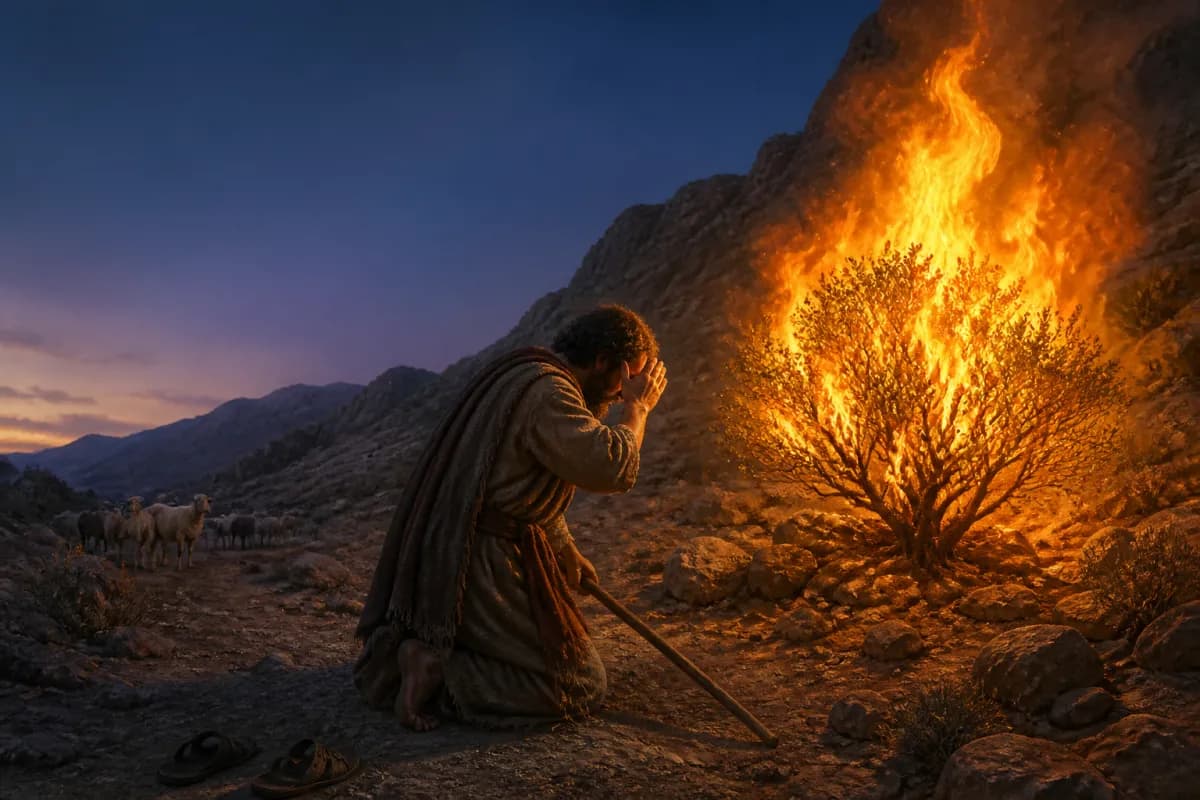
3:2The LORD’s angel appeared to him in a flame of fire out of the middle of a bush. He looked, and behold, the bush burned with fire, and the bush was not consumed.
3:3Moses said, “I will go now, and see this great sight, why the bush is not burned.”
3:4When the LORD saw that he came over to see, God called to him out of the middle of the bush, and said, “Moses! Moses!” He said, “Here I am.”
3:5He said, “Don’t come close. Take off your sandals, for the place you are standing on is holy ground.”
3:6Moreover he said, “I am the God of your father, the God of Abraham, the God of Isaac, and the God of Jacob.” Moses hid his face because he was afraid to look at God.
CONTEXTUAL OVERVIEW
Moses has fled Egypt after killing an Egyptian and now keeps sheep in Midian. The future deliverer of Israel is not standing before Pharaoh but living far from the court. God’s appearance begins the exodus not with Moses’ plan or Israel’s strength, but with divine initiative.
The bush burns without being consumed, drawing Moses aside. When he approaches, God calls him by name and stops him: holy ground is not ordinary ground because God is present. The first lesson of Moses’ commission is that the God who saves is not manageable.
HISTORICAL AND LITERARY CONTEXT
Exodus 3 follows Israel’s groaning under Pharaoh and God’s remembrance of His covenant. The mountain is called Horeb here and Sinai elsewhere; it will become the place where the rescued people receive God’s covenant instruction. The encounter therefore joins rescue, worship, and holy service from the beginning.
God identifies Himself as the God of Abraham, Isaac, and Jacob. Israel’s rescue is not an isolated response to a crisis but the continuation of the promise made to the patriarchs. Moses’ hidden face and bare feet establish the proper response to this covenant God: reverent fear before His presence.
Did you know?
Jesus used the burning-bush account to answer a question about resurrection. He drew attention to God naming Abraham, Isaac, and Jacob, then explained that God is the God of the living (Mark 12:26–27).
Why it matters: The encounter that launches Israel’s rescue also becomes, in Jesus’ teaching, testimony to life beyond death.
SECTION-BY-SECTION ANALYSIS
- The unconsumed bush · Exodus 3:2The sign signals a divine presence that is not exhausted or controlled by the created thing through which it appears.
- The name · Exodus 3:1God addresses Moses personally, showing that His call comes with knowledge and authority.
- Holy ground · Exodus 3:5The ground is holy because God is present; reverence is the fitting response to the God who draws near.
CHRIST IN THIS PASSAGE
The burning bush is not presented as a direct prediction of Jesus, so its imagery should not be forced into a one-to-one allegory. Its central theme is clearer: the holy God comes near in order to save His covenant people. In the incarnation, the eternal Son comes among us without ceasing to be holy, revealing the Father and making reconciliation possible.
Jesus fulfills the exodus pattern at a deeper level. He confronts the slavery of sin and death, gives Himself as the Passover sacrifice, and leads His people into worship of God. Through Him, those who once had reason to hide from holiness are cleansed and invited to draw near with reverence and confidence.
REFLECTION
Moses’ first response is not self-confidence but attention and reverence. This passage corrects both casual religion and despair: God’s holiness exposes our unfitness, yet this holy God is the One who sees oppression and acts to rescue.
Jesus does not make God’s holiness less serious; He bears sin’s cost so that forgiven people can belong to God. When He calls His church into difficult service, He does not send it on the strength of its past competence. He sends it as people who have first met the God who is holy, merciful, and present.
Original Hebrew Word Study
Exodus 3:5
קֹדֶשׁ
qodesh · H6944
Usually translated: holiness or holy place
Qodesh marks what belongs to God and is set apart by His presence. The soil itself is ordinary; it becomes holy because the Lord has drawn near.
Follow the Scripture trail
The Burning Bush: The Holy God Who Comes Down to Save in the larger story
The connection: The God of the patriarchs comes down in holiness to rescue Israel and make them His worshiping people. Jesus fulfills that saving mission by bringing God near, delivering people from sin and death, and forming a holy people who serve the Father.
Respond to the passage
Turn aside from distraction long enough to hear what God’s holiness says about your life. Come to Jesus with reverence rather than self-reliance, trusting that the One who cleanses you also sends you to serve people who need His rescue.
- Why does the story begin with Moses as a shepherd in the wilderness?
- What do the command to remove sandals and Moses’ hidden face teach about God’s presence?
- How does Jesus bring people near to the holy God without making holiness casual?
Prayer
Holy God, thank You for seeing the suffering of Your people and acting to save. Thank You for Jesus, who brings me near through His sacrifice. Teach me reverence, cleanse my motives, and make me ready to serve wherever You call me. Amen.