Passage Study
God Commissions Moses: The Lord Who Sees and Comes Down
Exodus 3:7–3:12
Exodus 3:7–12 begins Israel’s rescue with God’s own attention: He has seen their misery, heard their cry, and knows their suffering. He comes down to deliver them, then sends Moses with the promise of His presence. The passage points to Jesus, in whom God comes near to save people from slavery to sin and bring them into worship of the Father.
- In this study
- 6 verses · 5 movements
Exodus 3
3:7The LORD said, “I have surely seen the affliction of my people who are in Egypt, and have heard their cry because of their taskmasters, for I know their sorrows.
3:8I have come down to deliver them out of the hand of the Egyptians, and to bring them up out of that land to a good and large land, to a land flowing with milk and honey; to the place of the Canaanite, the Hittite, the Amorite, the Perizzite, the Hivite, and the Jebusite.
3:9Now, behold, the cry of the children of Israel has come to me. Moreover I have seen the oppression with which the Egyptians oppress them.
3:10Come now therefore, and I will send you to Pharaoh, that you may bring my people, the children of Israel, out of Egypt.”
3:11Moses said to God, “Who am I, that I should go to Pharaoh, and that I should bring the children of Israel out of Egypt?”
3:12He said, “Certainly I will be with you. This will be the token to you, that I have sent you: when you have brought the people out of Egypt, you shall serve God on this mountain.”
CONTEXTUAL OVERVIEW
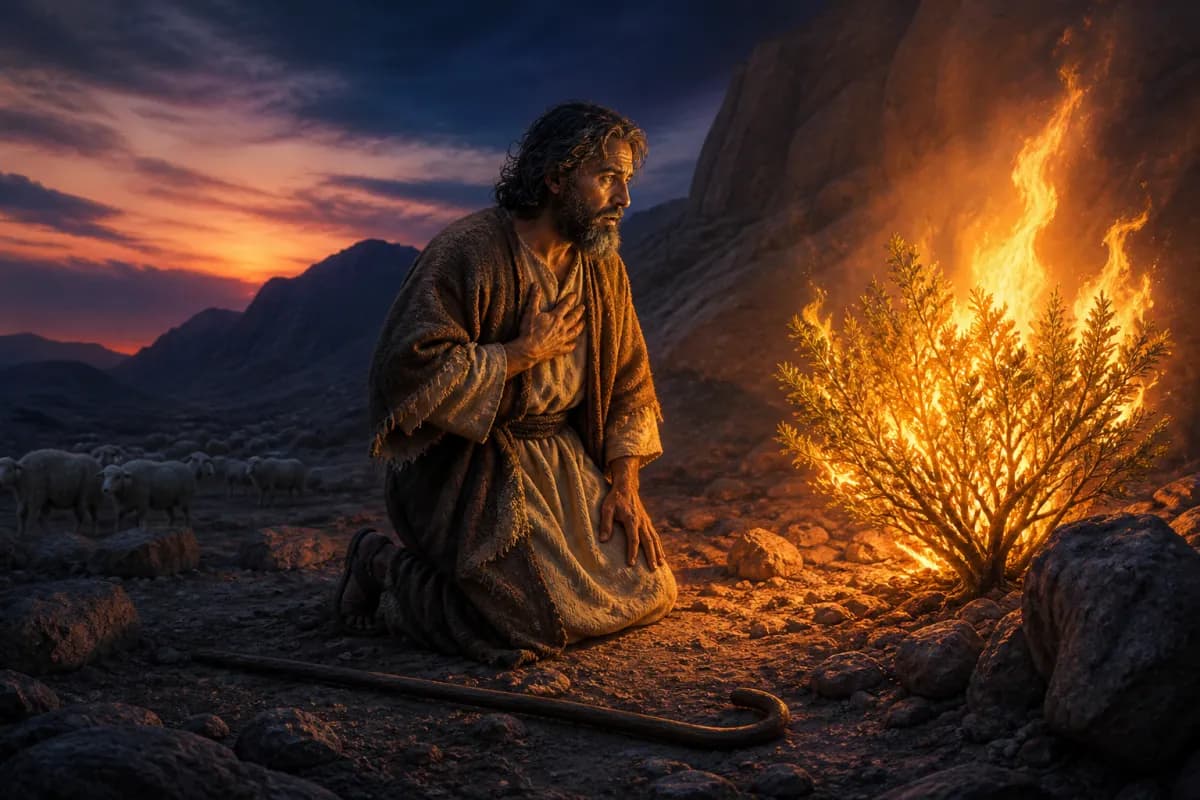
At the burning bush, the Lord moves from revealing His holiness to explaining why He has appeared. Israel’s groaning at the end of Exodus 2 has not gone unnoticed. God names three dimensions of their suffering—what He has seen, what He has heard, and what He knows—and His knowledge is covenant concern that leads to action.
The rescue has a destination as well as an escape: a broad and fertile land promised to the patriarchs. Yet Moses is included in God’s action. The Lord says, “I will send you,” placing an eighty-year-old shepherd between Israel’s misery and Pharaoh’s court.
HISTORICAL AND LITERARY CONTEXT
This commission follows the long account of Pharaoh’s forced labor and infant-killing policy. The named peoples in the land recall the territory promised to Abraham’s descendants; Exodus is therefore the continuation of Genesis’s covenant story, not simply a national uprising.
Moses’ objection belongs to a recurring biblical pattern in which God calls a reluctant servant. The answer does not flatter Moses with hidden ability. It redirects the question from “Who am I?” to the decisive reality: the God who sends him will be with him.
Did you know?
At Tel Rehov in northern Israel, archaeologists found rows of clay beehives about 3,000 years old—with remains of bees still inside. The cylinders had a small entrance for the bees and a removable lid for harvesting honeycomb.
Why it matters: The discovery adds a tangible glimpse of later honey production in the land promised here.
SECTION-BY-SECTION ANALYSIS
- God sees · Exodus 3:11Israel is not invisible under Pharaoh; the Lord’s attention is the beginning of their deliverance.
- God comes down · Exodus 3:8The Lord initiates rescue before Moses offers any plan or capacity.
- God sends · Exodus 3:12Moses is genuinely commissioned, but the mission rests on God’s promised presence rather than Moses’ résumé.
CHRIST IN THIS PASSAGE
Exodus 3 does not directly predict the incarnation, but its pattern is a strong canonical one: God sees bondage, comes down to save, and forms a people for worship. In Jesus, God the Son truly comes among us. His mission reaches beneath Pharaoh-like oppression to sin, death, and the devil, powers people cannot overcome by their own strength.
Jesus also sends witnesses while grounding them in His presence. After His resurrection, He commissions disciples to make disciples of the nations and promises to be with them always. Moses’ adequacy rests in God-with-him; the church’s mission rests in the risen Christ’s saving authority and abiding presence.
REFLECTION
People in suffering may wonder whether their cries have disappeared into the air. This passage answers with God’s attention, though it does not promise an instant or effortless exodus. The Lord’s care can include a difficult call, a confronting word to power, and a long road toward worship.
Moses’ question is familiar to anyone asked to serve beyond familiar competence. Jesus does not ask His people to manufacture sufficiency. He calls them to depend on Him, care for those who are burdened, and speak the gospel of freedom with humility and courage.
Original Hebrew Word Study
Exodus 3:7
יָדַע
yada · H3045
Usually translated: to know
When the Lord says He knows Israel’s suffering, yada is more than awareness of facts. It speaks of personal recognition and covenant concern that moves God toward rescue.
Follow the Scripture trail
God Commissions Moses: The Lord Who Sees and Comes Down in the larger story
The connection: The God who hears Israel’s cry acts to bring them from slavery into worship. Jesus fulfills that saving pattern by coming near to free people from sin and death, then sending a redeemed people to announce His reign among the nations.
Respond to the passage
Bring the burden you think God may have overlooked to Jesus. Then ask where His presence may be sending you—not to prove your worth, but to serve a person or speak truth in dependence on Him.
- Why does God’s threefold attention to Israel’s suffering matter before He gives Moses a task?
- What does the promised worship at the mountain reveal about the purpose of deliverance?
- How does Christ’s promise to be with His disciples reshape a sense of inadequacy for mission?
Prayer
Lord Jesus, thank You for seeing suffering and coming near to save. Forgive my self-reliance and my despair. Give me confidence in Your presence, compassion for the burdened, and courage to serve where You send me. Amen.