Passage Study
Incense Before the Veil: Prayer and Holy Access
Exodus 30:1–30:10
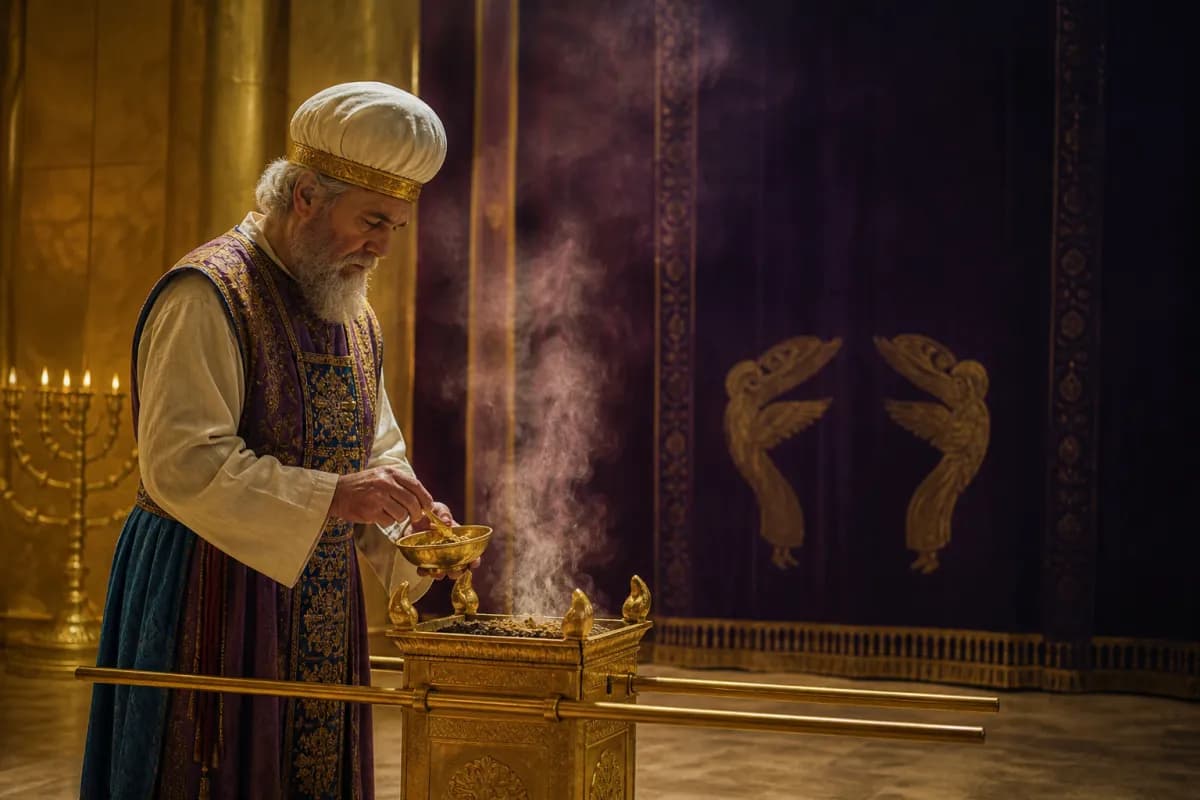
Exodus 30:1–10 commands a small gold altar for fragrant incense before the veil, where Aaron burns incense morning and evening and makes annual atonement on its horns. The altar joins continual worship to the need for atonement at the threshold of God’s presence. Jesus, through His saving death and living intercession, brings His people near to the Father and teaches them to pray in His name.
- In this study
- 10 verses · 5 movements
Exodus 30
30:1“You shall make an altar to burn incense on. You shall make it of acacia wood.
30:2Its length shall be a cubit, and its width a cubit. It shall be square, and its height shall be two cubits. Its horns shall be of one piece with it.
30:3You shall overlay it with pure gold, its top, its sides around it, and its horns; and you shall make a gold molding around it.
30:4You shall make two golden rings for it under its molding; on its two ribs, on its two sides you shall make them; and they shall be for places for poles with which to bear it.
30:5You shall make the poles of acacia wood, and overlay them with gold.
30:6You shall put it before the veil that is by the ark of the covenant, before the mercy seat that is over the covenant, where I will meet with you.
30:7Aaron shall burn incense of sweet spices on it every morning. When he tends the lamps, he shall burn it.
30:8When Aaron lights the lamps at evening, he shall burn it, a perpetual incense before the LORD throughout your generations.
30:9You shall offer no strange incense on it, nor burnt offering, nor meal offering; and you shall pour no drink offering on it.
30:10Aaron shall make atonement on its horns once in the year; with the blood of the sin offering of atonement once in the year he shall make atonement for it throughout your generations. It is most holy to the LORD.”
CONTEXTUAL OVERVIEW
The incense altar stands before the veil, nearest the Most Holy Place without crossing its boundary. Its location makes the passage’s tension visible: God invites continual worship in His dwelling, yet even fragrant service cannot remove the need for atonement.
Aaron tends the incense when he tends the lamps, morning and evening. The same daily rhythm that frames the public offering reaches into the holy place. Israel’s worship is meant to be regular, beautiful, and reverent, but it remains governed by God’s command rather than by a desire to create spiritual atmosphere.
HISTORICAL AND LITERARY CONTEXT
Incense was used in ancient worship, but Exodus strictly defines Israel’s altar, placement, timing, and boundaries. No burnt offering, grain offering, drink offering, or unauthorized incense belongs on it. The Lord is not rejecting worship; He is protecting it from becoming a platform for experimentation, control, or religious self-expression.
The annual blood rite on the altar’s horns links incense to the Day of Atonement. The fragrance does not make sinful people acceptable by itself. Even this inner altar needs cleansing from the effects of sin, which keeps Israel from confusing a moving ritual with true reconciliation.
SECTION-BY-SECTION ANALYSIS
- Before the veil · Exodus 30:6The altar belongs near God’s presence while preserving the boundary of His holiness.
- Morning and evening incense · Exodus 30:7Worship is sustained and ordered, accompanying the lamp service.
- Atonement on the horns · Exodus 30:10Even holy service depends on cleansing from sin through God’s provision.
CHRIST IN THIS PASSAGE
Scripture sometimes uses incense as an image for prayer, but Exodus 30 itself first concerns a real altar and priestly service. Its strongest Christ-centered connection is the combination of access, atonement, and continual ministry. Jesus gives Himself to remove sin and now intercedes for those who come to God through Him.
Because Christ has opened access to the Father, believers pray with confidence rather than trying to recreate sanctuary rituals. His mission turns prayer outward as well: those reconciled to God intercede for neighbors and speak of the Savior who alone brings people near. Prayer is not manipulation of God; it is communion with the Father through the Son.
REFLECTION
It is possible to enjoy the feel of worship while avoiding the God who searches the heart. The incense altar calls for reverence joined to atonement. Come to Jesus honestly, confess sin, and ask that your prayer life be shaped by His mercy rather than by performance or spiritual mood.
Use a daily pause to pray for people by name, especially those far from God. Let your intercession lead to love and truthful witness. The God who receives prayer through Christ also sends His people to embody and announce the reconciliation for which they pray.
Original Hebrew Word Study
Exodus 30:1
קְטֹרֶת
qetoret · H7004
Usually translated: incense or smoke of incense
Qetoret is incense, the fragrant smoke offered before the Lord. Its placement near the veil ties this daily act of worship to the holy presence Israel may approach only through God’s appointed mediation.
Follow the Scripture trail
Incense Before the Veil: Prayer and Holy Access in the larger story
The connection: The incense altar brings ordered worship to the very edge of the veil, yet its annual blood rite declares that access still needs atonement. Jesus gives the cleansing sacrifice and living intercession that bring people to the Father and send them to pray and witness for His saving mission.
Respond to the passage
Choose one daily moment this week to pray through Jesus for a named person who needs His mercy. Let that prayer shape one concrete act of love or one honest gospel conversation.
- Why is the incense altar placed before the veil rather than beyond it?
- What does the annual blood rite say about worship that feels beautiful or regular?
- How does Christ’s intercession reshape Christian prayer?
Prayer
Lord Jesus, thank You for opening access to the Father through Your sacrifice and intercession. Purify my prayers from performance, teach me to pray for others by name, and send me to speak Your reconciling mercy with love. Amen.