Passage Study
The Census Offering: Every Life Ransomed Before the Lord
Exodus 30:11–30:16
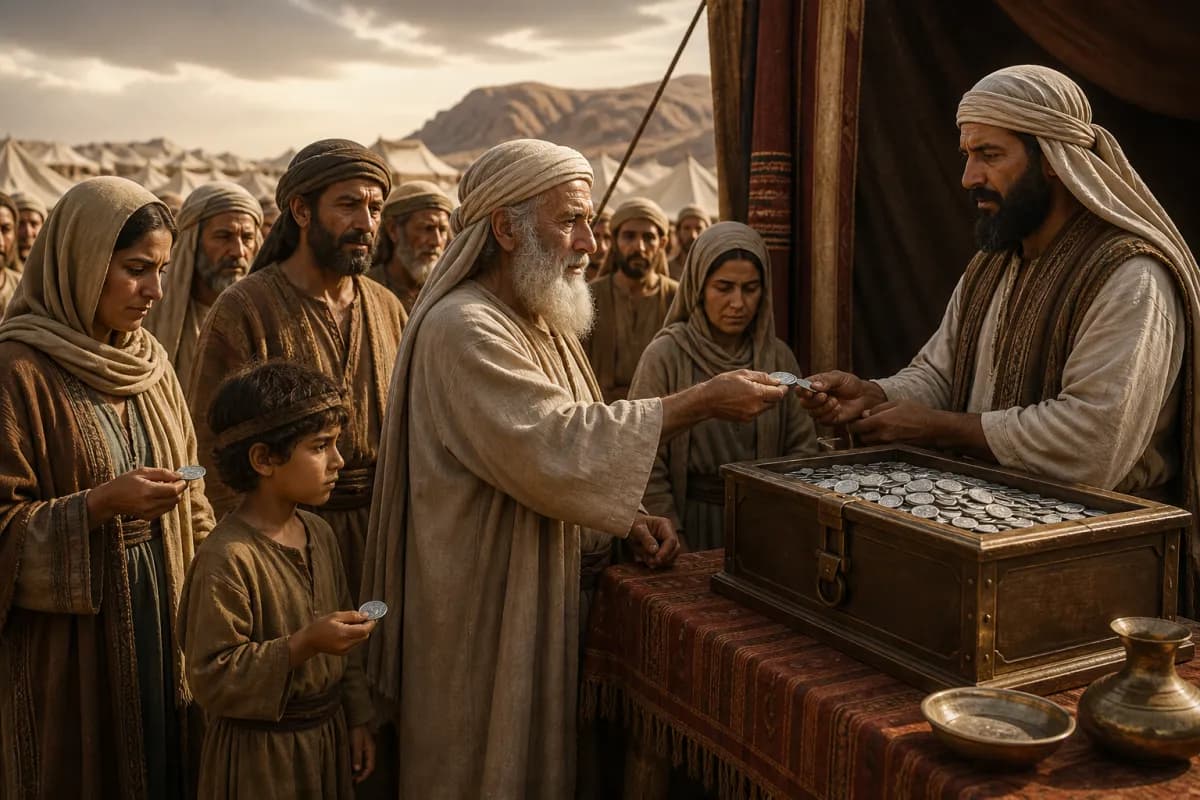
Exodus 30:11–16 requires every Israelite counted in a census to give the same half-shekel ransom for the service of the tent of meeting. Rich and poor give alike because no one approaches the holy God by superior worth. The offering teaches Israel that each life needs God’s merciful provision, a truth fulfilled in Jesus, who gives Himself as the ransom that brings sinners to God.
- In this study
- 6 verses · 5 movements
Exodus 30
30:11The LORD spoke to Moses, saying,
30:12“When you take a census of the children of Israel, according to those who are counted among them, then each man shall give a ransom for his soul to the LORD when you count them, that there be no plague among them when you count them.
30:13They shall give this, everyone who passes over to those who are counted, half a shekel according to the shekel of the sanctuary (the shekel is twenty gerahs ); half a shekel for an offering to the LORD.
30:14Everyone who passes over to those who are counted, from twenty years old and upward, shall give the offering to the LORD.
30:15The rich shall not give more, and the poor shall not give less, than the half shekel, when they give the offering of the LORD, to make atonement for your souls.
30:16You shall take the atonement money from the children of Israel, and shall appoint it for the service of the Tent of Meeting; that it may be a memorial for the children of Israel before the LORD, to make atonement for your souls.”
CONTEXTUAL OVERVIEW
After the incense altar, Exodus pauses over the moment when Israel is numbered. A census can suggest military strength, wealth, or royal control, but the Lord requires each counted man to bring a ransom. Israel must not look at its numbers and imagine that its security rests in the size of its force.
The amount is deliberately equal: the rich do not give more and the poor do not give less. The half-shekel does not price a human life or buy a better place before God. It publicly confesses one shared reality: every person stands before the Lord by His mercy.
HISTORICAL AND LITERARY CONTEXT
The silver is assigned to the service of the tent of meeting, joining the count of the people to the place where God meets them. Israel is not counted as an anonymous state population. These are covenant people whose lives are ordered around the Lord’s dwelling in their midst.
Verse 12 warns of a plague if the ransom is neglected. Exodus does not explain the mechanism, so the passage should not be turned into a formula for avoiding misfortune. Its plain point is that numbering God’s people is a holy matter, requiring acknowledgement that life belongs to Him.
SECTION-BY-SECTION ANALYSIS
- One equal amount · Exodus 30:12Every counted Israelite confesses the same need for God’s merciful provision.
- A ransom at the census · Exodus 30:11Human strength and numbers cannot become substitutes for humble dependence on the Lord.
- Silver for the tent · Exodus 30:16The offering joins individual lives to Israel’s common worship before God.
CHRIST IN THIS PASSAGE
The half-shekel does not itself predict the price or mechanics of Jesus’ death. It establishes a strong covenant pattern: a people whose lives belong to God need a ransom He provides, and social rank cannot alter that need. Jesus names His own mission as giving His life “a ransom for many.”
At the cross, Christ does what a census offering could never finally do: He deals with sin and reconciles those who trust Him to the Father. His saving mission levels human boasting. Wealth, status, and usefulness cannot secure access to God; all come through the same crucified and risen Savior.
REFLECTION
Modern life counts followers, income, influence, attendance, and output. Exodus asks what those numbers are doing to us. If they make us feel self-made, indispensable, or entitled to control others, they have become spiritually dangerous. Bring the desire to measure your worth to Jesus, whose mercy—not your scale—names your value.
The equal offering also changes how Christians see other people. Do not sort a congregation or neighborhood by who can contribute the most. Pray for and serve the overlooked person as one for whom Christ gave Himself, and let the gospel create a community where gratitude replaces comparison.
Original Hebrew Word Study
Exodus 30:15
כָּפַר
kaphar · H3722
Usually translated: to cover, make atonement, or ransom
Kaphar is the root behind atonement and ransom. When Israel is counted, each person brings the same ransom, teaching that every life stands before God on the same need for His merciful provision.
Follow the Scripture trail
The Census Offering: Every Life Ransomed Before the Lord in the larger story
The connection: The equal census offering teaches Israel that every life needs God’s ransom and belongs within His worshiping people. Jesus fulfills that saving pattern by giving His life for sinners and forming a people whose standing rests on His grace rather than social rank.
Respond to the passage
Name one number you use to prove your worth or security. Bring it to Jesus in prayer, thank Him that His ransom—not your performance—brings you near, and treat one easily overlooked person this week with the honor His sacrifice gives them.
- Why does the Lord require a ransom when Israel is counted?
- What does the equal half-shekel say about wealth and access to God?
- Where are you tempted to use numbers as a substitute for trust in Christ?
Prayer
Lord Jesus, thank You for giving Yourself as my ransom. Free me from measuring my worth by influence or achievement, teach me to honor every person You made, and make Your church a visible witness to Your equal mercy. Amen.