Passage Study
Holy Anointing Oil: What Belongs to God Cannot Be Made Common
Exodus 30:22–30:33
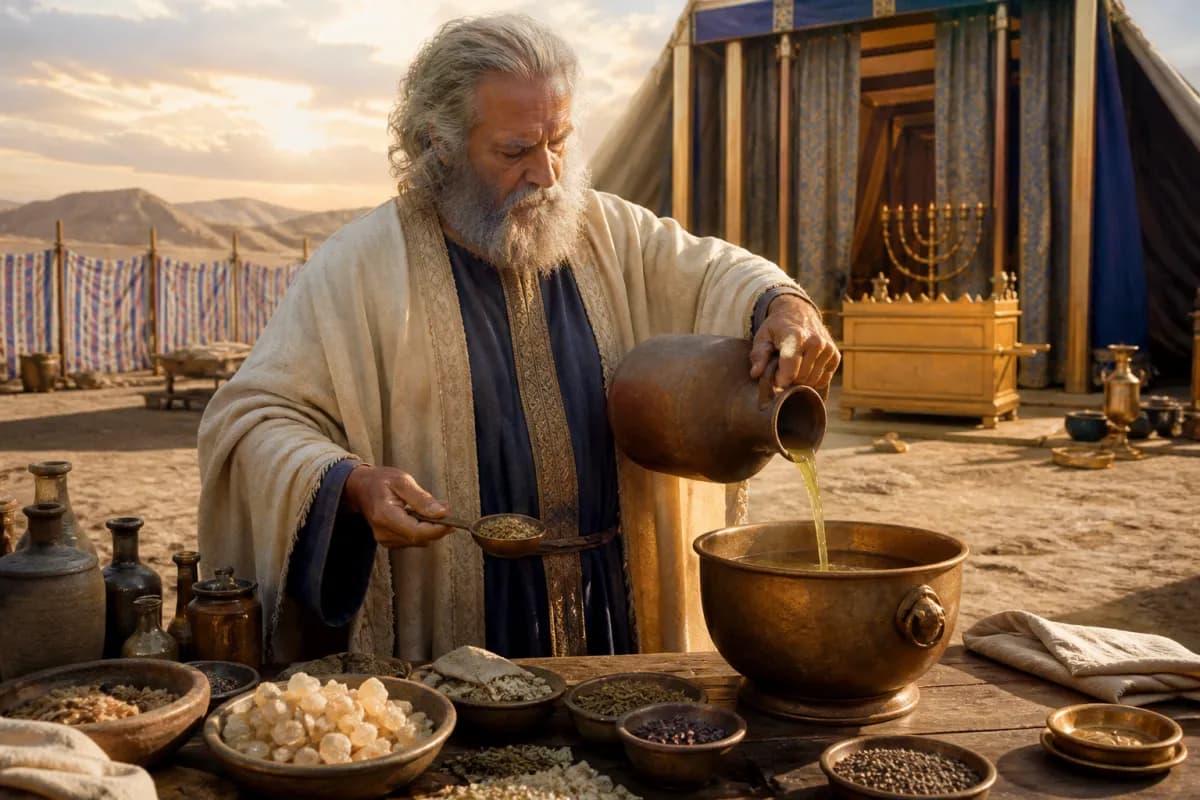
Exodus 30:22–33 gives Moses a fragrant oil made from measured spices and olive oil to anoint the tabernacle, its furnishings, and Aaron’s priestly family. The oil marks persons and objects as holy to the Lord and forbids private imitation. It prepares the biblical theme of God’s anointed King and Priest, fulfilled in Jesus Christ, whose Spirit-set-apart people belong to God for His saving mission.
- In this study
- 12 verses · 5 movements
Exodus 30
30:22Moreover the LORD spoke to Moses, saying,
30:23“Also take fine spices: of liquid myrrh, five hundred shekels; and of fragrant cinnamon half as much, even two hundred and fifty; and of fragrant cane, two hundred and fifty;
30:24and of cassia five hundred, according to the shekel of the sanctuary; and a hin of olive oil.
30:25You shall make it into a holy anointing oil, a perfume compounded after the art of the perfumer: it shall be a holy anointing oil.
30:26You shall use it to anoint the Tent of Meeting, the ark of the covenant,
30:27the table and all its articles, the lamp stand and its accessories, the altar of incense,
30:28the altar of burnt offering with all its utensils, and the basin with its base.
30:29You shall sanctify them, that they may be most holy. Whatever touches them shall be holy.
30:30You shall anoint Aaron and his sons, and sanctify them, that they may minister to me in the priest’s office.
30:31You shall speak to the children of Israel, saying, ‘This shall be a holy anointing oil to me throughout your generations.
30:32It shall not be poured on man’s flesh, and do not make any like it, according to its composition. It is holy. It shall be holy to you.
30:33Whoever compounds any like it, or whoever puts any of it on a stranger, he shall be cut off from his people.’”
CONTEXTUAL OVERVIEW
The anointing oil follows the basin, extending the distinction of holiness from priestly washing to the tent, furniture, altar, basin, and priests themselves. Israel’s sanctuary is not holy because its materials are naturally magical. It is holy because the Lord claims it for His dwelling and service.
The fragrance is memorable, but the passage’s main concern is consecration. Objects that receive the oil are set apart as most holy, and Aaron and his sons are anointed for priesthood. God gives beauty and scent a rightful place in worship while refusing their reduction to private luxury or spiritual technique.
HISTORICAL AND LITERARY CONTEXT
The recipe names costly aromatic materials and specifies their weights. Some identification of ancient spice terms is discussed, but Exodus gives enough clarity for its purpose: Moses must make the oil according to the Lord’s instructed composition. The careful measurements guard the oil’s holy use rather than invite readers to reconstruct a commercial perfume.
To anoint is to set apart for a task belonging to God. Later Israel anoints kings as well as priests, and the Hebrew word for anointed gives rise to “Messiah.” Exodus 30 is not yet naming a future king, but it establishes the category of a person publicly claimed and equipped for the Lord’s service.
SECTION-BY-SECTION ANALYSIS
- Measured spices · Exodus 30:23The oil is made according to God’s instruction, not according to a worshiper’s invention.
- Tent, furnishings, and priests · Exodus 30:26The whole ordered ministry of the sanctuary is claimed for God’s holy service.
- No private imitation · Exodus 30:25What God consecrates for His presence cannot be converted into personal religious status or consumption.
CHRIST IN THIS PASSAGE
Exodus does not identify this oil with Jesus in a one-to-one way. It does establish an anointing pattern that later Scripture develops around God’s chosen servants. Jesus is the Christ—the Anointed One—whose public ministry is empowered by the Spirit and whose mission fulfills the offices of King, Priest, and Savior.
Unlike sanctuary objects, Jesus is holy in His own person. He gives the Spirit to His people so that they belong to God and share in His mission, yet Christians do not reproduce Exodus’ recipe as a means of access or power. The gospel centers on Christ’s saving work, not on possession of a sacred substance.
REFLECTION
We easily turn holy things into brands, tools for status, or comforting products. Exodus corrects that instinct. Ask whether you seek God Himself or merely the feelings, language, and visible signals associated with faith. Jesus calls His people to belong to the Father with integrity rather than to market holiness for self-importance.
Your ordinary work can become devoted service when it is offered to Christ in obedience and love. The perfumer’s craft mattered because it served God’s dwelling. Name one skill you tend to keep for yourself, and ask how it can help a neighbor, strengthen the church, or make the gospel’s mercy more tangible.
Original Hebrew Word Study
Exodus 30:30
מָשַׁח
mashach · H4886
Usually translated: to anoint
Mashach means to anoint by applying oil for sacred service. The oil sets apart the tabernacle and its priests, pointing to a service that belongs to God and cannot be treated as common property.
Follow the Scripture trail
Holy Anointing Oil: What Belongs to God Cannot Be Made Common in the larger story
The connection: The holy oil marks God’s dwelling and servants as belonging wholly to Him, establishing the biblical language of anointing. Jesus is the true Anointed One who brings good news and gives His Spirit to a people set apart for the Father’s saving mission.
Respond to the passage
Ask Jesus to expose one way you use faith for image, control, or comfort apart from Him. Offer one practical skill back to Him this week for a specific act of service that makes His mercy visible.
- Why does Exodus anoint both objects and priests?
- What does the ban on copying the oil protect?
- How does Jesus fulfill the theme of God’s Anointed One without making a sacred substance the center?
Prayer
Lord Jesus, You are God’s true Anointed One. Keep me from using holy things for myself, consecrate my gifts for Your purposes, and fill my service with the mercy that brings good news to those in need. Amen.