Passage Study
The Golden Calf: Worship That Refuses to Wait for God
Exodus 32:1–32:6
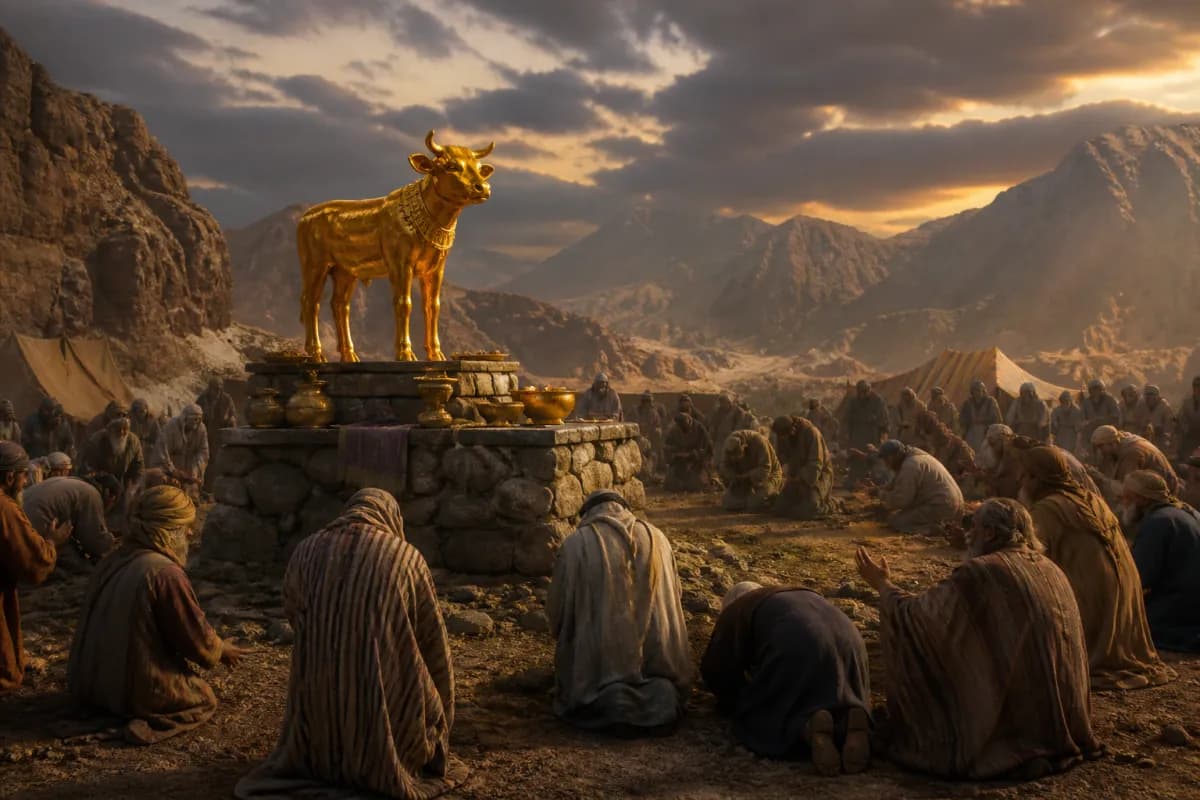
Exodus 32:1–6 shows Israel making and celebrating a golden calf while Moses remains on the mountain. The people attribute their exodus to an image made from their own gifts, turning fear and impatience into idolatry. The passage exposes the human desire for a controllable god and prepares readers for Jesus, who reveals the true God and rescues idolaters through His reconciling death.
- In this study
- 6 verses · 5 movements
Exodus 32
32:1When the people saw that Moses delayed coming down from the mountain, the people gathered themselves together to Aaron, and said to him, “Come, make us gods, which shall go before us; for as for this Moses, the man who brought us up out of the land of Egypt, we don’t know what has become of him.”
32:2Aaron said to them, “Take off the golden rings, which are in the ears of your wives, of your sons, and of your daughters, and bring them to me.”
32:3All the people took off the golden rings which were in their ears, and brought them to Aaron.
32:4He received what they handed him, fashioned it with an engraving tool, and made it a molded calf. Then they said, “These are your gods, Israel, which brought you up out of the land of Egypt.”
32:5When Aaron saw this, he built an altar before it; and Aaron made a proclamation, and said, “Tomorrow shall be a feast to the LORD.”
32:6They rose up early on the next day, and offered burnt offerings, and brought peace offerings; and the people sat down to eat and to drink, and rose up to play.
CONTEXTUAL OVERVIEW
The golden calf appears while Moses is receiving instructions for worship on Sinai. The timing is devastating. God is describing how He will dwell among Israel, while Israel manufactures an alternative center of worship at the foot of the mountain.
The people’s complaint begins with waiting: Moses has been gone a long time, and they say they do not know what has become of him. Their fear is real, but it is turned into a demand for a visible deity they can gather around and manage.
HISTORICAL AND LITERARY CONTEXT
Exodus has repeatedly forbidden images as substitutes for the Lord. The calf may have drawn on familiar ancient symbols of strength and fertility, but the passage’s own accusation is sufficient: Israel credits the image with the exodus. Responsible interpretation need not settle every proposed cultural background in order to see the rebellion.
Aaron’s altar and feast use language associated with Israel’s worship of the Lord. That mixture makes the sin more, not less, serious. Israel is not simply abandoning religion; it is trying to attach the Lord’s saving name to an object shaped by human hands.
SECTION-BY-SECTION ANALYSIS
- Impatience · Exodus 32:1Waiting for God becomes the occasion for demanding a god that can be seen and controlled.
- Gold misdirected · Exodus 32:2A gift connected to deliverance is turned into the material of rebellion.
- A counterfeit feast · Exodus 32:5Sacrifice and celebration cannot sanctify worship that contradicts God’s revealed word.
CHRIST IN THIS PASSAGE
The calf does not function as a direct prediction of Jesus. It exposes the need that Jesus meets: sinners do not merely lack information about God; they remake God in forms that serve their desires. Jesus is the true image of the invisible God, not an object we control but the incarnate Son who makes the Father known.
Christ’s saving mission reaches idolaters with both truth and mercy. He dies to reconcile people who have exchanged God’s glory for created things, then sends His church to turn from false worship and invite the nations into the worship of the living God. The gospel does not polish our idols; it calls us away from them.
REFLECTION
An idol can be a visible object, but it can also be the version of God we prefer: always approving, always predictable, useful for our goals, and silent about repentance. Ask where impatience, fear, or the desire for control is tempting you to edit God’s character.
Bring that substitute to Jesus without excuse. Replace private management with concrete worship: read what God has actually said, confess the false trust, and speak honestly with one person who can help you return to faithful obedience. Let your repentance become a gracious invitation to others who are also weary of gods that cannot save.
Original Hebrew Word Study
Exodus 32:4
עֵגֶל
egel · H5695
Usually translated: calf
Egel is a young bull or calf. Israel gives a visible image the credit for the exodus, revealing how quickly a people can exchange the living God for something they can see, control, and celebrate.
Follow the Scripture trail
The Golden Calf: Worship That Refuses to Wait for God in the larger story
The connection: Israel credits a made thing with the rescue only the Lord accomplished, revealing the human heart’s persistent idolatry. Jesus reveals the Father truly, bears the guilt of idolaters, and sends a reconciled people to call the world from false gods to the living God.
Respond to the passage
Name one place where you are demanding a controllable version of God. Confess it to Jesus, replace that false trust with a specific act of worship and obedience, and pray for one person who needs freedom from a rival allegiance.
- Why does Israel’s waiting for Moses become a demand for visible gods?
- How does the calf misuse the language of the exodus?
- What contemporary forms of idolatry try to make God manageable?
Prayer
Lord Jesus, forgive me for reshaping You around my fears and desires. Reveal the Father to me more truly, free me from every false trust, and make my worship and witness point others to the living God. Amen.