Passage Study
Moses Confronts Israel: Idolatry Exposed and Judgment Begun
Exodus 32:15–32:29
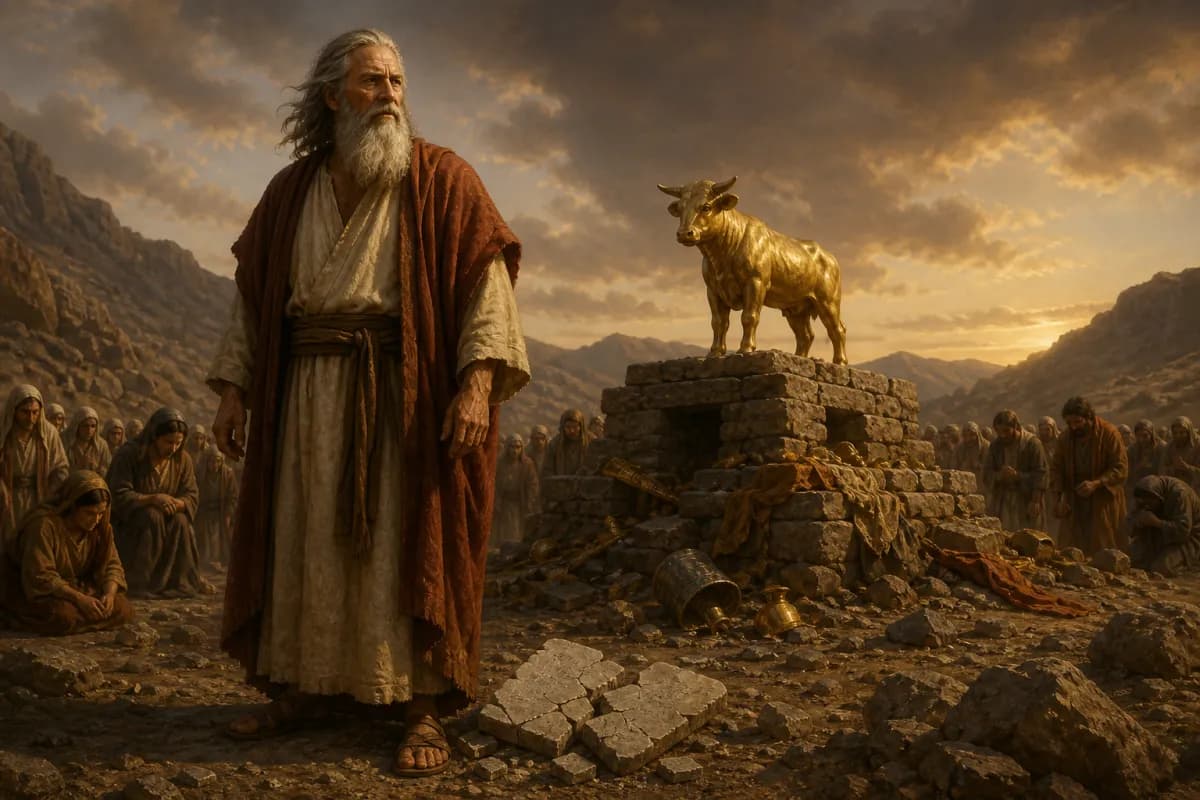
Exodus 32:15–29 brings Moses down from Sinai with the tablets, exposes the calf worship, breaks the tablets, destroys the image, confronts Aaron, calls for decisive loyalty to the Lord, and begins judgment in the camp. The passage refuses cheap forgiveness: idolatry ruptures covenant life and requires truth, repentance, and God’s mercy. Jesus bears judgment for sinners and forms a people whose allegiance to Him produces holy, costly love.
- In this study
- 15 verses · 5 movements
Exodus 32
32:15Moses turned, and went down from the mountain, with the two tablets of the covenant in his hand; tablets that were written on both their sides. They were written on one side and on the other.
32:16The tablets were the work of God, and the writing was the writing of God, engraved on the tablets.
32:17When Joshua heard the noise of the people as they shouted, he said to Moses, “There is the noise of war in the camp.”
32:18He said, “It isn’t the voice of those who shout for victory. It is not the voice of those who cry for being overcome; but the noise of those who sing that I hear.”
32:19As soon as he came near to the camp, he saw the calf and the dancing. Then Moses’ anger grew hot, and he threw the tablets out of his hands, and broke them beneath the mountain.
32:20He took the calf which they had made, and burned it with fire, ground it to powder, and scattered it on the water, and made the children of Israel drink it.
32:21Moses said to Aaron, “What did these people do to you, that you have brought a great sin on them?”
32:22Aaron said, “Don’t let the anger of my lord grow hot. You know the people, that they are set on evil.
32:23For they said to me, ‘Make us gods, which shall go before us. As for this Moses, the man who brought us up out of the land of Egypt, we don’t know what has become of him.’
32:24I said to them, ‘Whoever has any gold, let them take it off.’ So they gave it to me; and I threw it into the fire, and out came this calf.”
32:25When Moses saw that the people were out of control, (for Aaron had let them lose control, causing derision among their enemies),
32:26then Moses stood in the gate of the camp, and said, “Whoever is on the LORD’s side, come to me!” All the sons of Levi gathered themselves together to him.
32:27He said to them, “The LORD, the God of Israel, says, ‘Every man put his sword on his thigh, and go back and forth from gate to gate throughout the camp, and every man kill his brother, and every man his companion, and every man his neighbor.’”
32:28The sons of Levi did according to the word of Moses. About three thousand men fell of the people that day.
32:29Moses said, “Consecrate yourselves today to the LORD, for every man was against his son and against his brother, that he may give you a blessing today.”
CONTEXTUAL OVERVIEW
Moses returns carrying the covenant tablets at the very moment Israel is violating the covenant they contain. The tablets are “the work of God,” so their breaking becomes a visible verdict on the camp: Israel’s rebellion has shattered the relationship it was given to keep.
The scene is difficult because it includes public judgment and violence. Exodus does not present it as private revenge or a model for religious coercion. It records a unique covenant crisis in which the nation has repudiated the Lord immediately after its covenant ratification, and it insists that idolatry is destructive enough to require decisive judgment.
HISTORICAL AND LITERARY CONTEXT
Joshua first mistakes the sound for battle, but Moses recognizes singing. The contrast heightens the tragedy: the camp is celebrating while it is spiritually collapsing. Aaron’s evasive explanation compounds the failure of leadership; he describes the gold and then claims the calf simply came out.
Verse 25 says Moses saw that the people were “running wild” or left unrestrained. The precise social details are not fully explained, but the text makes clear that the calf has produced disorder and public shame before Israel’s enemies. Covenant worship is never morally neutral; it shapes a people’s communal life.
SECTION-BY-SECTION ANALYSIS
- Broken tablets · Exodus 32:15The shattered testimony visibly declares that the covenant has been violated.
- Ground calf · Exodus 32:20The image is exposed as powerless material rather than a god capable of rescuing Israel.
- Who is for the Lord? · Exodus 32:27The crisis demands loyalty to God that refuses to normalize rebellion.
CHRIST IN THIS PASSAGE
This passage does not authorize the church to enforce faith by the sword. Jesus rebukes His disciples’ desire to call down destructive judgment and gives His life for enemies. Yet He also confirms that idolatry and sin matter enough to require judgment; grace is costly because evil is real.
At the cross, Jesus bears the judgment sinners deserve without becoming an idol we can control. His saving mission creates a people who renounce false gods and pursue holiness through repentance, discipline, forgiveness, and sacrificial love. The church’s weapons are truth, prayer, service, and the gospel, not coercion.
REFLECTION
Aaron’s answer warns against the instinct to explain away our participation in wrong. When Jesus exposes sin, name it plainly. Do not blame pressure, culture, or other people for choices that require repentance. His mercy is strong enough to meet the truth.
The question “Who is for the Lord?” still asks for wholehearted allegiance, but Christian allegiance looks like following the crucified King. Turn from the idol that competes for your obedience, seek wise accountability, and practice one costly act of love that makes Christ’s holy mercy visible to someone near you.
Original Hebrew Word Study
Exodus 32:25
פָּרַע
para · H6544
Usually translated: to let loose or leave unrestrained
Para means to let loose or leave unrestrained. Israel’s calf worship has become more than a mistaken ritual; it has broken into disorder that dishonors the Lord before the watching nations.
Follow the Scripture trail
Moses Confronts Israel: Idolatry Exposed and Judgment Begun in the larger story
The connection: The broken tablets and ruined calf show that idolatry shatters covenant life and deserves judgment. Jesus bears judgment for sinners, calls them from false gods, and forms a holy people who display His saving mercy through repentance and love rather than coercion.
Respond to the passage
Confess one excuse you use to avoid owning sin. Bring it to Jesus, ask a trusted believer for help where appropriate, and take one concrete step away from an idol toward faithful love of God and neighbor.
- What does Moses’ destruction of the calf reveal about the image Israel worshiped?
- Why is Aaron’s response a warning to spiritual leaders and ordinary believers alike?
- How does Jesus call His church to take sin seriously without using coercion?
Prayer
Lord Jesus, expose the idols and excuses I protect. Thank You for bearing the judgment my sin deserves. Give me courage to repent, wisdom to pursue holiness with others, and love that makes Your mercy visible. Amen.