Passage Study
Moses’ Radiant Face: Nearness That Cannot Be Managed
Exodus 34:29–34:35
Exodus 34:29–35 records Moses returning from speaking with the Lord with a radiant face. Israel fears the visible effect of God’s holiness, and Moses veils his face after delivering God’s words. The scene anticipates the greater glory revealed in Jesus, who reconciles people to God and sends them to reflect His character without pretending to possess His glory.
- In this study
- 7 verses · 5 movements
Exodus 34
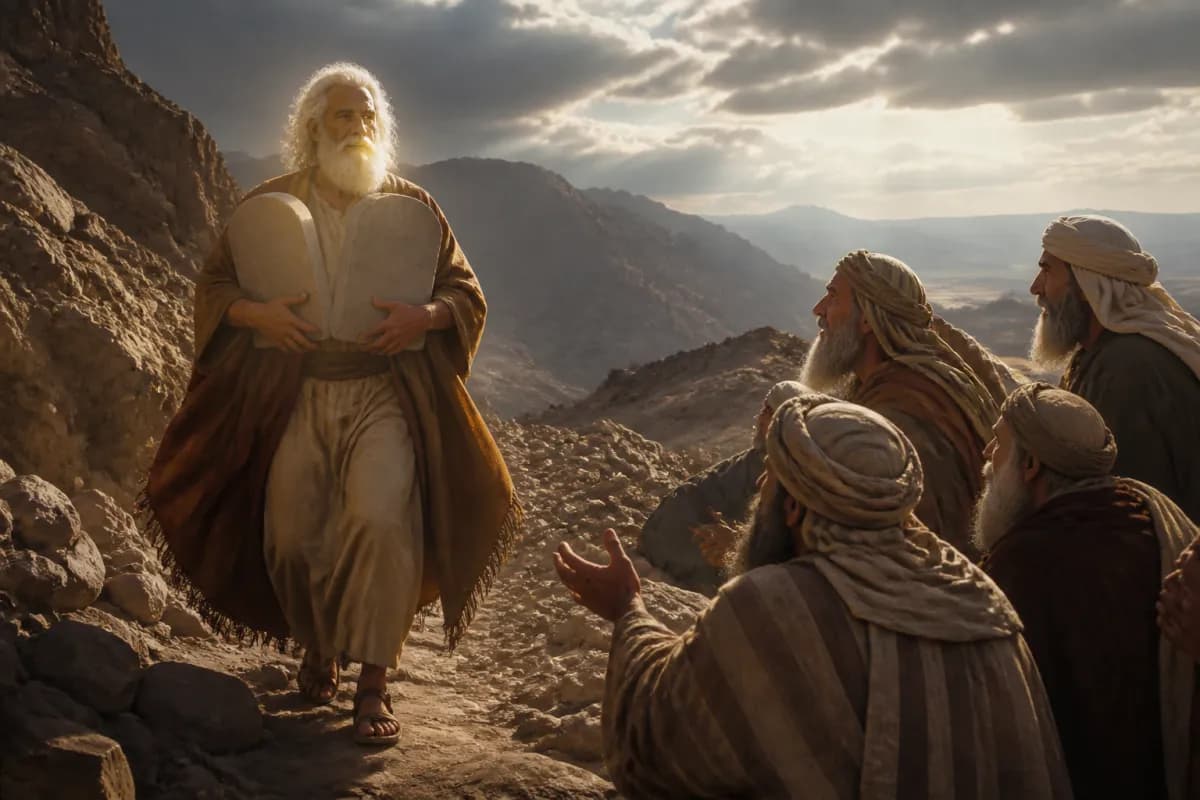
34:29When Moses came down from Mount Sinai with the two tablets of the covenant in Moses’ hand, when he came down from the mountain, Moses didn’t know that the skin of his face shone by reason of his speaking with him.
34:30When Aaron and all the children of Israel saw Moses, behold, the skin of his face shone; and they were afraid to come near him.
34:31Moses called to them, and Aaron and all the rulers of the congregation returned to him; and Moses spoke to them.
34:32Afterward all the children of Israel came near, and he gave them all the commandments that the LORD had spoken with him on Mount Sinai.
34:33When Moses was done speaking with them, he put a veil on his face.
34:34But when Moses went in before the LORD to speak with him, he took the veil off, until he came out; and he came out, and spoke to the children of Israel that which he was commanded.
34:35The children of Israel saw Moses’ face, that the skin of Moses’ face shone; so Moses put the veil on his face again, until he went in to speak with him.
CONTEXTUAL OVERVIEW
Moses comes down from Sinai after the covenant has been renewed following the golden calf. He carries the replacement tablets, but the first thing Israel sees is not the stone in his hands. His face shines because he has been speaking with the Lord, though Moses himself does not know it at first.
The people’s fear matters. God’s nearness is not a spiritual accessory for Israel to enjoy on demand. His holiness leaves a visible mark on the mediator, and Israel needs Moses to call them near before they can receive the covenant words he brings.
HISTORICAL AND LITERARY CONTEXT
This paragraph closes the Sinai renewal sequence. Exodus 34:5–7 has proclaimed the Lord’s name as merciful, gracious, faithful, forgiving, and just; verses 10–28 have restated covenant obligations. Moses’ radiant face therefore belongs to the aftermath of divine self-disclosure, not to a private mystical achievement.
The text says the skin of Moses’ face shone after he spoke with the Lord. It does not explain a physical mechanism, and it does not ask readers to imitate a technique for producing visible glory. Its literary purpose is to show that the God who renews covenant with a sinful people is genuinely holy and that His word reaches Israel through an appointed mediator.
SECTION-BY-SECTION ANALYSIS
- Radiance · Exodus 34:29Moses’ shining face follows communion with the Lord and signals God’s holy presence.
- Fear and invitation · Exodus 34:30Israel is afraid, yet Moses calls the people near to hear the covenant word.
- The veil · Exodus 34:34The repeated covering and uncovering frames Moses as a mediator who enters before God and delivers God’s commands.
CHRIST IN THIS PASSAGE
Moses reflects a borrowed and fading radiance; he is not the source of divine glory. The New Testament draws this contrast carefully: Jesus is the definitive revelation of the Father, and His saving work gives His people open access to God. That does not diminish Moses’ faithful ministry; it shows why Israel needed a mediator greater than Moses.
Christ’s mission transforms fearful distance into reconciled nearness. Through His death and resurrection, sinners are brought to the Father and are being changed to resemble the Lord they worship. The church reflects Christ’s light as a witness, never as an independent possession, so its life should direct attention to the Savior rather than to spiritual spectacle.
REFLECTION
We easily turn spiritual experience into a way to appear impressive. Moses’ face is striking, but the passage keeps returning to the words he delivers from God. Ask Jesus to make His Word, not your image or intensity, the center of your devotion and service.
Approach Christ with reverence and confidence. He does not trivialize God’s holiness; He makes reconciliation possible. In a conversation this week, tell someone how the gospel gives real access to God through Jesus, and let your patience, honesty, and repentance make that claim visible.
Original Hebrew Word Study
Exodus 34:29
קָרַן
qaran · H7160
Usually translated: to shine or send out rays
Qaran means to shine or send out rays. Moses’ face reflects the reality that he has been with the Lord, making visible the glory of a God whose presence changes the one who approaches Him.
Follow the Scripture trail
Moses’ Radiant Face: Nearness That Cannot Be Managed in the larger story
The connection: Moses’ reflected radiance shows that the covenant God is holy and that His word reaches Israel through a mediator. Jesus reveals the Father’s glory fully, purifies sinners, and sends a reconciled people to bear witness to His light.
Respond to the passage
Ask Jesus where you have wanted spiritual appearance more than faithful obedience. Receive His welcome, return to His Word, and choose one humble act of service that points attention toward Him rather than yourself.
- Why are Aaron and Israel afraid when Moses returns from Sinai?
- What does the veil’s repeated use reveal about Moses’ role?
- How does Jesus provide a greater and lasting access to God?
Prayer
Lord Jesus, You reveal the Father and bring sinners near through Your saving work. Forgive my hunger for attention. Shape me by Your Word, make me reverent and confident before God, and let my life point others to Your glory. Amen.