Passage Study
Skilled Hearts and Holy Work
Exodus 35:10–35:19
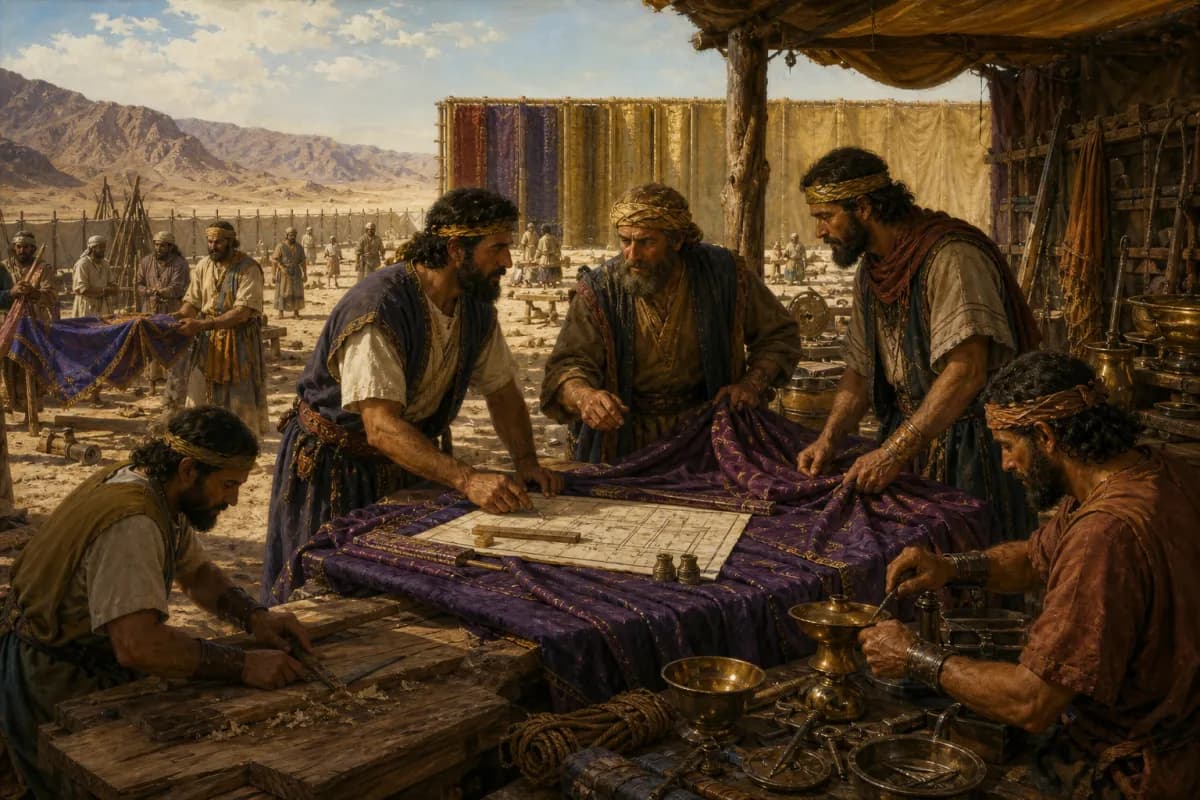
Exodus 35:10–19 summons every skilled person in Israel to make the tabernacle exactly as the Lord has commanded. The passage honors craftsmanship while keeping it under God’s design and worship. Jesus equips His people for service so that diverse gifts build up the church and make His saving mission visible.
- In this study
- 10 verses · 5 movements
Exodus 35
35:10“‘Let every wise-hearted man among you come, and make all that the LORD has commanded:
35:11the tabernacle, its outer covering, its roof, its clasps, its boards, its bars, its pillars, and its sockets;
35:12the ark, and its poles, the mercy seat, the veil of the screen;
35:13the table with its poles and all its vessels, and the show bread;
35:14the lamp stand also for the light, with its vessels, its lamps, and the oil for the light;
35:15and the altar of incense with its poles, the anointing oil, the sweet incense, the screen for the door, at the door of the tabernacle;
35:16the altar of burnt offering, with its grating of bronze, its poles, and all its vessels, the basin and its base;
35:17the hangings of the court, its pillars, their sockets, and the screen for the gate of the court;
35:18the pins of the tabernacle, the pins of the court, and their cords;
35:19the finely worked garments for ministering in the holy place—the holy garments for Aaron the priest, and the garments of his sons—to minister in the priest’s office.’”
CONTEXTUAL OVERVIEW
After inviting material offerings, Moses calls for skilled work. The tabernacle will not appear through vague spiritual intention. People with abilities are asked to come and make what the Lord has commanded, joining craftsmanship to covenant worship.
The list moves through the sanctuary from its structure and coverings to its furnishings, courtyard, tools, and priestly garments. Its detail slows the reader down. Israel is not making a symbol according to imagination; it is carrying out a pattern received from God for the place where He will dwell among His people.
HISTORICAL AND LITERARY CONTEXT
Exodus 25–31 gave the instructions; Exodus 35–40 records their execution. This verse sequence stands between the people’s donations and the naming of Bezalel and Oholiab. Skill is already present in the community, but the narrative will identify it as wisdom given by God and directed toward the work He commands.
The sanctuary’s furnishings and garments distinguish places and tasks within Israel’s worship. Their purpose is access to the holy God through the sacrifices and priesthood He appoints. The passage should not make every object a private code for modern readers; its repeated stress is the ordered whole God commands for His dwelling.
SECTION-BY-SECTION ANALYSIS
- Skilled people called · Exodus 35:10The invitation recognizes real human ability while directing it to what the Lord commands.
- An ordered sanctuary · Exodus 35:11The detailed list prevents Israel from treating worship as a self-designed experience.
- Whole-community service · Exodus 35:13Materials, artisans, priests, and congregation all participate in the dwelling God establishes.
CHRIST IN THIS PASSAGE
The tabernacle’s ordered worship points beyond itself to the need for God-given access. Jesus fulfills that need as the true mediator who brings people to the Father. The passage does not make a direct prediction from every peg or utensil, but its unified concern for God dwelling with His people reaches its goal in Christ.
The risen Jesus also gives varied gifts to His church. Skill becomes holy service when it is used in love, under His lordship, for the good of others and the spread of His gospel. Artists, organizers, builders, teachers, caregivers, and workers can all serve Christ’s mission without turning their competence into a substitute for Him.
REFLECTION
Some people dismiss their abilities as unspiritual because they are practical; others use gifts to build a name for themselves. Exodus 35 corrects both instincts. God values skilled work, and God defines its purpose. Ask where your abilities could become an offering of love rather than a platform for self-protection.
Take one concrete skill into service this week. Repair something, organize a need, make something beautiful, teach carefully, or help a ministry function well. Do it under Christ’s authority and with attention to people, so the work becomes a quiet sign of the Savior who equips His people for His mission.
Original Hebrew Word Study
Exodus 35:10
לֵב
lev · H3820
Usually translated: heart, mind, or inner will
Lev includes the mind, will, and inner person. The skilled are called to come and make what the Lord commanded, showing that craftsmanship begins in an inward responsiveness to God.
Follow the Scripture trail
Skilled Hearts and Holy Work in the larger story
The connection: Israel’s skilled work follows God’s pattern for dwelling among His people. Jesus supplies final access to the Father and equips a diverse church whose gifts serve one another and carry His saving message into the world.
Respond to the passage
Name one ability God has given you and one need near you. Offer that ability to Jesus in prayer, then take a specific step to use it for another person’s good rather than for recognition.
- Why does Moses address skilled people after inviting material offerings?
- What does the detailed list reveal about worship in Exodus?
- How can Christians use practical abilities under Christ’s mission?
Prayer
Lord Jesus, thank You for every ability You have entrusted to me. Keep me from hiding it in fear or using it for myself. Give me wisdom to serve Your people well and to make Your mercy visible through faithful work. Amen.