Passage Study
The Work Begins: Enough Is More Than Enough
Exodus 36:1–36:7
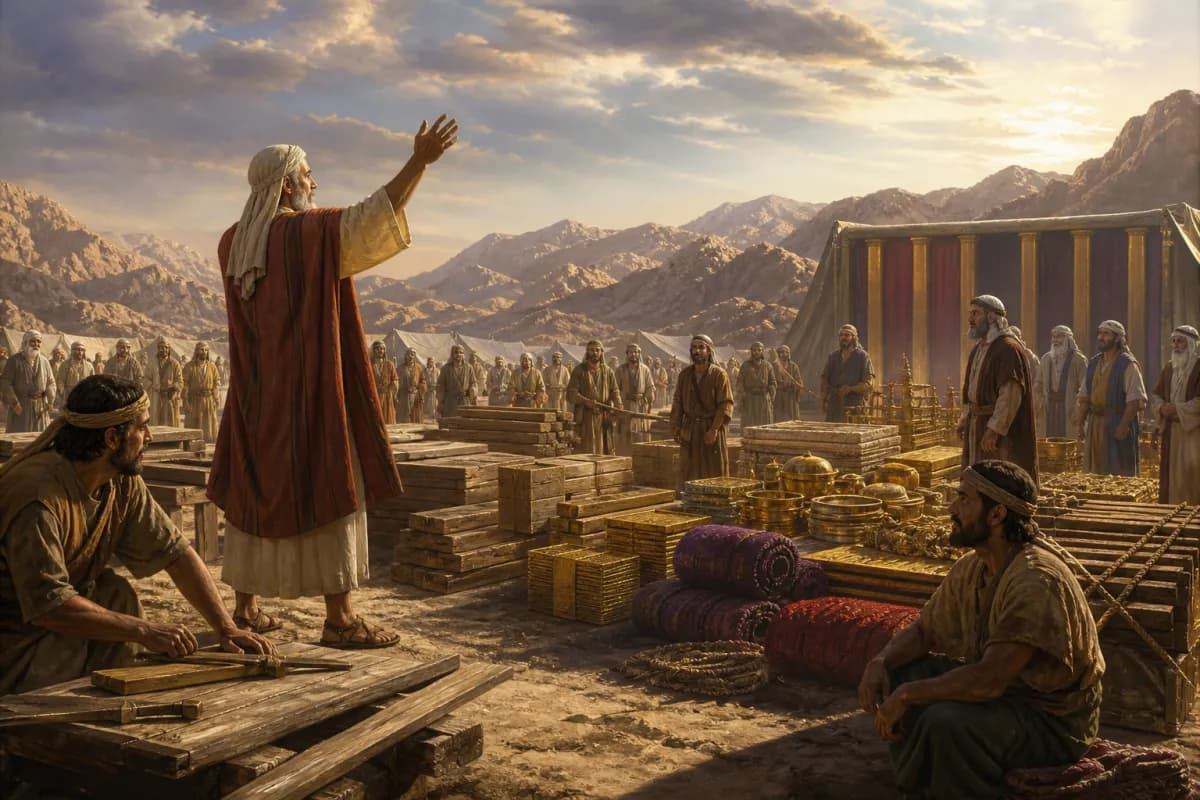
Exodus 36:1–7 shows Bezalel, Oholiab, and the skilled workers beginning the tabernacle with God-given ability while Israel continues bringing offerings until Moses must stop them. The scene joins willing generosity to careful obedience. In Christ, grace frees a people to serve without coercion, directing every gift toward the Savior’s mission rather than toward religious display.
- In this study
- 7 verses · 5 movements
Exodus 36
36:1“Bezalel and Oholiab shall work with every wise-hearted man, in whom the LORD has put wisdom and understanding to know how to do all the work for the service of the sanctuary, according to all that the LORD has commanded.”
36:2Moses called Bezalel and Oholiab, and every wise-hearted man, in whose heart the LORD had put wisdom, even everyone whose heart stirred him up to come to the work to do it.
36:3They received from Moses all the offering which the children of Israel had brought for the work of the service of the sanctuary, with which to make it. They kept bringing free will offerings to him every morning.
36:4All the wise men, who performed all the work of the sanctuary, each came from his work which he did.
36:5They spoke to Moses, saying, “The people have brought much more than enough for the service of the work which the LORD commanded to make.”
36:6Moses gave a commandment, and they caused it to be proclaimed throughout the camp, saying, “Let neither man nor woman make anything else for the offering for the sanctuary.” So the people were restrained from bringing.
36:7For the stuff they had was sufficient to do all the work, and too much.
CONTEXTUAL OVERVIEW
Exodus 36 moves from commissioning to execution. Bezalel, Oholiab, and every skilled person begin only after the Lord has given both ability and understanding. The text joins divine provision and human responsibility: God equips the workers, and the workers do all that He has commanded.
At the same time, Israel keeps bringing freewill offerings each morning. The artisans eventually interrupt their labor to report that the people have supplied more than the work requires. Moses’ command to stop is one of Scripture’s clearest pictures of generosity governed by the actual need rather than by manipulation.
HISTORICAL AND LITERARY CONTEXT
The account follows Exodus 35:20–35, where hearts are stirred to give and workers are equipped. Its contrast with the golden calf remains close at hand. Israel had once given gold rapidly for a forbidden image; now it gives materials freely for the Lord’s commanded dwelling, and Moses sets a limit when the purpose is supplied.
The repetition of “as the Lord commanded” is the literary center of these construction chapters. Israel is not innovating a new way to approach God. The offerings, workers, and finished sanctuary all remain accountable to the pattern revealed through Moses.
SECTION-BY-SECTION ANALYSIS
- Given ability · Exodus 36:1The workers’ competence is named as a gift from the Lord for the work He commands.
- Willing hearts · Exodus 36:4Those who come to labor and those who bring offerings respond voluntarily to God’s call.
- A commanded limit · Exodus 36:5Moses stops the contributions once the actual need has been met, guarding generosity from exploitation.
CHRIST IN THIS PASSAGE
The people’s surplus does not purchase God’s presence or atone for their sin. The tabernacle exists because God has already redeemed Israel and made a way to dwell among them. Jesus fulfills that saving purpose by giving Himself once for all, so Christian giving and service answer His grace rather than try to make Him indebted to us.
Christ also forms a body in which gifts are shared for the common good. His mission does not depend on pressure, exaggeration, or endless expansion. Believers can give freely, steward resources honestly, and stop when a need has been met, because the church belongs to a Savior whose provision is sufficient and whose gospel reaches people through grace.
REFLECTION
Some Christians feel valued only when they can give visibly; others stay detached because they assume their contribution is too small. Exodus 36 makes both labor and material support part of one obedient response. Ask Jesus what He has actually placed in your hands and where it could meet a real need.
Practice generosity with truthfulness. Support a need, serve a person, or give time this week, but resist the urge to use your gift for control or recognition. Let your freedom become a natural occasion to say that Christ gave Himself first, and His grace has made you free to serve.
Original Hebrew Word Study
Exodus 36:1
מְלָאכָה
melakhah · H4399
Usually translated: work, task, or skilled labor
Melakhah is the skilled work of the sanctuary. The artisans work according to all that the Lord has commanded, making obedience—not personal invention—the measure of faithful craftsmanship.
Follow the Scripture trail
The Work Begins: Enough Is More Than Enough in the larger story
The connection: Redeemed Israel gives and works freely for the dwelling God commands, and the abundance is measured by faithful need. Jesus gives Himself fully for sinners and creates a generous people whose resources serve His body and His gospel mission.
Respond to the passage
Identify one concrete need and one resource you can offer without seeking control or credit. Give or serve this week, then thank Jesus that His grace—not your contribution—secures your welcome before God.
- What does the phrase “as the Lord commanded” protect in this construction account?
- Why is Moses’ order to stop receiving offerings spiritually significant?
- How does Christ’s sufficient sacrifice reshape Christian generosity?
Prayer
Lord Jesus, You gave Yourself for me before I had anything to offer. Free me from fear, pride, and pressure. Make me a truthful and willing steward of time, skill, and resources, so that Your grace is seen and Your gospel is carried forward. Amen.