Passage Study
The Tabernacle Curtains Made: A Dwelling Shaped by God’s Pattern
Exodus 36:8–36:19
Exodus 36:8–19 records the making of the tabernacle curtains, loops, clasps, and layered coverings exactly as the Lord commanded. The repeated details show that Israel’s worship receives its form from God. The sanctuary points to the holy God who makes a way to dwell with His people, fulfilled in Jesus, who brings sinners near through His saving mission.
- In this study
- 12 verses · 5 movements
Exodus 36
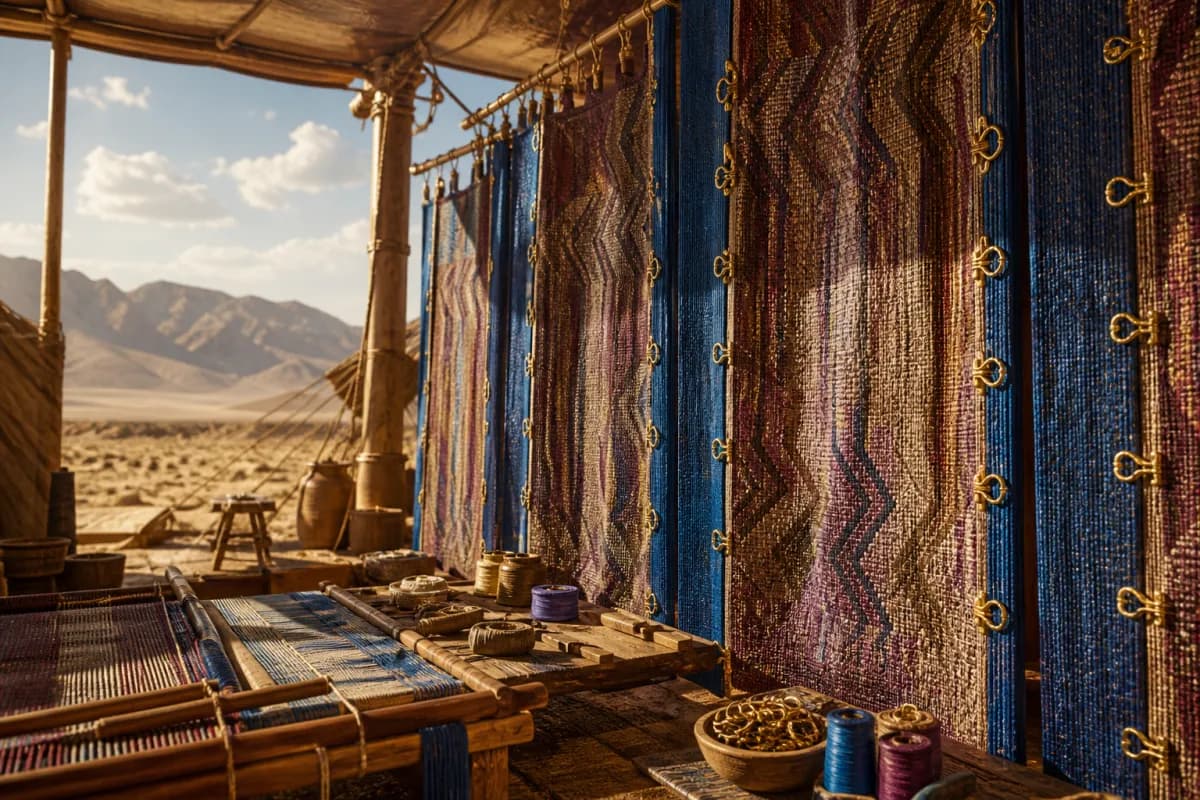
36:8All the wise-hearted men among those who did the work made the tabernacle with ten curtains of fine twined linen, blue, purple, and scarlet. They made them with cherubim, the work of a skillful workman.
36:9The length of each curtain was twenty-eight cubits, and the width of each curtain four cubits. All the curtains had one measure.
36:10He coupled five curtains to one another, and the other five curtains he coupled to one another.
36:11He made loops of blue on the edge of the one curtain from the edge in the coupling. Likewise he made in the edge of the curtain that was outermost in the second coupling.
36:12He made fifty loops in the one curtain, and he made fifty loops in the edge of the curtain that was in the second coupling. The loops were opposite to one another.
36:13He made fifty clasps of gold, and coupled the curtains to one another with the clasps: so the tabernacle was a unit.
36:14He made curtains of goats’ hair for a covering over the tabernacle. He made them eleven curtains.
36:15The length of each curtain was thirty cubits, and four cubits the width of each curtain. The eleven curtains had one measure.
36:16He coupled five curtains by themselves, and six curtains by themselves.
36:17He made fifty loops on the edge of the curtain that was outermost in the coupling, and he made fifty loops on the edge of the curtain which was outermost in the second coupling.
36:18He made fifty clasps of bronze to couple the tent together, that it might be a unit.
36:19He made a covering for the tent of rams’ skins dyed red, and a covering of sea cow hides above.
CONTEXTUAL OVERVIEW
The first item built is the tabernacle’s textile dwelling. Ten linen curtains, embroidered cherubim, loops, and gold clasps are assembled into one unified structure. The details may feel remote, but they make a central claim: the place where God meets Israel is neither improvised nor ordinary.
The linen interior is followed by goat-hair curtains and two outer coverings. The layered construction gives the sanctuary an inward and outward life: beauty and guarded holiness within, durable protection without. Israel is building a real portable dwelling for worship in the wilderness, not merely arranging symbols for private reflection.
HISTORICAL AND LITERARY CONTEXT
Exodus 26 supplied the original instructions; Exodus 36 narrates their faithful completion. The chapter’s parallel wording is purposeful. It records that the workers carry out the revealed pattern, showing that Israel’s restored covenant life is marked by listening and obedience after the disorder of the calf.
Cherubim appear on the inner curtains and later guard the ark’s mercy seat. Genesis 3 associates cherubim with the guarded way to the tree of life. Exodus does not explain every visual association here, but their presence fittingly reminds readers that access to the holy God is ordered and that He alone provides the way for His people to draw near.
SECTION-BY-SECTION ANALYSIS
- One tabernacle · Exodus 36:13Curtains, loops, and clasps turn many prepared pieces into the unified dwelling God commanded.
- Cherubim within · Exodus 36:8The inner woven figures signal that God’s dwelling is holy and access is not casual.
- Layered covering · Exodus 36:14The sanctuary is both beautiful and protected, suited to its holy purpose in Israel’s wilderness life.
CHRIST IN THIS PASSAGE
These curtains do not directly predict individual features of Jesus, and readers should resist turning every clasp into a hidden allegory. Their larger function is clearer: they form the God-appointed dwelling where Israel approaches a holy Lord through the priesthood and sacrifice He provides. John presents Jesus as the Word who dwells among us, and Hebrews presents Him as the One who opens access to God through His own saving work.
Christ’s mission brings the tabernacle’s hope to its goal. God does not remain distant from sinners; in His Son He comes near, bears sin, and reconciles people to the Father. The church’s worship therefore rests on Jesus’ finished work, while its ordered, reverent life witnesses that the God of grace is also holy.
REFLECTION
Modern people often assume sincerity is enough to define worship. Exodus 36 honors sincerity, skill, and generosity, yet it insists that Israel’s worship must be shaped by God’s word. Let that challenge the parts of your spiritual life built mainly around preference, convenience, or image.
Come to Jesus with gratitude that He has made access to God possible. In your congregation, support practices that make Scripture, prayer, confession, and the gospel clear. A reverent community can show a distracted world that God has not been reinvented by us; He has graciously made Himself known in His Son.
Original Hebrew Word Study
Exodus 36:8
מִשְׁכָּן
mishkan · H4908
Usually translated: dwelling place or tabernacle
Mishkan means dwelling place. The construction account repeats the tabernacle’s details to show that Israel is making a real dwelling for the Lord according to the pattern He gave.
Follow the Scripture trail
The Tabernacle Curtains Made: A Dwelling Shaped by God’s Pattern in the larger story
The connection: The curtains establish the God-given dwelling where Israel learns that His presence is holy and graciously ordered. Jesus fulfills the hope of God living with His people by reconciling sinners to the Father and forming a worshiping people around His finished work.
Respond to the passage
Ask where your approach to God has been shaped more by preference than by His Word. Thank Jesus for opening access to the Father, then take one practical step to make Scripture and prayer more central in your worshiping life.
- Why does Exodus spend so much time on loops, clasps, and joined curtains?
- What do the cherubim contribute to the atmosphere of the sanctuary?
- How does Jesus fulfill the tabernacle’s purpose without making its details disposable?
Prayer
Lord Jesus, thank You for coming near and opening the way to the Father through Your sacrifice. Teach me to worship with gratitude and reverence. Shape my church’s life by Your Word so that our worship points people toward Your saving presence. Amen.