Passage Study
The Ark Is Made: God’s Covenant Testimony at the Center
Exodus 37:1–37:9
Exodus 37:1–9 records Bezalel making the ark, its mercy seat, and the cherubim that overshadow it. The ark is the appointed place for the covenant testimony and the place above which God promises to meet Moses. It points beyond itself to Jesus, whose saving work brings sinners near to the holy God without reducing His holiness.
- In this study
- 9 verses · 5 movements
Exodus 37
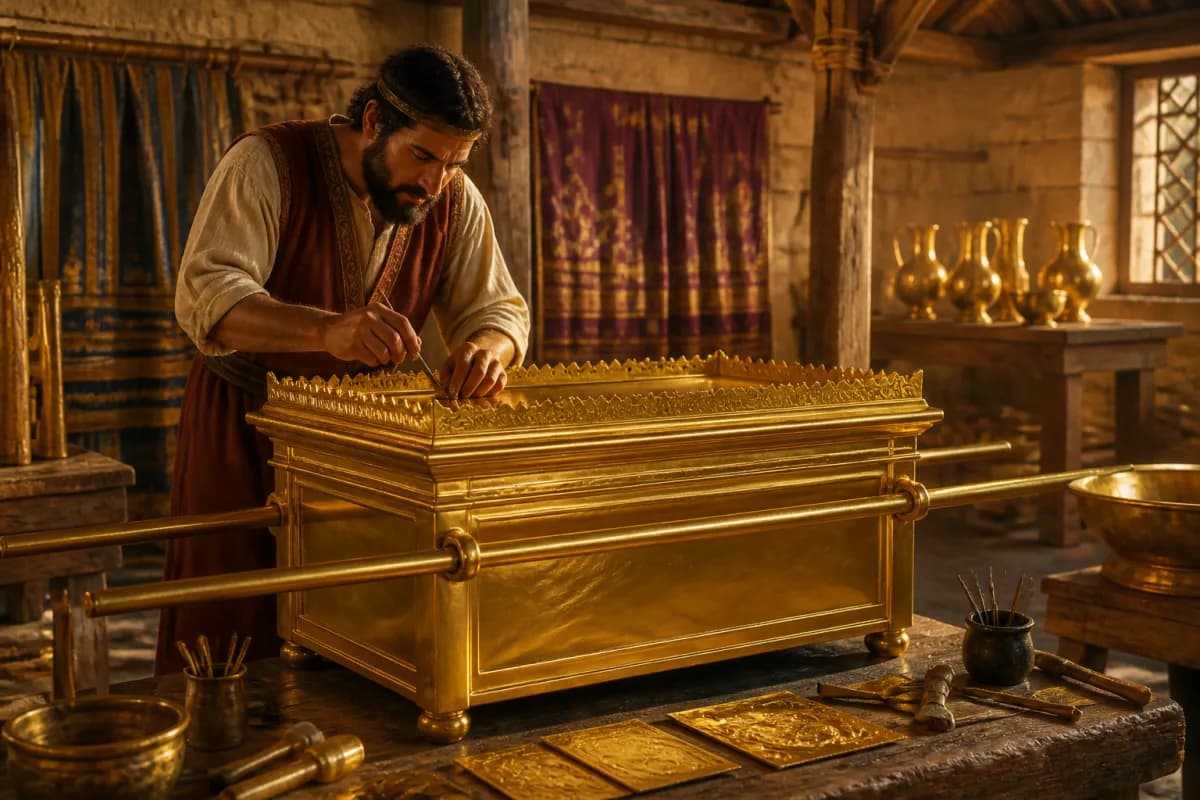
37:1Bezalel made the ark of acacia wood. Its length was two and a half cubits, and its width a cubit and a half, and a cubit and a half its height.
37:2He overlaid it with pure gold inside and outside, and made a molding of gold for it around it.
37:3He cast four rings of gold for it in its four feet—two rings on its one side, and two rings on its other side.
37:4He made poles of acacia wood and overlaid them with gold.
37:5He put the poles into the rings on the sides of the ark, to bear the ark.
37:6He made a mercy seat of pure gold. Its length was two and a half cubits, and a cubit and a half its width.
37:7He made two cherubim of gold. He made them of beaten work, at the two ends of the mercy seat:
37:8one cherub at the one end, and one cherub at the other end. He made the cherubim of one piece with the mercy seat at its two ends.
37:9The cherubim spread out their wings above, covering the mercy seat with their wings, with their faces toward one another. The faces of the cherubim were toward the mercy seat.
CONTEXTUAL OVERVIEW
After Israel has supplied the materials and the artisans have begun their work, Exodus turns to the furnishings themselves. Bezalel starts with the ark, a chest made of acacia wood and overlaid with gold. This is not a display case for religious treasure; it will hold the testimony of the covenant and stand in the most holy place.
The ark’s cover, often called the mercy seat, is framed by two cherubim. Their posture directs attention downward toward the cover rather than outward toward the camp. The scene makes visible a central tension of Israel’s worship: the Lord chooses to dwell among His redeemed people, yet His presence is holy and approach must be received on His terms.
HISTORICAL AND LITERARY CONTEXT
Exodus 37 carries out the design first given in Exodus 25:10–22. The repeated materials, dimensions, rings, poles, and cherubim show that the work is responsive obedience, not a new religious invention. In the larger story, this comes after the golden calf and covenant renewal, so faithful construction is part of Israel’s restored life under the Lord’s word.
The passage does not say the ark contains God or puts Him under Israel’s control. Exodus 25 says the Lord will meet Moses above the mercy seat and speak from between the cherubim. The ark therefore marks God’s gracious self-disclosure and covenant rule, while its restricted location and transport requirements preserve the distinction between Creator and creature.
SECTION-BY-SECTION ANALYSIS
- The testimony · Exodus 37:1The ark will hold the covenant tablets, placing God’s spoken will at the center of Israel’s worship.
- The mercy seat · Exodus 37:6The gold cover is the appointed meeting place above the ark, later central to Israel’s Day of Atonement ritual.
- The cherubim · Exodus 37:9Their overshadowing wings visibly guard the holy center and direct attention toward God’s covenant provision.
CHRIST IN THIS PASSAGE
The ark is not Jesus in a simple one-to-one sense, and Exodus 37 does not say that every feature predicts Him. It belongs, however, to the sanctuary system through which God taught Israel that holy communion requires His covenant provision. The New Testament presents Christ as the definitive mediator whose self-giving death deals with sin and opens reconciled access to the Father.
Jesus’ mission does not make God less holy; it fulfills the mercy toward which the sanctuary pointed. In Him, God’s righteous judgment of sin and His merciful welcome of repentant sinners meet. Those who come through Christ are not invited to manage God’s presence but to receive His grace, obey His word, and bear witness to the Savior who brings people near.
REFLECTION
The ark challenges both casual religion and despairing distance. God is neither a useful object to be carried into our plans nor a remote power unwilling to meet His people. He has made a way to be known, and that way calls for reverence, trust, and obedience shaped by His word.
Come to Jesus with the part of your life you have tried either to hide from God or control before Him. Receive His mercy honestly, then let His covenant word reorder one concrete decision. When you speak of faith this week, point people to Christ’s reconciling work rather than to your own spiritual performance.
Original Hebrew Word Study
Exodus 37:6
כַּפֹּרֶת
kapporet · H3727
Usually translated: mercy seat or atonement cover
Kapporet is the cover placed over the ark, often called the mercy seat. It is the place of atonement above the covenant testimony, bringing together God’s righteous word and His merciful provision for a sinful people.
Follow the Scripture trail
The Ark Is Made: God’s Covenant Testimony at the Center in the larger story
The connection: The ark places God’s covenant testimony and His appointed mercy at Israel’s worshiping center. Jesus fulfills the sanctuary’s saving purpose by dealing with sin and bringing a redeemed people into true fellowship with the Father.
Respond to the passage
Name one place where you have treated God as either manageable or unreachable. Bring it to Jesus, receive His mercy, and let His word shape one act of repentance or obedience today.
- Why do the poles and rings matter in a passage about the ark?
- What does the cherubim’s posture communicate about the place of meeting?
- How does Christ give real access to God without making holiness casual?
Prayer
Holy Father, thank You for providing mercy rather than leaving me to approach You on my own terms. Thank You for Jesus, who has dealt with my sin and brought me near. Teach me reverence, trust, and willing obedience, and make my life point others to Your reconciling grace. Amen.