Passage Study
The Table Is Made: Provision Before the Lord
Exodus 37:10–37:16
Exodus 37:10–16 records the making of the gold-covered table and its utensils for the bread of the Presence. The table belongs inside God’s dwelling and keeps Israel’s life before Him as a covenant gift. In Jesus, God gives the true bread of life and welcomes His people into fellowship that becomes witness to His saving mission.
- In this study
- 7 verses · 5 movements
Exodus 37
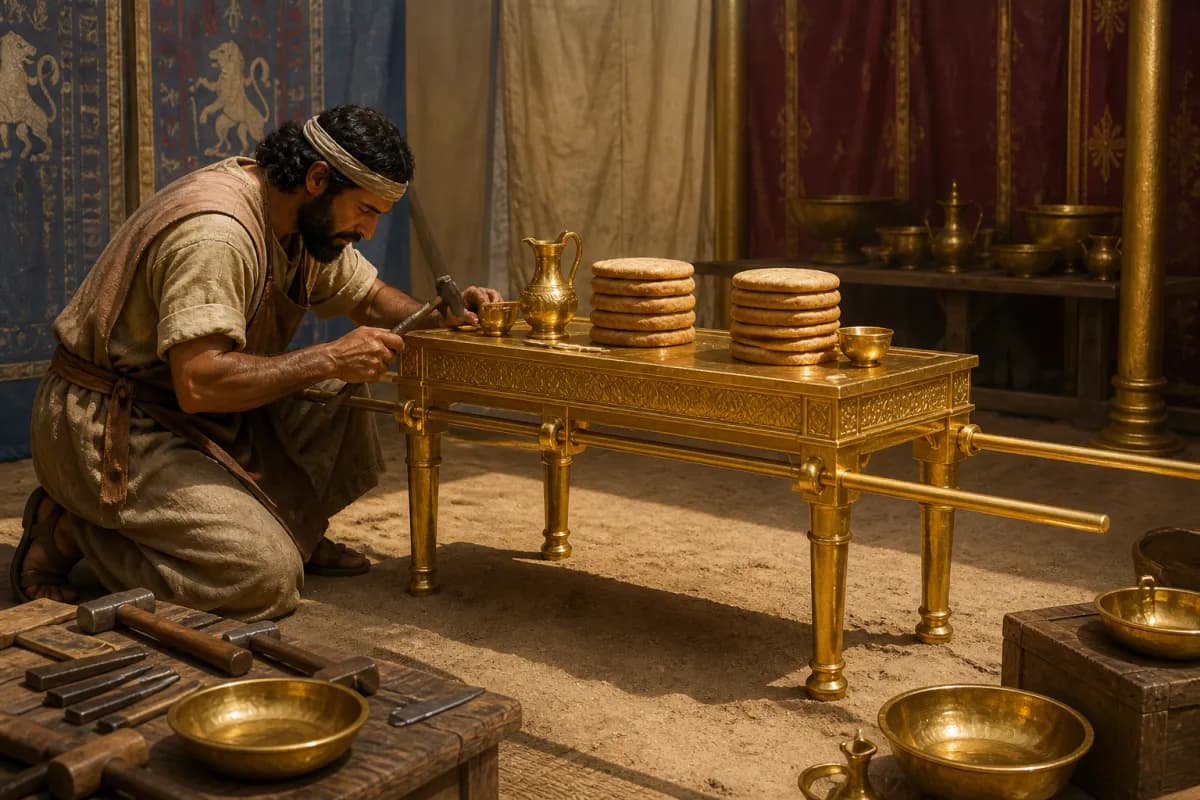
37:10He made the table of acacia wood. Its length was two cubits, and its width was a cubit, and its height was a cubit and a half.
37:11He overlaid it with pure gold, and made a gold molding around it.
37:12He made a border of a hand’s width around it, and made a golden molding on its border around it.
37:13He cast four rings of gold for it, and put the rings in the four corners that were on its four feet.
37:14The rings were close by the border, the places for the poles to carry the table.
37:15He made the poles of acacia wood, and overlaid them with gold, to carry the table.
37:16He made the vessels which were on the table, its dishes, its spoons, its bowls, and its pitchers with which to pour out, of pure gold.
CONTEXTUAL OVERVIEW
The ark is followed by a table. That ordering places a striking picture beside the covenant testimony: the God who gives His word also appoints bread to be set continually before Him. The table is made from acacia wood overlaid with gold, fitting its location in the holy place.
Exodus 37 does not yet narrate the placement of bread, but it makes the vessel and every utensil required for that service. Israel’s ordinary provision is brought into the sanctuary as a sign of covenant fellowship. The Lord does not need food from His people; the table teaches them to receive daily life as His gift and to live before Him.
HISTORICAL AND LITERARY CONTEXT
This construction account corresponds to Exodus 25:23–30, where the table is commanded and the bread of the Presence is named. Leviticus 24 later gives practical directions for the twelve loaves, renewed each Sabbath. These texts should be read together without making the table a generic symbol for every meal or a secret prediction in every measurement.
The table belongs to the tabernacle, not to Israel’s private homes. Its gold, rings, poles, and dedicated vessels identify it as holy equipment for worship. Yet the object uses the familiar realities of bread and table fellowship to teach that Israel’s material life is not outside the Lord’s covenant care.
SECTION-BY-SECTION ANALYSIS
- Bread before God · Exodus 37:10The table prepares for the continual bread of the Presence, a covenant sign of Israel’s life before the Lord.
- Holy ordinary things · Exodus 37:16A table and vessels are familiar objects, yet their setting teaches that daily provision belongs under God’s rule.
- Portable fellowship · Exodus 37:14The rings and poles show that God’s covenant care accompanies Israel on its wilderness journey.
CHRIST IN THIS PASSAGE
The bread of the Presence is not itself the body of Christ, and Exodus 37 does not provide a Eucharistic explanation. It does establish a sanctuary pattern of provision and fellowship before God. Jesus takes that theme to its fulfillment when He identifies Himself as the bread of life, the One sent by the Father who gives life to the world.
Christ feeds His people first through His saving grace, not through their religious achievement. His mission creates a table-shaped community of gratitude, hospitality, and reconciliation. Christians should therefore receive meals and resources as gifts, resist self-sufficient pride, and make room for others to hear the good news of the Savior who satisfies the deepest hunger.
REFLECTION
A full pantry or a carefully planned meal can make us feel self-made; an empty one can make us afraid that God has forgotten us. The table in the holy place redirects both responses. Provision belongs before the Lord, who knows the needs of His people and teaches them grateful dependence.
Give thanks over one ordinary provision today and ask Jesus to expose either anxiety or entitlement in your heart. Then practice a small act of welcome: share a meal, bring food to a neighbor, or make room for someone who is often left out. Let that generosity point to the Savior who gives Himself for the life of the world.
Original Hebrew Word Study
Exodus 37:16
לֶחֶם
lechem · H3899
Usually translated: bread
Lechem is bread, the ordinary food of life. The table made for the bread of the Presence gives Israel’s daily provision a worshipful setting: life is sustained before the Lord who provides it.
Follow the Scripture trail
The Table Is Made: Provision Before the Lord in the larger story
The connection: The holy table keeps Israel’s covenant life and provision before the Lord. Jesus is the true bread who gives life, gathers grateful people around Himself, and sends them to extend His welcome in the world.
Respond to the passage
Thank Jesus for a specific provision you usually take for granted. Ask Him to replace anxiety or entitlement with trust, then share one tangible gift or act of welcome in His name.
- Why does a table belong inside the holy place?
- What do the dedicated utensils add to the meaning of the bread service?
- How does Jesus as the bread of life reshape gratitude and hospitality?
Prayer
Lord Jesus, You are the bread of life and every good gift comes from the Father through Your grace. Free me from anxious self-reliance and from entitlement. Make my home and resources places of gratitude, welcome, and truthful witness to Your saving love. Amen.