Passage Study
The Incense Altar and Holy Oil: Worship Marked Off for God
Exodus 37:25–37:29
Exodus 37:25–29 records the making of the gold incense altar, the holy anointing oil, and the fragrant incense. These items belong to the ordered service of the tabernacle and cannot be reduced to private spiritual mood. They prepare readers to see Jesus as the consecrated mediator whose saving work brings His people to God and sets them apart for worship and witness.
- In this study
- 5 verses · 5 movements
Exodus 37
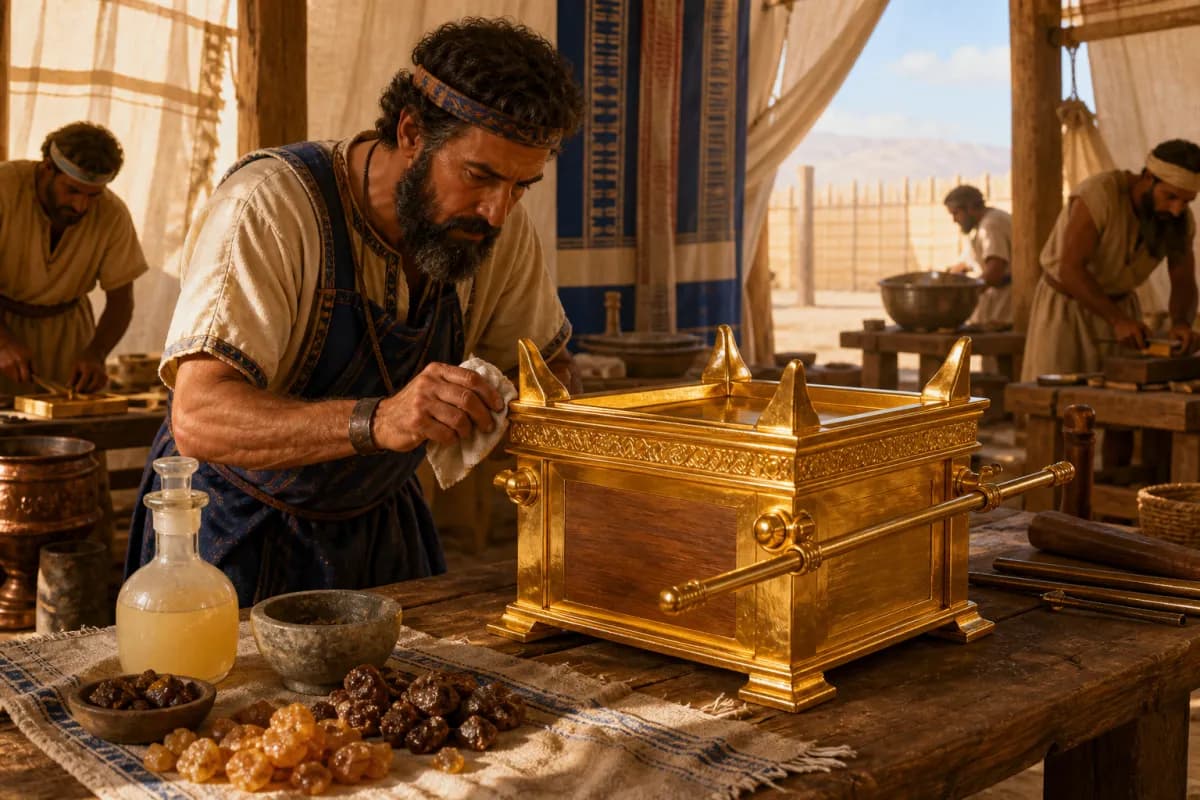
37:25He made the altar of incense of acacia wood. It was square: its length was a cubit, and its width a cubit. Its height was two cubits. Its horns were of one piece with it.
37:26He overlaid it with pure gold: its top, its sides around it, and its horns. He made a gold molding around it.
37:27He made two golden rings for it under its molding crown, on its two ribs, on its two sides, for places for poles with which to carry it.
37:28He made the poles of acacia wood, and overlaid them with gold.
37:29He made the holy anointing oil and the pure incense of sweet spices, after the art of the perfumer.
CONTEXTUAL OVERVIEW
Exodus 37 concludes the holy-place furnishings with an altar for incense and two carefully prepared substances: holy anointing oil and pure fragrant incense. The altar is small compared with the bronze altar outside, but its gold overlay, horns, rings, and poles mark it as a distinct piece of sanctuary equipment.
The brief account speaks of scent, skill, and holiness. It does not suggest that fragrance produces God’s presence or that religious objects work by technique. These are God-appointed materials for the worship He defines, reminding Israel that the life of prayer, service, and consecration belongs to the Lord rather than to human improvisation.
HISTORICAL AND LITERARY CONTEXT
The instructions appear in Exodus 30:1–10 and 22–38. There the incense altar stands before the veil, incense is offered regularly, anointing oil consecrates the tabernacle and its servants, and Israel is forbidden to reproduce the holy formulas for ordinary use. Exodus 37 now reports their careful preparation as part of the completed work.
In the ancient world, perfumes and oils could be associated with status, hospitality, burial, medicine, and worship. Exodus gives them a specific covenant setting. The text does not explain the ingredients as coded messages; it emphasizes that what belongs to God’s sanctuary is holy because He has designated it for His service.
SECTION-BY-SECTION ANALYSIS
- Before the veil · Exodus 37:25The incense altar is positioned near the boundary of the most holy place, joining regular worship to God’s guarded presence.
- Holy use · Exodus 37:29The oil and incense are set apart for the sanctuary rather than available for common self-display.
- Skilled obedience · Exodus 37:26The perfumer’s craft is valuable because it serves the exact purpose God has revealed.
CHRIST IN THIS PASSAGE
Neither oil nor incense is a mechanical substitute for Jesus, and Christians should not treat Exodus’s holy formulas as personal recipes. The sanctuary pattern does, however, teach that sinners need God-provided mediation and consecration. Jesus is the Messiah, the anointed One, whose obedient life and sacrificial death accomplish what sacred objects could only anticipate.
Through Christ, prayer is welcomed by the Father and believers are set apart as a people for God. His mission creates more than an inward religious feeling: it makes a holy people who offer their lives to God, intercede for others, and speak of the Savior whose grace turns former rebels into worshipers.
REFLECTION
It is possible to seek a spiritual atmosphere while avoiding the God who calls us to holiness. Exodus ties beauty and fragrance to obedience. Ask whether a practice, object, or mood has become a substitute for actual prayer, confession, and submission to Christ.
Pray for one person by name today, asking that Jesus would bring that person near to the Father. Then take one consecrated step yourself: refuse a compromise, repair a relationship, or serve someone quietly. Let your life carry the aroma of Christ’s grace rather than the scent of spiritual self-promotion.
Original Hebrew Word Study
Exodus 37:29
קְטֹרֶת
qetoret · H7004
Usually translated: incense or smoke of incense
Qetoret is incense. The final preparation of oil and incense completes what is needed for the sanctuary’s regular worship, where Israel approaches God through the means He has appointed.
Follow the Scripture trail
The Incense Altar and Holy Oil: Worship Marked Off for God in the larger story
The connection: The incense altar and holy oil set worship apart for the God who dwells among Israel. Jesus, the true anointed mediator, brings people to the Father and forms them into a praying, holy people who witness to His saving grace.
Respond to the passage
Identify one spiritual habit that has become more about atmosphere than obedience. Turn to Jesus in honest prayer, intercede for one person by name, and take one concrete step that reflects His holy grace.
- Why does Exodus distinguish holy oil and incense from common use?
- What does the altar’s position near the veil communicate about worship?
- How does Christ keep prayer from becoming an attempt to manipulate God?
Prayer
Lord Jesus, You are my faithful mediator and the One who brings my prayer to the Father. Forgive me for seeking spiritual appearances without surrender. Set my life apart by Your grace, teach me to intercede for others, and make my obedience a witness to Your saving love. Amen.