Passage Study
The Bronze Altar Is Made: Costly Approach at the Entrance
Exodus 38:1–38:7
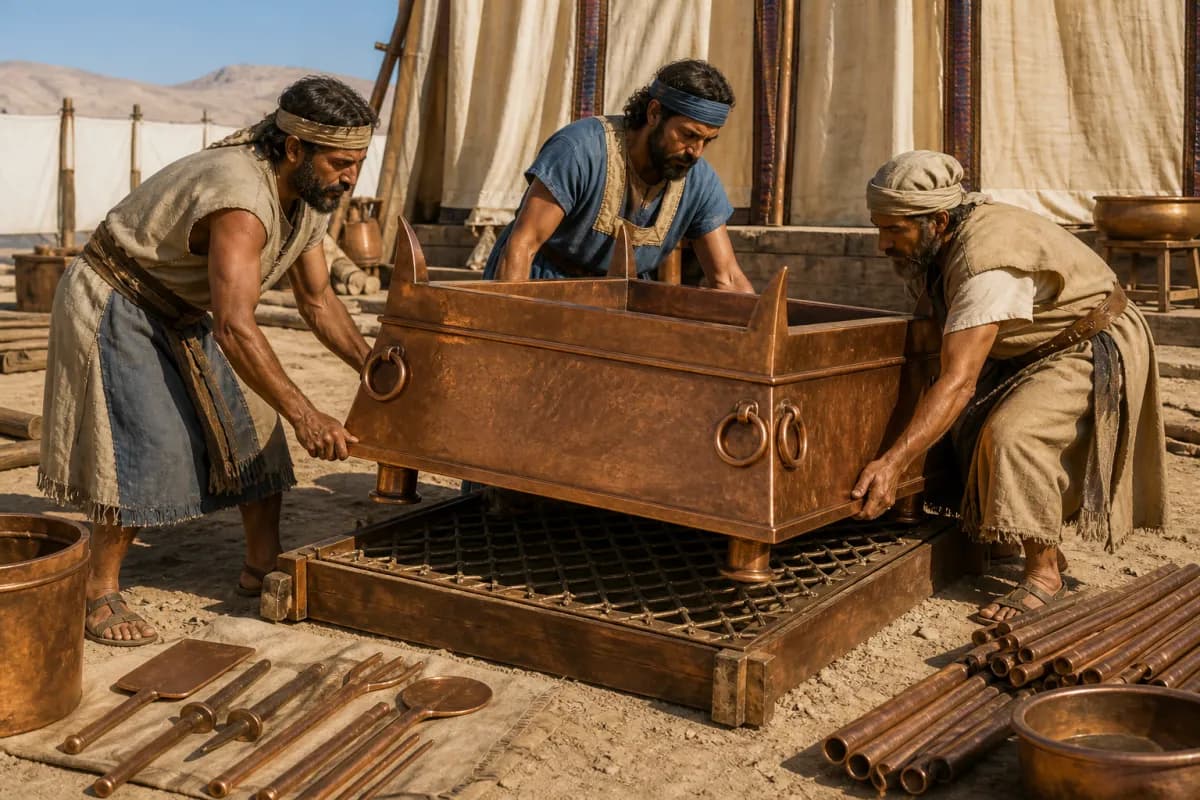
Exodus 38:1–7 records the making of the bronze altar, its horns, utensils, grating, rings, and carrying poles. Placed at the entrance of the tabernacle court, it makes sacrifice central to Israel’s approach to the holy God. It prepares readers for Jesus, whose once-for-all self-giving death reconciles sinners to the Father and sends them as ambassadors of that peace.
- In this study
- 7 verses · 5 movements
Exodus 38
38:1He made the altar of burnt offering of acacia wood. It was square. Its length was five cubits, its width was five cubits, and its height was three cubits.
38:2He made its horns on its four corners. Its horns were of one piece with it, and he overlaid it with bronze.
38:3He made all the vessels of the altar: the pots, the shovels, the basins, the forks, and the fire pans. He made all its vessels of bronze.
38:4He made for the altar a grating of a network of bronze, under the ledge around it beneath, reaching halfway up.
38:5He cast four rings for the four corners of bronze grating, to be places for the poles.
38:6He made the poles of acacia wood, and overlaid them with bronze.
38:7He put the poles into the rings on the sides of the altar, with which to carry it. He made it hollow with planks.
CONTEXTUAL OVERVIEW
At Exodus 38 the construction moves from the holy place outward to the court’s great bronze altar. Anyone approaching the tabernacle meets this altar before reaching the tent itself. Its placement teaches that Israel’s relationship with the holy God cannot be built on casual access or moral self-confidence.
The altar is made of acacia wood overlaid with bronze, with horns at its corners and a full set of utensils for ash, blood, fire, and sacrifice. Exodus 38 focuses on construction rather than offering procedures, but the physical reality is unmistakable: reconciliation in Israel’s worship is costly and God Himself appoints its place and order.
HISTORICAL AND LITERARY CONTEXT
Exodus 27:1–8 gives the design; Leviticus explains how burnt offerings and other sacrifices are offered upon it. The altar belongs to the covenant God established after redeeming Israel from Egypt. Sacrifice does not purchase the exodus; it is the worship of a people already rescued and taught how to live before their Redeemer.
Bronze is used for the altar and its implements, distinguishing this court furnishing from the gold-covered furniture inside the tent. The passage does not attach a separate theological meaning to every metal or measurement. Its plain force is that Israel’s approach is tangible, ordered, and governed by God’s holy mercy rather than invented by religious impulse.
SECTION-BY-SECTION ANALYSIS
- At the entrance · Exodus 38:1The altar stands before the tabernacle, showing that God provides a sacrificial way of approach.
- Costly worship · Exodus 38:4The utensils and grating make the physical seriousness of sacrifice visible rather than sentimental.
- Mercy on God’s terms · Exodus 38:2Its design and transport are commanded by the Lord, ruling out self-made access to Him.
CHRIST IN THIS PASSAGE
The bronze altar is not the cross itself, and Exodus 38 does not explain Jesus by allegorizing its horns or grating. It belongs to the sacrificial system that teaches a lasting truth: sin is serious, and reconciliation requires the provision of God’s mercy. The New Testament proclaims that Christ gives Himself once for all, accomplishing the reconciliation repeated animal sacrifices could not finally secure.
Jesus’ saving mission therefore speaks both pardon and transformation. Those reconciled through His death are not left at a ritual boundary; they are brought to the Father and sent into the world as ambassadors of His peace. The cross undermines pride because access is received, and it undermines despair because the Savior has borne the cost.
REFLECTION
Many people alternate between trying to prove they deserve God and assuming they are beyond His welcome. The altar corrects both instincts. God takes sin with full seriousness, and God provides the way of mercy. You do not bring a better record to earn entrance; you come to Christ with need and trust His finished work.
Bring one specific guilt or self-justifying pattern to Jesus today. Receive His forgiveness, then make peace where you can: apologize, pay what you owe, or speak truthfully to someone you have avoided. Let that reconciliation become a simple testimony that Christ has made peace with God possible.
Original Hebrew Word Study
Exodus 38:1
עֹלָה
olah · H5930
Usually translated: burnt offering; that which goes up
Olah is the offering that goes up in smoke. The altar bears this name because sacrifice rises before God, making atonement and whole-hearted devotion central to Israel’s approach.
Follow the Scripture trail
The Bronze Altar Is Made: Costly Approach at the Entrance in the larger story
The connection: The bronze altar stands at Israel’s appointed entrance to God’s dwelling, teaching that mercy is costly and given by God. Jesus fulfills that saving purpose through His once-for-all sacrifice and sends reconciled people to announce His peace.
Respond to the passage
Bring a specific guilt or self-justifying habit to Jesus rather than trying to manage it alone. Trust His finished sacrifice, then take one concrete step toward reconciliation with another person.
- Why is the altar placed before the tent rather than inside the holy place?
- What do the altar’s utensils add to the passage’s understanding of sacrifice?
- How does Christ’s once-for-all sacrifice address both pride and despair?
Prayer
Father, thank You for providing mercy at great cost through Your Son. Forgive my pride and my attempts to hide from You. Through Jesus, make me a person who receives reconciliation gratefully and carries its message into the relationships You place before me. Amen.