Passage Study
The Tabernacle Inventory: Gifts Accounted for Before God
Exodus 38:21–38:31
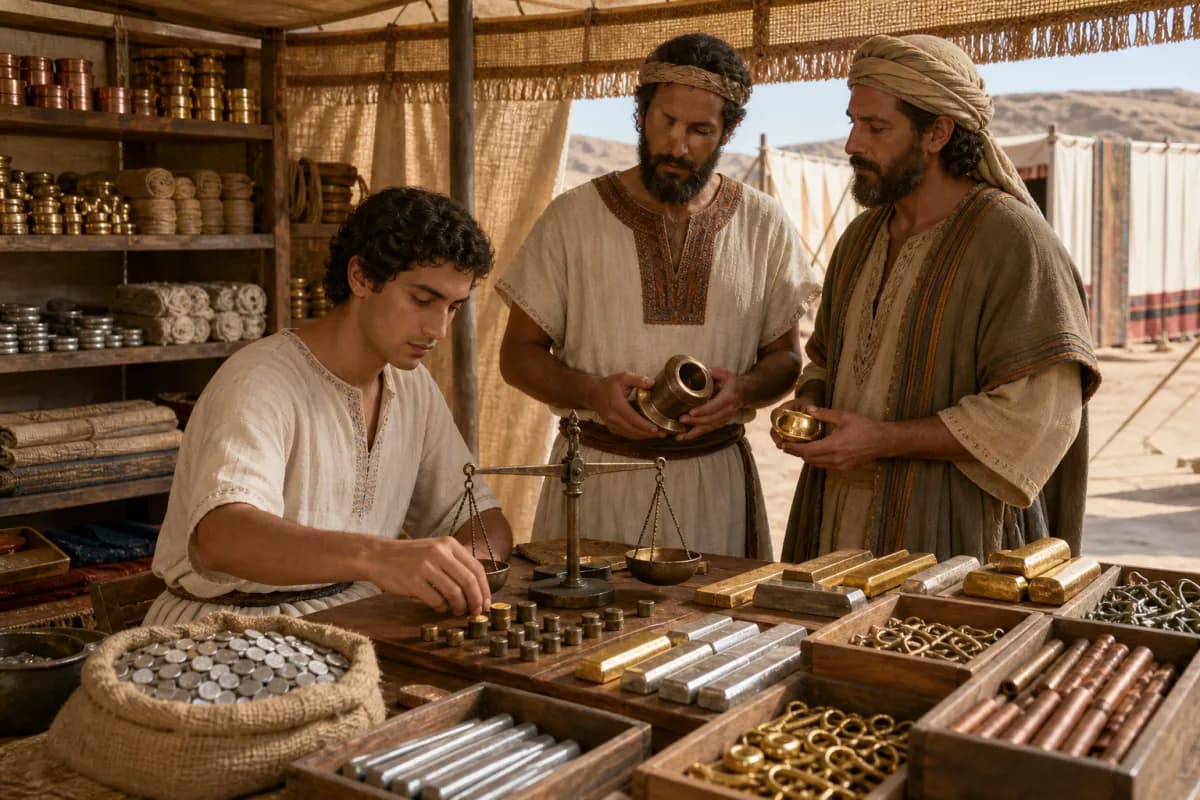
Exodus 38:21–31 records the inventory of gold, silver, and bronze used for the tabernacle under the oversight of Ithamar and the work of Bezalel and Oholiab. The passage treats Israel’s gifts as a sacred trust, not anonymous surplus. Jesus redeems a people to belong to Him, and His mission trains them to use what they have with grateful integrity for God’s glory and their neighbors’ good.
- In this study
- 11 verses · 5 movements
Exodus 38
38:21These are the amounts of materials used for the tabernacle, even the Tabernacle of the Testimony, as they were counted, according to the commandment of Moses, for the service of the Levites, by the hand of Ithamar, the son of Aaron the priest.
38:22Bezalel the son of Uri, the son of Hur, of the tribe of Judah, made all that the LORD commanded Moses.
38:23With him was Oholiab, the son of Ahisamach, of the tribe of Dan, an engraver, and a skillful workman, and an embroiderer in blue, in purple, in scarlet, and in fine linen.
38:24All the gold that was used for the work in all the work of the sanctuary, even the gold of the offering, was twenty-nine talents and seven hundred thirty shekels, according to the shekel of the sanctuary.
38:25The silver of those who were counted of the congregation was one hundred talents and one thousand seven hundred seventy-five shekels, according to the shekel of the sanctuary:
38:26a beka a head, that is, half a shekel, according to the shekel of the sanctuary, for everyone who passed over to those who were counted, from twenty years old and upward, for six hundred three thousand five hundred fifty men.
38:27The one hundred talents of silver were for casting the sockets of the sanctuary and the sockets of the veil: one hundred sockets for the one hundred talents, one talent per socket.
38:28From the one thousand seven hundred seventy-five shekels he made hooks for the pillars, overlaid their capitals, and made fillets for them.
38:29The bronze of the offering was seventy talents and two thousand four hundred shekels.
38:30With this he made the sockets to the door of the Tent of Meeting, the bronze altar, the bronze grating for it, all the vessels of the altar,
38:31the sockets around the court, the sockets of the gate of the court, all the pins of the tabernacle, and all the pins around the court.
CONTEXTUAL OVERVIEW
After describing the courtyard, Exodus pauses to account for the materials used in the tabernacle. Gold, silver, and bronze are weighed, counted, and connected to specific parts of the sanctuary. What can feel like a ledger is a theological statement: worship does not float above ordinary material life. The people’s contributions are handled before God with named oversight and visible purpose.
This is especially fitting after Israel misused gold to make the calf. The same people now bring resources for the dwelling God commanded, and the text records what was received and where it went. Grace does not erase the need for truthfulness; restored worship includes careful stewardship.
HISTORICAL AND LITERARY CONTEXT
Verse 21 calls this an accounting of the tabernacle, the tabernacle of the covenant testimony. Ithamar, Aaron’s son, serves under Moses’ direction, while Bezalel and Oholiab are identified with their respective work. The paragraph links priestly oversight, skilled labor, and community giving without collapsing them into the same role.
The silver comes from the census half-shekel described in Exodus 30:11–16. The text counts 603,550 men of twenty years and upward and then explains the number of silver talents and shekels in terms of that required offering. Its concern is not a modern population debate; it is the covenant principle that every Israelite’s life belongs to the Lord and that the sanctuary is supported through the provision He commands.
SECTION-BY-SECTION ANALYSIS
- Named oversight · Exodus 38:21Ithamar, Bezalel, and Oholiab show that sacred work is carried through identifiable responsibility.
- Ransom silver · Exodus 38:25The census offering remembers that each Israelite belongs to the Lord and cannot treat life as self-owned.
- Concrete uses · Exodus 38:24The inventory links each material to particular sanctuary fittings, making stewardship visible rather than vague.
CHRIST IN THIS PASSAGE
This inventory does not teach that money or metals can purchase salvation. The census offering itself points beyond payment by human wealth: God provides atonement and claims His people as His own. Jesus gives Himself as the ransom for many, accomplishing the redemption that no sanctuary contribution could finally secure.
Because Christ has bought His people at great cost, Christian stewardship becomes a response to grace rather than a bid for acceptance. His mission reshapes resources, skills, and leadership into gifts for worship, service, and gospel witness. Honest accounting becomes one ordinary way a church shows that the message of reconciliation is trustworthy.
REFLECTION
Financial care can seem unspiritual until we remember that gifts, buildings, tools, and salaries affect the credibility and service of God’s people. Exodus 38 does not romanticize untracked generosity. It honors a community in which offerings are received, counted, and used with integrity under responsible oversight.
Review one resource God has entrusted to you—money, time, influence, or professional skill. Ask Jesus to free it from fear and self-display, then choose one transparent, purposeful use of it for a neighbor, your church, or gospel work. Give without pretending that your gift earns what Christ has already given.
Original Hebrew Word Study
Exodus 38:21
פָּקַד
paqad · H6485
Usually translated: to account for, attend to, or appoint
Paqad can mean to attend to or account for. The inventory of sanctuary materials treats the people’s gifts as a sacred trust, handled with care under the oversight God appoints.
Follow the Scripture trail
The Tabernacle Inventory: Gifts Accounted for Before God in the larger story
The connection: Israel’s inventory shows that redeemed people handle gifts as a trust for God’s dwelling. Jesus ransoms His people by His own life and teaches them to steward resources and abilities with integrity for worship, service, and His mission.
Respond to the passage
Ask Jesus where you treat a resource as exclusively your own. Make one specific plan to use it transparently and generously for someone else’s good, remembering that Christ’s grace—not your giving—secures your standing with God.
- Why does Exodus name overseers and craftsmen in a materials inventory?
- How does the census silver shape the meaning of the accounting?
- How can transparent stewardship support a church’s witness to Christ?
Prayer
Lord Jesus, everything I have comes from Your grace and belongs to You. Deliver me from possessiveness and careless stewardship. Give me honesty, gratitude, and generosity so that my use of resources serves people and honors Your saving name. Amen.