Passage Study
The Courtyard Is Made: A Place Set Apart for Approach
Exodus 38:8–38:20
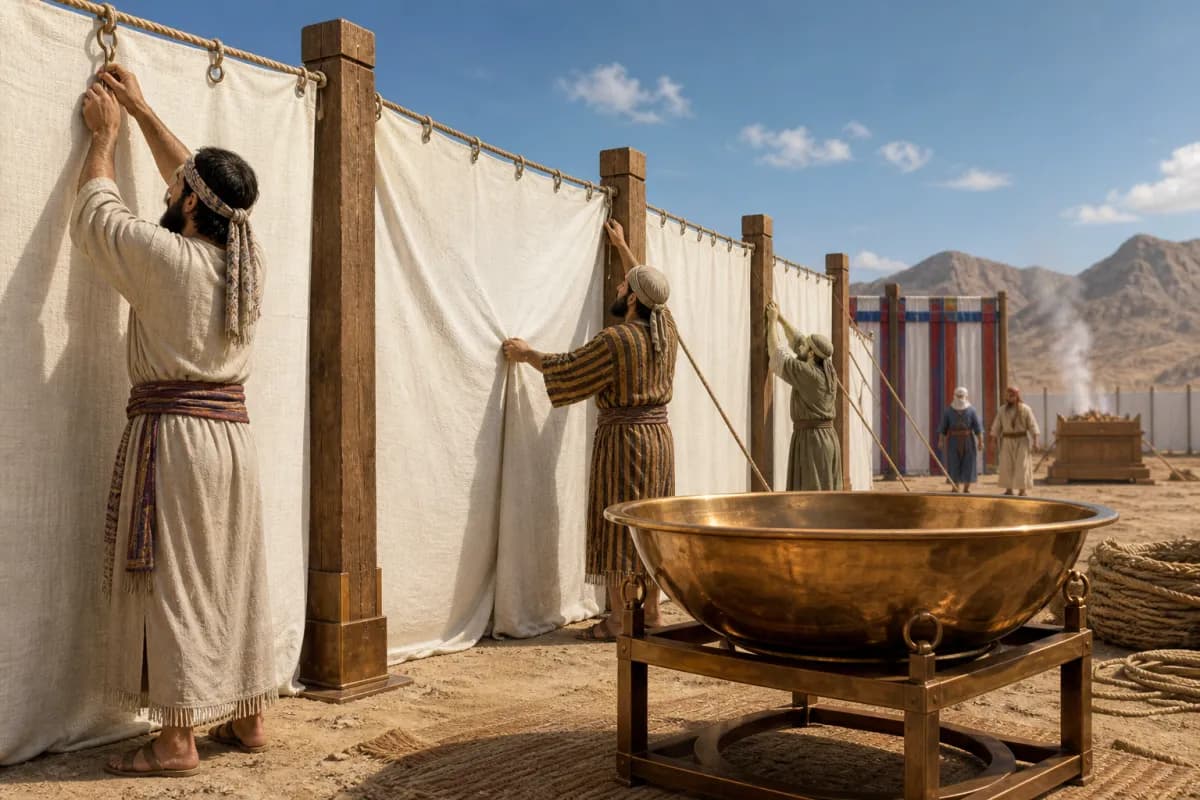
Exodus 38:8–20 records the bronze basin made from the mirrors of women serving at the entrance and the linen courtyard that surrounds the altar. The enclosed court gives Israel a real place to gather before the holy God by the means He provides. Jesus fulfills the sanctuary’s saving purpose by bringing sinners to the Father and creating a people who invite the world to Him.
- In this study
- 13 verses · 5 movements
Exodus 38
38:8He made the basin of bronze, and its base of bronze, out of the mirrors of the ministering women who ministered at the door of the Tent of Meeting.
38:9He made the court: for the south side southward the hangings of the court were of fine twined linen, one hundred cubits;
38:10their pillars were twenty, and their sockets twenty, of bronze; the hooks of the pillars and their fillets were of silver.
38:11For the north side one hundred cubits, their pillars twenty, and their sockets twenty, of bronze; the hooks of the pillars, and their fillets, of silver.
38:12For the west side were hangings of fifty cubits, their pillars ten, and their sockets ten; the hooks of the pillars, and their fillets, of silver.
38:13For the east side eastward fifty cubits,
38:14the hangings for the one side were fifteen cubits; their pillars three, and their sockets three;
38:15and so for the other side: on this hand and that hand by the gate of the court were hangings of fifteen cubits; their pillars three, and their sockets three.
38:16All the hangings around the court were of fine twined linen.
38:17The sockets for the pillars were of bronze. The hooks of the pillars and their fillets were of silver. Their capitals were overlaid with silver. All the pillars of the court had silver bands.
38:18The screen for the gate of the court was the work of the embroiderer, of blue, purple, scarlet, and fine twined linen. Twenty cubits was the length, and the height along the width was five cubits, like the hangings of the court.
38:19Their pillars were four, and their sockets four, of bronze; their hooks of silver, and the overlaying of their capitals, and their fillets, of silver.
38:20All the pins of the tabernacle, and around the court, were of bronze.
CONTEXTUAL OVERVIEW
The altar has been made, and the construction account now turns to the space around it. Exodus first notes a bronze basin and then describes the long linen hangings, posts, bases, and screen that form the tabernacle courtyard. These details may appear repetitive, but they give shape to a central truth: the Lord is present among Israel, and Israel approaches Him in the way He appoints.
The courtyard is neither a private shrine nor an open field where anyone invents a form of worship. It gathers the people around sacrifice and service. Its boundary does not say that God is unwilling to receive His people; it teaches that communion with the holy God is a gift ordered by His holiness and mercy.
HISTORICAL AND LITERARY CONTEXT
Exodus 38 carries out the instructions of Exodus 27:9–19 and 30:17–21. The text’s repeated formulas show that Israel is building according to the word already given, especially important after the golden-calf episode showed the danger of self-made worship. The court will stand around the altar where sacrifices are offered and before the tent where the Lord meets with His people.
Verse 8 says the basin was made from the bronze mirrors of women who served at the entrance of the tent of meeting. The verse does not explain their particular duties or invite speculation beyond what it says. Its clear point is that tangible gifts from Israel’s life are turned toward the service of God’s dwelling. The basin will later be associated with priestly washing before ministry.
SECTION-BY-SECTION ANALYSIS
- The basin · Exodus 38:8The bronze basin prepares for washing in the sanctuary service, joining approach to the cleansing God commands.
- The boundary · Exodus 38:16The linen court visibly distinguishes the worshiping space around the altar from the ordinary camp.
- The entrance · Exodus 38:18The eastern screen provides an appointed entry, teaching Israel that approach to God is received rather than invented.
CHRIST IN THIS PASSAGE
The courtyard is not a coded diagram in which every hook and post directly predicts Jesus. It belongs to the sanctuary pattern that teaches a true need: sinful people require God’s provision if they are to draw near. Jesus fulfills that saving purpose by offering Himself, cleansing His people, and bringing them into reconciled fellowship with the Father.
The New Testament calls believers to draw near through Christ with confidence and clean hearts. That confidence is not permission to treat God lightly; it rests on the Son’s sufficient sacrifice and priestly mediation. Christ’s mission also sends those welcomed by grace outward, so that people who once stood at a distance may hear of the open access He has secured.
REFLECTION
We tend to swing between two errors: imagining that God is inaccessible to us, or assuming that we can approach Him on our own terms. The courtyard corrects both. God establishes a real place for His people to gather, yet He establishes its boundaries and means of approach. Jesus answers our distance without flattering our self-sufficiency.
Bring one area of spiritual self-reliance to Christ today. Thank Him that His welcome is purchased by grace, then make one concrete act of worship that honors His holiness: confess sin plainly, join the gathered church, or serve someone who feels far from God. Let your welcome of that person reflect the Savior who has brought you near.
Original Hebrew Word Study
Exodus 38:9
חָצֵר
chatser · H2691
Usually translated: court or enclosed courtyard
Chatser is an enclosed courtyard. The completed court gives a defined communal space around the altar, making clear that worship gathers a people before God in the place He provides.
Follow the Scripture trail
The Courtyard Is Made: A Place Set Apart for Approach in the larger story
The connection: The courtyard gathers Israel around sacrifice in a space God has set apart. Jesus brings the sanctuary’s purpose to fulfillment by cleansing and reconciling sinners, then forming a worshiping people who point others toward the Father.
Respond to the passage
Thank Jesus for giving you access to the Father. Identify one habit where you have approached God casually or avoided Him in shame, and replace it this week with a deliberate act of reverent trust.
- Why does the courtyard need both a boundary and an entrance?
- What can be said with confidence about the women and mirrors in verse 8?
- How does Christ give access to God without making holiness casual?
Prayer
Holy Father, thank You for making a way for me to draw near through Jesus. Cleanse me from self-reliance and shame, teach me reverent worship, and use my welcome and service to point others toward Your reconciling grace. Amen.