Passage Study
The Priestly Garments Are Made: Holy Service Before the Lord
Exodus 39:1–39:31
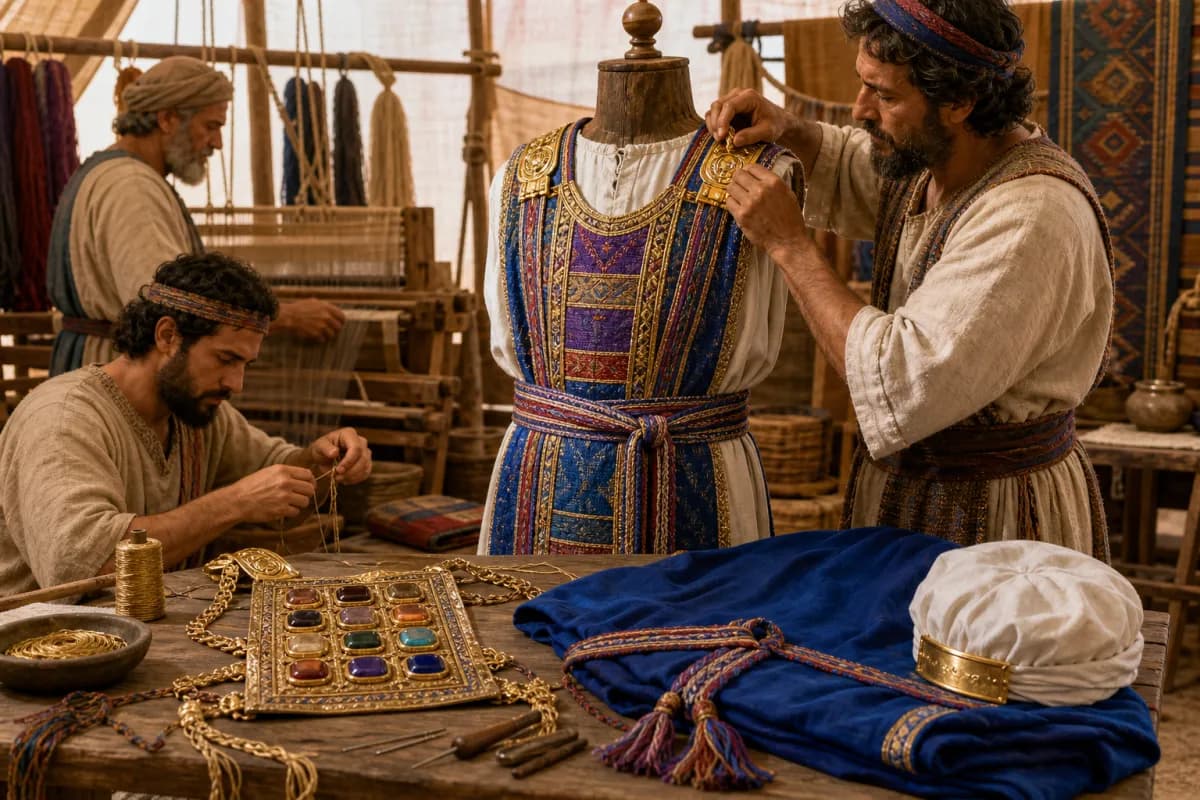
Exodus 39:1–31 records the making of Aaron’s holy garments, including the ephod, breastpiece, robe, turban, and gold plate inscribed “Holy to the LORD.” The repeated obedience matters because priests represent the people before a holy God only through God’s appointed provision. Jesus is the final holy High Priest who brings His people to God and sends them to live as a consecrated witness in the world.
- In this study
- 31 verses · 5 movements
Exodus 39
39:1Of the blue, purple, and scarlet, they made finely worked garments for ministering in the holy place, and made the holy garments for Aaron, as the LORD commanded Moses.
39:2He made the ephod of gold, blue, purple, scarlet, and fine twined linen.
39:3They beat the gold into thin plates, and cut it into wires, to work it in with the blue, the purple, the scarlet, and the fine linen, the work of the skillful workman.
39:4They made shoulder straps for it, joined together. It was joined together at the two ends.
39:5The skillfully woven band that was on it, with which to fasten it on, was of the same piece, like its work: of gold, of blue, purple, scarlet, and fine twined linen, as the LORD commanded Moses.
39:6They worked the onyx stones, enclosed in settings of gold, engraved with the engravings of a signet, according to the names of the children of Israel.
39:7He put them on the shoulder straps of the ephod, to be stones of memorial for the children of Israel, as the LORD commanded Moses.
39:8He made the breastplate, the work of a skillful workman, like the work of the ephod: of gold, of blue, purple, scarlet, and fine twined linen.
39:9It was square. They made the breastplate double. Its length was a span, and its width a span, being double.
39:10They set in it four rows of stones. A row of ruby, topaz, and beryl was the first row;
39:11and the second row, a turquoise, a sapphire, and an emerald;
39:12and the third row, a jacinth, an agate, and an amethyst;
39:13and the fourth row, a chrysolite, an onyx, and a jasper. They were enclosed in gold settings.
39:14The stones were according to the names of the children of Israel, twelve, according to their names; like the engravings of a signet, everyone according to his name, for the twelve tribes.
39:15They made on the breastplate chains like cords, of braided work of pure gold.
39:16They made two settings of gold, and two gold rings, and put the two rings on the two ends of the breastplate.
39:17They put the two braided chains of gold in the two rings at the ends of the breastplate.
39:18The other two ends of the two braided chains they put on the two settings, and put them on the shoulder straps of the ephod, in its front.
39:19They made two rings of gold, and put them on the two ends of the breastplate, on its edge, which was toward the side of the ephod inward.
39:20They made two more rings of gold, and put them on the two shoulder straps of the ephod underneath, in its front, close by its coupling, above the skillfully woven band of the ephod.
39:21They bound the breastplate by its rings to the rings of the ephod with a lace of blue, that it might be on the skillfully woven band of the ephod, and that the breastplate might not come loose from the ephod, as the LORD commanded Moses.
39:22He made the robe of the ephod of woven work, all of blue.
39:23The opening of the robe in the middle of it was like the opening of a coat of mail, with a binding around its opening, that it should not be torn.
39:24They made on the skirts of the robe pomegranates of blue, purple, scarlet, and twined linen.
39:25They made bells of pure gold, and put the bells between the pomegranates around the skirts of the robe, between the pomegranates;
39:26a bell and a pomegranate, a bell and a pomegranate, around the skirts of the robe, to minister in, as the LORD commanded Moses.
39:27They made the tunics of fine linen of woven work for Aaron and for his sons,
39:28the turban of fine linen, the linen headbands of fine linen, the linen trousers of fine twined linen,
39:29the sash of fine twined linen, blue, purple, and scarlet, the work of the embroiderer, as the LORD commanded Moses.
39:30They made the plate of the holy crown of pure gold, and wrote on it an inscription, like the engravings of a signet: “HOLY TO THE LORD”.
39:31They tied to it a lace of blue, to fasten it on the turban above, as the LORD commanded Moses.
CONTEXTUAL OVERVIEW
Exodus 39 returns to the priestly clothing previously commanded in chapters 28 and 29. The garments are not decorative clothing for a religious leader. They equip Aaron and his sons for holy service, visibly declaring that Israel needs representation and cleansing before the God who has chosen to dwell in its midst.
The chapter repeatedly says the work is done “as the LORD had commanded Moses.” That refrain is the burden of the construction account. After the golden calf, Israel does not improvise an image or invent a priesthood. It receives the pattern God gives for approaching Him.
HISTORICAL AND LITERARY CONTEXT
The paragraph follows the design instructions in Exodus 28. Its sequence begins with the ephod and breastpiece, moves through the robe and other garments, and ends with the gold plate on the turban. The materials—blue, purple, crimson yarns, fine linen, and gold—belong to sanctuary service and make the priest’s public role visibly distinct from ordinary dress.
The priest is neither a spiritual celebrity nor an autonomous mediator. His garments identify an office under God’s command, bearing Israel’s names and serving before the Lord. The Old Testament priesthood is temporary and anticipatory; it teaches Israel both that God provides a mediator and that human priests remain dependent on atonement and consecration.
SECTION-BY-SECTION ANALYSIS
- Names on the shoulders · Exodus 39:6The engraved tribal names show that the priest bears Israel before the Lord in representative service.
- Twelve stones · Exodus 39:14The breastpiece keeps the whole covenant people in view, not merely a favored portion of the camp.
- Holy to the LORD · Exodus 39:30The gold plate declares that priestly service belongs wholly to God and requires His consecration.
CHRIST IN THIS PASSAGE
Aaron’s garments do not mean that Jesus wears a literal ephod, and this passage does not require a symbol-by-symbol allegory. They establish the priestly pattern of representative holy service. Jesus fulfills that pattern as the sinless High Priest who does not merely bear names before God but gives Himself to bring His people near to the Father.
The inscription of holiness also points to a need Israel cannot meet by fabric and gold. Christ is holy in Himself and, through His saving work, consecrates those who belong to Him. His mission therefore creates a people set apart not for withdrawal from the world but for faithful witness, compassionate service, and proclamation of the One who reconciles sinners to God.
REFLECTION
You do not carry yourself into God’s presence by impressive religious clothing, performance, or usefulness. Jesus is the holy Mediator you need. He knows His people personally, bears their need, and brings them to the Father by grace. That truth dismantles both spiritual pride and the fear that you have been forgotten.
Let Christ’s care for His people shape your care for names rather than crowds. Pray this week for two people by name, and contact one of them with a concrete encouragement. As you do, speak naturally of the Savior who has not forgotten you and who calls His people to belong wholly to God.
Original Hebrew Word Study
Exodus 39:1
קֹדֶשׁ
qodesh · H6944
Usually translated: holy; belonging to God
Qodesh marks the garments as holy service garments. Their careful making reinforces that the priest’s work is not private religious expression; it belongs to the Lord and represents the people before Him.
Follow the Scripture trail
The Priestly Garments Are Made: Holy Service Before the Lord in the larger story
The connection: The garments teach that Israel needs holy representation before God. Jesus is the final High Priest who brings His people near through His saving work and sets them apart to make His mercy known.
Respond to the passage
Bring your fear of being forgotten or your habit of religious self-display to Jesus. Trust His priestly care, then bear one person’s name before God in prayer and take one concrete step to serve them.
- What do the tribal names on the shoulders and breastpiece communicate?
- Why is “Holy to the LORD” central to priestly clothing?
- How does Jesus fulfill priestly representation more fully than Aaron?
Prayer
Lord Jesus, thank You for bringing me to the Father as my holy High Priest. Keep me from trusting my performance, teach me to remember others in prayer, and set my life apart to display Your mercy in the world. Amen.