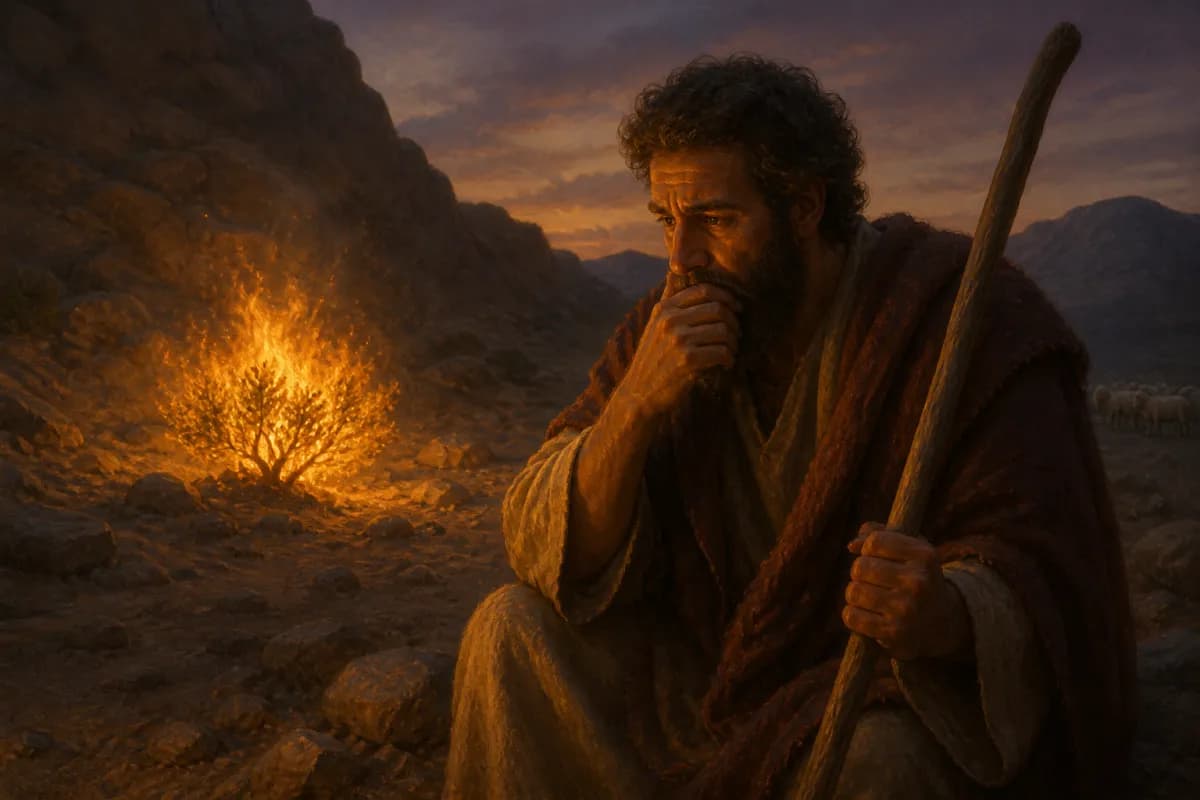
Passage Study
Moses’ Reluctance: The God Who Made the Mouth
Exodus 4:10–4:17
Exodus 4:10–17 exposes Moses’ fear of speaking before Pharaoh. The Lord answers by claiming authority over the human mouth and promising to teach Moses what to say. When Moses asks to be excused, God provides Aaron as a spokesperson while making clear that the message and authority remain His. The passage directs readers to Jesus, whose saving mission speaks God’s truth and equips His people for witness.
- In this study
- 8 verses · 5 movements
Exodus 4
4:10Moses said to the LORD, “O Lord, I am not eloquent, neither before now, nor since you have spoken to your servant; for I am slow of speech, and of a slow tongue.”
4:11The LORD said to him, “Who made man’s mouth? Or who makes one mute, or deaf, or seeing, or blind? Isn’t it I, the LORD?
4:12Now therefore go, and I will be with your mouth, and teach you what you shall speak.”
4:13Moses said, “Oh, Lord, please send someone else.”
4:14The LORD’s anger burned against Moses, and he said, “What about Aaron, your brother, the Levite? I know that he can speak well. Also, behold, he is coming out to meet you. When he sees you, he will be glad in his heart.
4:15You shall speak to him, and put the words in his mouth. I will be with your mouth, and with his mouth, and will teach you what you shall do.
4:16He will be your spokesman to the people. It will happen that he will be to you a mouth, and you will be to him as God.
4:17You shall take this rod in your hand, with which you shall do the signs.”
CONTEXTUAL OVERVIEW
After receiving God’s name, promise, and signs, Moses raises a final practical objection: he is “slow of speech and slow of tongue.” Whether this describes a lasting speech difficulty, lack of rhetorical confidence, or both, the passage does not diagnose it. It does show that Moses feels unfit for the public words his commission requires.
God answers Moses at the level of creation. The One who made human mouths also governs speech, sight, and hearing. That claim does not trivialize disability or struggle; it establishes that no human limitation places Moses outside the authority or help of the God who sends him.
HISTORICAL AND LITERARY CONTEXT
Moses’ objections form a sustained dialogue at the burning bush. They reveal a servant who has moved from honest uncertainty to a direct request that God choose someone else. The Lord’s anger names the seriousness of refusing a commission after such patient revelation, even as His mercy still provides a way forward.
Aaron’s appointment establishes a representative pattern for the coming conflict: Moses will receive God’s instruction and Aaron will speak it. The arrangement does not dilute Moses’ commission. It shows God accommodating weakness while retaining ownership of the message and mission.
Did you know?
Moses’ fearful description of his own speech is not the only biblical portrait of him. In Acts 7:22, Stephen describes Moses as educated in Egyptian wisdom and powerful in his words and deeds.
Why it matters: Reading both portraits helps us avoid reducing Moses’ whole life to his objection at the bush.
SECTION-BY-SECTION ANALYSIS
- The mouth · Exodus 4:16God’s response locates ability for witness in the Creator’s presence, not in a servant’s natural polish.
- The anger · Exodus 4:14Moses’ request for another messenger shows that fear can harden into refusal even after God has answered it.
- Aaron · Exodus 4:10God provides a brother to speak, demonstrating mercy without removing Moses’ responsibility to obey.
CHRIST IN THIS PASSAGE
Moses needs another person to assist his speech; Jesus is the eternal Word who perfectly reveals the Father. The contrast matters. Jesus’ saving mission does not rest on a hesitant messenger trying to master God’s message. He Himself is God’s definitive self-disclosure, and His words and works faithfully accomplish the Father’s will.
Jesus also equips ordinary disciples for witness. He does not promise effortless public speaking, but He promises the Spirit’s help when His followers testify. The church’s confidence belongs in Christ and His gospel, not in a performance standard that excludes people who feel weak or anxious.
REFLECTION
This passage gives permission to name real weakness before God. Moses is not condemned for saying he feels unable; the turning point is his request to avoid the call altogether. God’s answer invites dependence, practical help, and obedience rather than shame-filled self-reliance.
A church shaped by Jesus should make room for shared service like Moses and Aaron’s. Someone may need a partner, preparation, or a different role in order to serve faithfully. The gospel is still spoken by imperfect people, and its power belongs to the Christ who sends them.
Original Hebrew Word Study
Exodus 4:10
כָּבֵד
kaved · H3515
Usually translated: heavy or weighty
Moses describes his mouth and tongue as “heavy.” The word makes his felt inadequacy concrete, and the Lord answers by claiming authority over the very ability Moses thinks he lacks.
Follow the Scripture trail
Moses’ Reluctance: The God Who Made the Mouth in the larger story
The connection: God works through Moses’ weakness without confusing the servant with the message. Jesus fulfills the hope of divine speech as the Word made flesh, and He sends His people with the Spirit’s help to bear witness to His saving death and resurrection.
Respond to the passage
Tell Jesus honestly where fear of failure or speech has kept you from obedience. Receive practical help where it is needed, then take the next faithful step in witness, trusting that the power belongs to His gospel rather than your polish.
- What does God’s answer about making the mouth reveal about Moses’ fear?
- Why is Aaron’s help an act of mercy without becoming permission for Moses to abandon his call?
- How does Jesus as the Word made flesh change the basis of Christian witness?
Prayer
Lord Jesus, You perfectly reveal the Father and graciously use weak servants. Forgive my excuses and fear. Give me humble dependence, wise companions, and courage to speak Your gospel when the moment calls for it. Amen.