Passage Study
Moses Returns to Egypt: The Lord Claims His Son
Exodus 4:18–4:23
Exodus 4:18–23 sends Moses from Midian back to Egypt after the death of those seeking his life. God calls Israel His firstborn son and commands Pharaoh to release him for worship, while warning of the deadly cost of Pharaoh’s refusal. The passage frames the exodus as God reclaiming a people for Himself and prepares for Jesus, the faithful Son who delivers His people from slavery for the Father’s service.
- In this study
- 6 verses · 5 movements
Exodus 4
4:18Moses went and returned to Jethro his father-in-law, and said to him, “Please let me go and return to my brothers who are in Egypt, and see whether they are still alive.” Jethro said to Moses, “Go in peace.”
4:19The LORD said to Moses in Midian, “Go, return into Egypt; for all the men who sought your life are dead.”
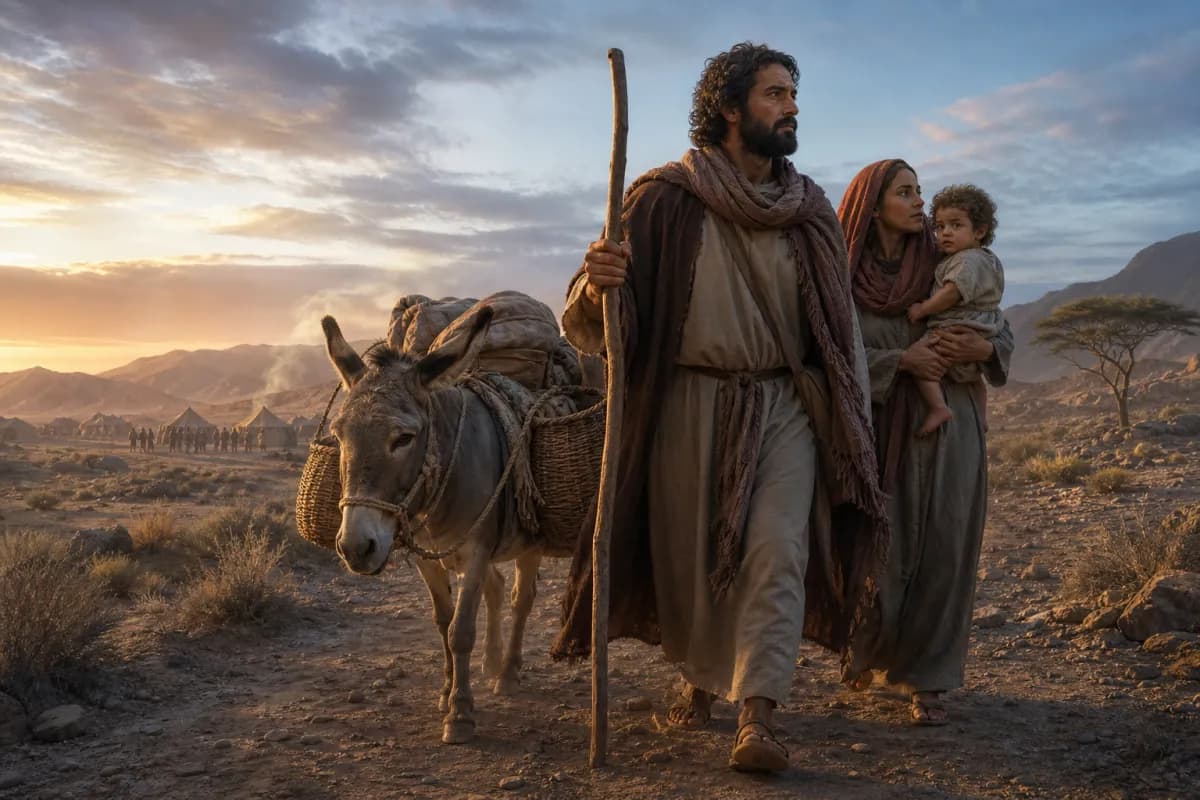
4:20Moses took his wife and his sons, and set them on a donkey, and he returned to the land of Egypt. Moses took God’s rod in his hand.
4:21The LORD said to Moses, “When you go back into Egypt, see that you do before Pharaoh all the wonders which I have put in your hand, but I will harden his heart and he will not let the people go.
4:22You shall tell Pharaoh, ‘The LORD says, Israel is my son, my firstborn,
4:23and I have said to you, “Let my son go, that he may serve me;” and you have refused to let him go. Behold, I will kill your firstborn son.’”
CONTEXTUAL OVERVIEW
Moses does not rush back to Egypt as an independent hero. He returns with Jethro’s blessing, his family, and the staff God has given him. The Lord’s word that the men seeking Moses’ life are dead removes an immediate danger and places the return under divine direction.
The heart of the passage is God’s word to Pharaoh: “Israel is my firstborn son.” Pharaoh has enslaved a people who belong to the Lord. The requested release is for worship, which shows that the exodus concerns a change of master and allegiance, not merely a change of location.
HISTORICAL AND LITERARY CONTEXT
This paragraph stands between Moses’ commissioning at Horeb and his arrival in Egypt. It anticipates the final plague before the first confrontation with Pharaoh, giving the reader an interpretive key for the conflict: Pharaoh’s treatment of Israel will return upon his own household.
The statement that God will harden Pharaoh’s heart must be read alongside Pharaoh’s own repeated refusal in the narrative. Exodus presents divine sovereignty and Pharaoh’s accountable rebellion together. The text does not treat Pharaoh as an innocent victim; it reveals judgment against a ruler determined to keep God’s son in bondage.
SECTION-BY-SECTION ANALYSIS
- The return · Exodus 4:19Moses returns at God’s command after years in Midian, carrying the staff that marks his dependence on God’s authority.
- The firstborn son · Exodus 4:23Israel’s identity is filial and covenantal: they belong to the Lord before they become a nation with land and law.
- The warning · Exodus 4:22The coming death of Egypt’s firstborn is announced as just judgment on Pharaoh’s refusal to release God’s son.
CHRIST IN THIS PASSAGE
Israel is called God’s son here in a corporate covenant sense. Matthew later applies the exodus language “Out of Egypt I have called my son” to Jesus, the faithful Son who relives Israel’s story without Israel’s rebellion. That is a direct canonical connection, not a claim that Exodus 4 alone gives every detail of Christ’s life.
Jesus’ saving mission brings people from slavery into the Father’s household. Unlike Pharaoh, He does not hold people through fear and death; He gives Himself to defeat death and make rebels into adopted children. The exodus demand to serve God reaches its fullest form in a redeemed people who belong to Christ and worship the Father.
REFLECTION
God’s claim, “Israel is my son,” speaks dignity over people whom empire has treated as disposable labor. Their identity is not created by Pharaoh’s quota or by their suffering. It is given by the God who knows them and acts to bring them into His service.
Jesus gives believers the same assurance in a fuller covenant reality: they are brought to the Father through the Son. That freedom changes what we serve. Christians resist masters that destroy life, practice worship that belongs to God, and invite others into the mercy of the Son who sets captives free.
Original Hebrew Word Study
Exodus 4:23
עָבַד
avad · H5647
Usually translated: to serve
Avad returns with a sharp contrast: Pharaoh keeps Israel in service to himself, while the Lord calls His son out to serve Him. Exodus is a contest over whom Israel will worship and obey.
Follow the Scripture trail
Moses Returns to Egypt: The Lord Claims His Son in the larger story
The connection: God confronts Pharaoh because Israel belongs to Him as His son and must be released for worship. Jesus, the faithful Son, fulfills this exodus-shaped mission by defeating sin and death and bringing people into the Father’s family for loving service.
Respond to the passage
Consider the masters that ask for your ultimate loyalty—fear, approval, money, resentment, or control. Bring them to Jesus. Receive again your identity as one welcomed by the Father through the Son, and choose one concrete act of worshipful obedience this week.
- Why does God call Israel His firstborn son before describing the plagues?
- How does the purpose of worship shape the meaning of freedom in Exodus?
- What does it mean for Jesus to fulfill Israel’s sonship without collapsing Israel and Christ into the same role?
Prayer
Father, thank You for claiming a people for Yourself and for sending Jesus, Your faithful Son, to bring me near. Free me from every false master, make my worship sincere, and teach me to live as Your beloved child in the world. Amen.