Passage Study
The Tabernacle Is Set Up: God Dwells Among a Redeemed People
Exodus 40:17–40:33
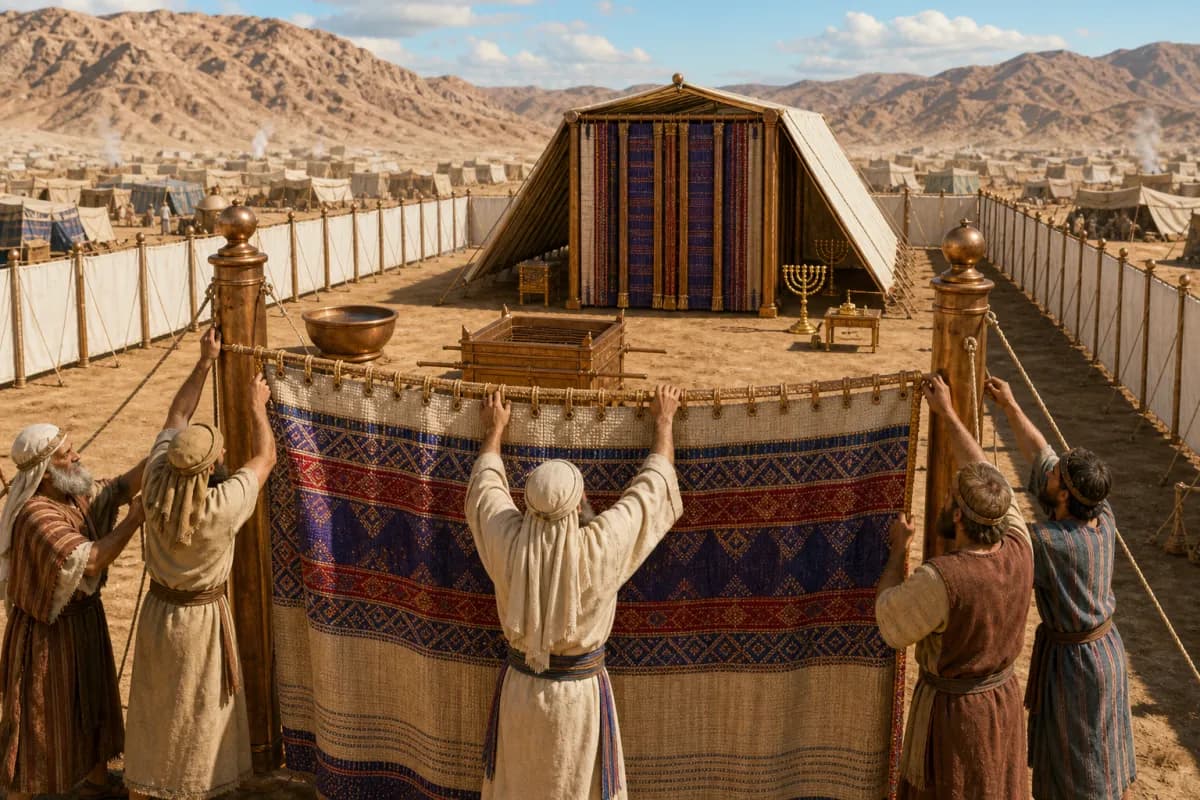
Exodus 40:17–33 records Moses raising the tabernacle on the first day of the first month, placing its furnishings in the commanded order, consecrating the court, and washing Aaron and his sons for service. The long instructions become a real dwelling in Israel’s camp. Jesus fulfills the sanctuary’s saving purpose by bringing people to God and making them a holy people for His mission.
- In this study
- 17 verses · 5 movements
Exodus 40
40:17In the first month in the second year, on the first day of the month, the tabernacle was raised up.
40:18Moses raised up the tabernacle, and laid its sockets, and set up its boards, and put in its bars, and raised up its pillars.
40:19He spread the covering over the tent, and put the roof of the tabernacle above on it, as the LORD commanded Moses.
40:20He took and put the covenant into the ark, and set the poles on the ark, and put the mercy seat above on the ark.
40:21He brought the ark into the tabernacle, and set up the veil of the screen, and screened the ark of the covenant, as the LORD commanded Moses.
40:22He put the table in the Tent of Meeting, on the north side of the tabernacle, outside of the veil.
40:23He set the bread in order on it before the LORD, as the LORD commanded Moses.
40:24He put the lamp stand in the Tent of Meeting, opposite the table, on the south side of the tabernacle.
40:25He lit the lamps before the LORD, as the LORD commanded Moses.
40:26He put the golden altar in the Tent of Meeting before the veil;
40:27and he burned incense of sweet spices on it, as the LORD commanded Moses.
40:28He put up the screen of the door to the tabernacle.
40:29He set the altar of burnt offering at the door of the tabernacle of the Tent of Meeting, and offered on it the burnt offering and the meal offering, as the LORD commanded Moses.
40:30He set the basin between the Tent of Meeting and the altar, and put water therein, with which to wash.
40:31Moses, Aaron, and his sons washed their hands and their feet there.
40:32When they went into the Tent of Meeting, and when they came near to the altar, they washed, as the LORD commanded Moses.
40:33He raised up the court around the tabernacle and the altar, and set up the screen of the gate of the court. So Moses finished the work.
CONTEXTUAL OVERVIEW
The tabernacle has been designed, supplied, and crafted; now Exodus narrates the day it is raised. Moses does not improvise a spiritual ceremony. He sets each object where the Lord commanded: testimony in the ark, veil before the ark, bread on the table, lamps before the Lord, incense on the altar, sacrifice at the bronze altar, and water in the basin.
The repeated phrase “as the LORD had commanded Moses” gives the passage its rhythm. Israel’s worshiping center is not the achievement of craftsmanship alone. It becomes a faithful dwelling because the people receive God’s pattern and obey it, awaiting the glory that will reveal whether the Lord truly takes up residence among them.
HISTORICAL AND LITERARY CONTEXT
Exodus 40 completes the tabernacle narrative that began with the sanctuary instructions in chapter 25. The setup occurs on the first day of the first month in the second year after the exodus, marking a new beginning for a people now ordered around the Lord’s covenant presence. The first month also recalls Passover, so Israel’s redemption and worship belong together.
This passage is not a fresh list of furnishings; it is a placement account. The order moves from the inner sanctuary outward and from furnishing to service. Its precision matters especially after the golden calf, where Israel attempted worship on its own terms. Here Moses’ obedience contrasts self-made religion with trustful response to God’s word.
SECTION-BY-SECTION ANALYSIS
- The testimony centered · Exodus 40:20The tablets are placed in the ark, locating Israel’s worship around the covenant word God has spoken.
- A finished order · Exodus 40:23Each furnishing is placed for its appointed service, so worship is embodied rather than left to individual invention.
- Cleansed service · Exodus 40:25The basin and priestly washing show that those who minister before God need the cleansing He requires.
CHRIST IN THIS PASSAGE
The assembled tabernacle gathers together sacrifice, cleansing, priesthood, word, light, bread, and God’s presence. Exodus does not say that each object has a one-to-one prediction of Jesus, but the sanctuary as a whole teaches that sinners need God’s provision to live before Him. Jesus fulfills that saving purpose as the final priest and sacrifice who brings His people to the Father.
In Christ, God does not merely arrange holy furniture among His people; He makes His dwelling with them and cleanses them for service. His mission forms a church that is holy not by self-made ritual but by His grace, then sends that people to embody His welcome, truth, and mercy before a world that needs reconciliation.
REFLECTION
The repetition of obedience can feel less dramatic than miracles, but it answers a deep temptation: to make worship fit our preferences. Moses finishes the work by doing what God has said, trusting that God’s presence—not human creativity—will give the sanctuary its meaning.
Ask Jesus where you have substituted spiritual habit or personal taste for listening obedience. Choose one concrete act that puts His word at the center: reconcile with someone, join the gathered church, confess a sin, or serve in a way that costs you comfort. Let your obedience point beyond itself to the Savior who makes people holy by grace.
Original Hebrew Word Study
Exodus 40:17
קוּם
qum · H6965
Usually translated: to rise, stand, or set up
Qum means to rise or stand. The tabernacle is raised at the appointed time, marking the transition from God’s instructions about dwelling with Israel to the visible reality of that dwelling in their camp.
Follow the Scripture trail
The Tabernacle Is Set Up: God Dwells Among a Redeemed People in the larger story
The connection: The completed tabernacle makes God’s appointed way of dwelling with Israel visible in sacrifice, cleansing, worship, and covenant word. Jesus fulfills this saving purpose by bringing His people to the Father and sending them as a holy community of witness.
Respond to the passage
Ask Christ where your worship has become preference-driven rather than word-shaped. Take one obedient action this week that centers His grace and serves another person in His name.
- Why does Exodus carefully record the placement of each furnishing?
- How does the sequence from ark to altar to basin shape the meaning of approach to God?
- What is the difference between self-made holiness and holiness received through Christ?
Prayer
Lord Jesus, thank You for bringing me into the Father’s presence by Your sacrifice and cleansing grace. Order my worship and daily choices around Your word, and make my life a holy, humble witness to Your reconciling mission. Amen.