Passage Study
Pharaoh Rejects the Lord: A Contest of Allegiance
Exodus 5:1–5:9
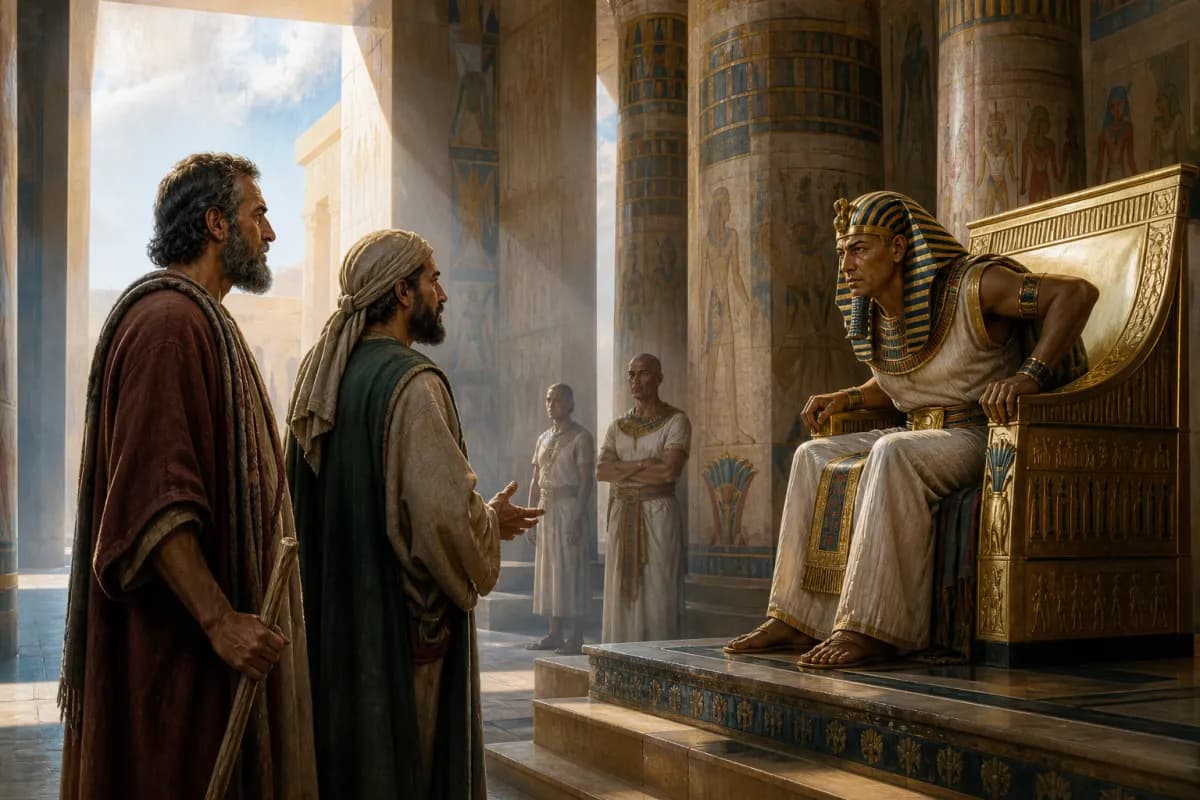
Exodus 5:1–9 opens the conflict between Pharaoh and the Lord with a direct demand for Israel’s worship. Pharaoh refuses to recognize the Lord and responds by tightening Israel’s labor. The passage exposes the arrogance of every power that claims ultimate authority and directs readers to Jesus, whose saving kingship frees people from slavery to serve God.
- In this study
- 9 verses · 5 movements
Exodus 5
5:1Afterward Moses and Aaron came, and said to Pharaoh, “This is what the LORD, the God of Israel, says, ‘Let my people go, that they may hold a feast to me in the wilderness.’”
5:2Pharaoh said, “Who is the LORD, that I should listen to his voice to let Israel go? I don’t know the LORD, and moreover I will not let Israel go.”
5:3They said, “The God of the Hebrews has met with us. Please let us go three days’ journey into the wilderness, and sacrifice to the LORD, our God, lest he fall on us with pestilence, or with the sword.”
5:4The king of Egypt said to them, “Why do you, Moses and Aaron, take the people from their work? Get back to your burdens!”
5:5Pharaoh said, “Behold, the people of the land are now many, and you make them rest from their burdens.”
5:6The same day Pharaoh commanded the taskmasters of the people and their officers, saying,
5:7“You shall no longer give the people straw to make brick, as before. Let them go and gather straw for themselves.
5:8You shall require from them the number of the bricks which they made before. You shall not diminish anything of it, for they are idle. Therefore they cry, saying, ‘Let’s go and sacrifice to our God.’
5:9Let heavier work be laid on the men, that they may labor in it. Don’t let them pay any attention to lying words.”
CONTEXTUAL OVERVIEW
Moses and Aaron’s first speech to Pharaoh is short and uncompromising. Israel’s God commands His people to hold a festival for Him in the wilderness. The request does not frame Israel as a workforce asking for better terms; it names the deeper issue of Exodus—whether Israel belongs to Pharaoh’s system of forced service or to the Lord who redeemed them.
Pharaoh’s answer gives the conflict its sharpest form: he does not know the Lord, will not obey His voice, and will not let Israel go. His refusal is not an innocent lack of information. It is a king’s rejection of a rival claim to authority, and he immediately uses economic pressure to make God’s word seem impractical.
HISTORICAL AND LITERARY CONTEXT
The passage turns the private acceptance of the elders into a public confrontation at the center of Egyptian power. Ancient kings commonly portrayed themselves as guardians of order and providers for the land; Exodus counters that political story by placing Pharaoh under the command of Israel’s God.
The proposed wilderness journey is connected to sacrifice and worship. Moses and Aaron warn that refusal to seek the Lord could bring judgment on Israel, not because they manipulate Pharaoh with a threat but because covenant worship is a matter of life before the holy God. Pharaoh treats the call to worship as laziness because it threatens the labor system he controls.
SECTION-BY-SECTION ANALYSIS
- The Lord commands · Exodus 5:1Israel’s freedom begins with God’s claim that they are to worship Him.
- Pharaoh refuses · Exodus 5:2His claimed ignorance is active rebellion against a Lord he refuses to acknowledge.
- Labor intensifies · Exodus 5:9Pharaoh uses exhaustion to silence hope and keep the people from listening to God.
CHRIST IN THIS PASSAGE
Pharaoh’s question—“Who is the Lord?”—is answered across Exodus by God’s acts of judgment and rescue. In the wider canon, Jesus reveals the Father’s authority in a still fuller way. His death and resurrection confront sin, death, and the devil, the enslaving powers that keep people unable to free themselves for God’s worship.
Jesus does not lead a rebellion for worldly domination. He gives Himself as the King who serves and ransoms many, then calls those He rescues to worship the Father in spirit and truth. Pharaoh’s contempt for worship makes the gospel’s purpose plain: Christ saves people not merely from consequences, but for God Himself.
REFLECTION
Pharaoh’s method still has force. A life filled with demand, urgency, and exhaustion can make prayer, gathered worship, and attention to God’s word feel irresponsible. This passage calls that pressure what it can become: a rival lordship that claims the whole person and leaves no space for God.
Jesus meets weary people with real authority and real rest. Following Him may expose conflicts in the systems and habits that shape us, but His yoke is good because He gives Himself for His people. His church must resist treating human worth as output and must invite weary neighbors into the freedom of knowing and serving God.
Original Hebrew Word Study
Exodus 5:2
יָדַע
yada · H3045
Usually translated: to know
Pharaoh’s “I do not know the Lord” is a refusal of recognition and allegiance. He is not claiming a lack of information; he is rejecting the Lord’s right to command him.
Follow the Scripture trail
Pharaoh Rejects the Lord: A Contest of Allegiance in the larger story
The connection: Pharaoh’s defiance makes Exodus a contest over worship and allegiance. Jesus completes God’s saving mission by rescuing sinners from deeper slavery and bringing them into His kingdom to know, love, and serve the Father.
Respond to the passage
Name the pressure that keeps you too exhausted to hear God’s word. Bring it to Jesus, whose authority does not crush His people. Ask Him to reorder your life around worship, truth, and love for the people whose burdens you may be able to lighten.
- Why is Pharaoh’s refusal to “know” the Lord more than a lack of religious information?
- How does Pharaoh use increased labor to keep Israel from hearing God’s word?
- What forms of pressure in modern life make worship and attention to Jesus seem expendable?
Prayer
Lord Jesus, free me from the masters that promise security while draining my attention from God. Teach me to receive Your good yoke and to resist systems that treat people as tools. Make my worship steady and my service merciful. Amen.