Passage Study
God Restates His Covenant Promise: I Will Redeem You
Exodus 6:1–6:13
Exodus 6:1–13 answers Moses’ despair after Pharaoh has made Israel’s work worse. The Lord does not rebuke him with a new strategy; He declares His covenant name, remembers His promise to Abraham, and pledges to bring Israel out, redeem them, and make them His people. The passage prepares us to see Jesus as the Redeemer who brings sinners out of bondage and into the Father’s family.
- In this study
- 13 verses · 5 movements
Exodus 6
6:1The LORD said to Moses, “Now you shall see what I will do to Pharaoh, for by a strong hand he shall let them go, and by a strong hand he shall drive them out of his land.”
6:2God spoke to Moses, and said to him, “I am the LORD.
6:3I appeared to Abraham, to Isaac, and to Jacob, as God Almighty; but by my name the LORD I was not known to them.
6:4I have also established my covenant with them, to give them the land of Canaan, the land of their travels, in which they lived as aliens.
6:5Moreover I have heard the groaning of the children of Israel, whom the Egyptians keep in bondage, and I have remembered my covenant.
6:6Therefore tell the children of Israel, ‘I am the LORD, and I will bring you out from under the burdens of the Egyptians, and I will rid you out of their bondage, and I will redeem you with an outstretched arm, and with great judgments.
6:7I will take you to myself for a people. I will be your God; and you shall know that I am the LORD your God, who brings you out from under the burdens of the Egyptians.
6:8I will bring you into the land which I swore to give to Abraham, to Isaac, and to Jacob; and I will give it to you for a heritage: I am the LORD.’”
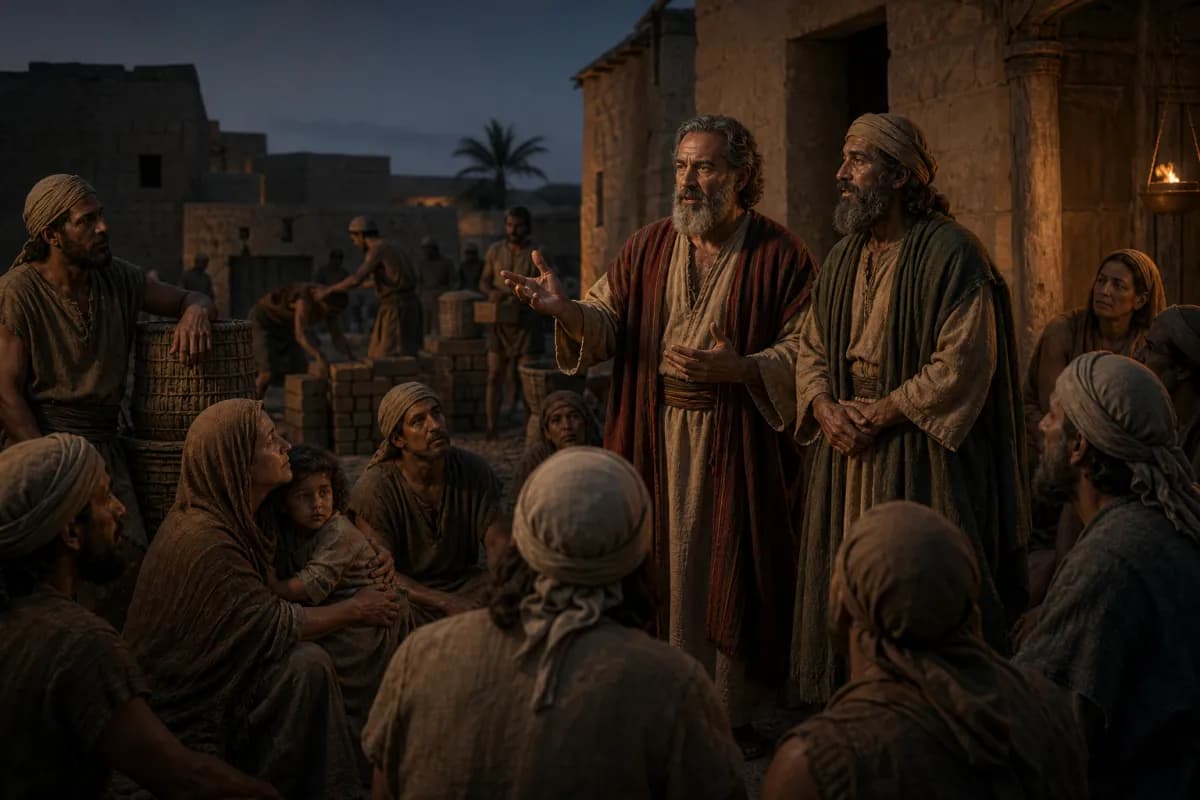
6:9Moses spoke so to the children of Israel, but they didn’t listen to Moses for anguish of spirit, and for cruel bondage.
6:10The LORD spoke to Moses, saying,
6:11“Go in, speak to Pharaoh king of Egypt, that he let the children of Israel go out of his land.”
6:12Moses spoke before the LORD, saying, “Behold, the children of Israel haven’t listened to me. How then shall Pharaoh listen to me, when I have uncircumcised lips?”
6:13The LORD spoke to Moses and to Aaron, and gave them a command to the children of Israel, and to Pharaoh king of Egypt, to bring the children of Israel out of the land of Egypt.
CONTEXTUAL OVERVIEW
Moses has just asked why the Lord sent him when Pharaoh answered the first request with harsher brick quotas. Exodus 6 opens in that disappointment. God’s answer begins with Pharaoh’s future defeat, but it reaches deeper: Israel’s hope rests on the Lord’s covenant character, not on the first visible result of Moses’ obedience.
The repeated first-person promises—“I will bring you out,” “I will free you,” “I will redeem you,” and “I will take you as my people”—turn the passage into a declaration of divine initiative. Israel’s rescue will be more than escape from forced labor. It will establish a people who know the Lord as their God.
HISTORICAL AND LITERARY CONTEXT
The passage resumes the name revelation from Exodus 3. God identifies Himself as the God who appeared to the patriarchs and who now acts on the covenant promise of land and descendants. The wording about being known by the name YHWH is debated; in this setting, the central point is that Israel will know the full weight of the Lord’s covenant faithfulness through His redeeming action.
Exodus places the promise beside Israel’s inability to receive it. Their “crushed spirit” and brutal labor do not make them faithless caricatures; they show how oppression can make even good news hard to hear. Moses’ renewed objection keeps the narrative honest about the human weakness inside God’s unfolding rescue.
SECTION-BY-SECTION ANALYSIS
- Remembered covenant · Exodus 6:5God’s response to Israel’s groaning flows from the promise He freely made to their fathers.
- Redeemed people · Exodus 6:7Deliverance has relational purpose: “I will take you as my people, and I will be your God.”
- Crushed spirit · Exodus 6:9The people’s inability to hear shows the real damage oppression does, while God continues His saving work.
CHRIST IN THIS PASSAGE
The Lord’s promise to redeem Israel with an outstretched arm establishes an exodus pattern that Jesus fulfills on a greater scale. The New Testament describes His death as redemption: He gives Himself to free people from sin’s guilt and slavery, not merely to improve their circumstances. The historical exodus remains Israel’s own deliverance, while it also gives the church language for the saving work of Christ.
Jesus’ mission carries the promise of Exodus 6 to its deepest goal. Through His blood He brings those who trust Him into God’s household, where they know the Father as their God. This does not erase Israel’s covenant story; it displays the faithful God’s purpose to create a redeemed people who belong to Him.
REFLECTION
A worsening situation after obedience can make God’s promises sound distant. Exodus 6 gives permission to name that pain without concluding that God has abandoned His word. He answers Moses by recalling who He is and what He has pledged to do.
Jesus receives people whose spirits are worn down. His gospel is not a demand to manufacture optimism before coming near; it is news that He has acted to redeem. The church can carry that news patiently to burdened people, serving their real needs while holding out the durable hope of belonging to God.
Original Hebrew Word Study
Exodus 6:6
גָּאַל
gaal · H1350
Usually translated: to redeem as a kinsman-redeemer
Gaal is rescue language shaped by family obligation and the restoration of what has been lost. The Lord does not promise a distant intervention; He claims Israel as His own and acts to bring them out.
Follow the Scripture trail
God Restates His Covenant Promise: I Will Redeem You in the larger story
The connection: Exodus 6 announces that God’s covenant purpose is to redeem enslaved people and make them His own. Jesus carries that saving mission to its fullness by giving Himself to free sinners from sin and bring them into the Father’s household.
Respond to the passage
When hardship makes God’s promises difficult to hear, bring the crushed place honestly to Jesus. Receive His redemption as a gift, and let His promise that you belong to God steady one concrete act of faithful love this week.
- Why does the Lord answer Moses’ disappointment by recalling His covenant rather than by explaining every delay?
- What do the promises to bring out, redeem, and take Israel as God’s people reveal about the goal of salvation?
- How can Jesus’ redemption meet someone whose spirit has been worn down by suffering or failure?
Prayer
Faithful God, when my heart is crushed, remind me of Your covenant mercy. Thank You for Jesus, who gave Himself to redeem and make me Yours. Strengthen me to trust Your word, receive Your grace, and serve burdened people with patient hope. Amen.