Passage Study
Aaron’s Staff Before Pharaoh: The Lord’s Sign in the Royal Court
Exodus 7:1–7:13
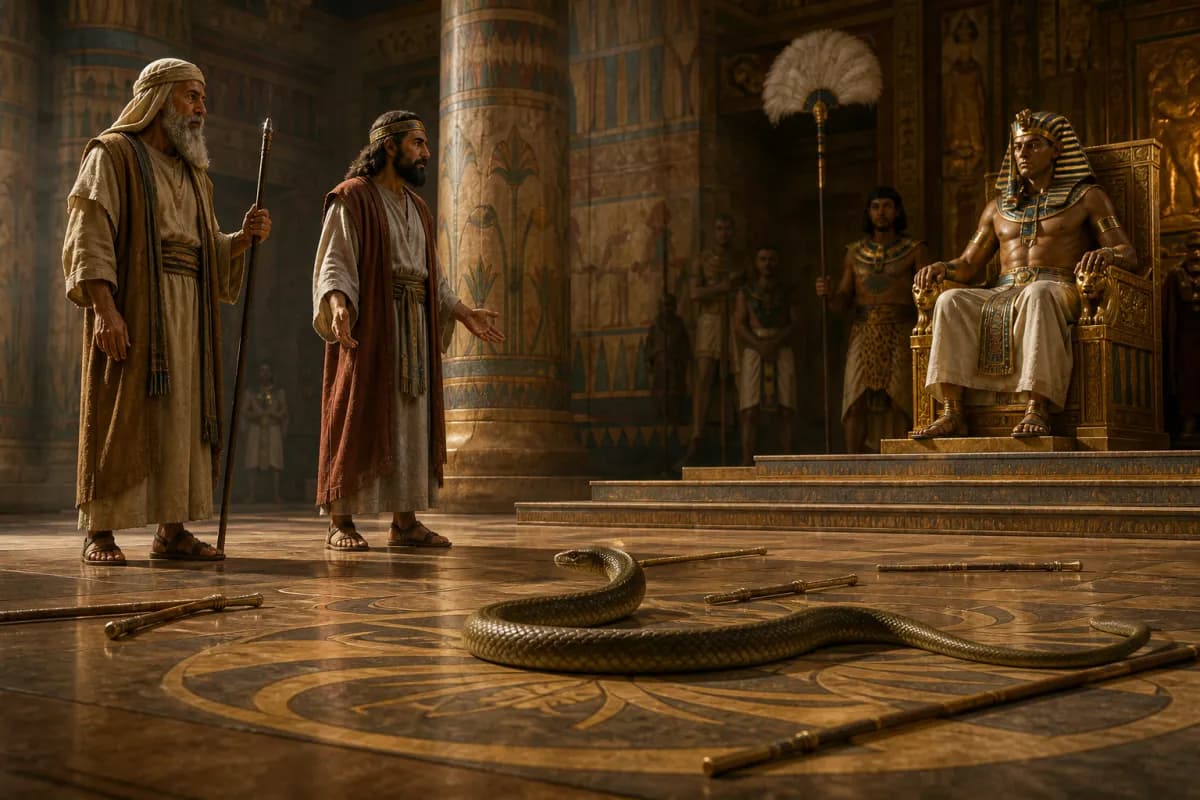
Exodus 7:8–13 brings Moses and Aaron before Pharaoh with the sign God appointed: Aaron’s staff becomes a serpent, and his staff swallows the staffs of Egypt’s magicians. Pharaoh’s court can imitate the outer wonder, but it cannot overcome the Lord’s authority. The scene begins the public exposure of Egypt’s false security and points to Jesus, whose resurrection triumphs over the powers that enslave humanity.
- In this study
- 13 verses · 5 movements
Exodus 7
7:1The LORD said to Moses, “Behold, I have made you as God to Pharaoh; and Aaron your brother shall be your prophet.
7:2You shall speak all that I command you; and Aaron your brother shall speak to Pharaoh, that he let the children of Israel go out of his land.
7:3I will harden Pharaoh’s heart, and multiply my signs and my wonders in the land of Egypt.
7:4But Pharaoh will not listen to you, so I will lay my hand on Egypt, and bring out my armies, my people the children of Israel, out of the land of Egypt by great judgments.
7:5The Egyptians shall know that I am the LORD when I stretch out my hand on Egypt, and bring the children of Israel out from among them.”
7:6Moses and Aaron did so. As the LORD commanded them, so they did.
7:7Moses was eighty years old, and Aaron eighty-three years old, when they spoke to Pharaoh.
7:8The LORD spoke to Moses and to Aaron, saying,
7:9“When Pharaoh speaks to you, saying, ‘Perform a miracle!’ then you shall tell Aaron, ‘Take your rod, and cast it down before Pharaoh, and it will become a serpent.’”
7:10Moses and Aaron went in to Pharaoh, and they did so, as the LORD had commanded. Aaron cast down his rod before Pharaoh and before his servants, and it became a serpent.
7:11Then Pharaoh also called for the wise men and the sorcerers. They also, the magicians of Egypt, did the same thing with their enchantments.
7:12For they each cast down their rods, and they became serpents; but Aaron’s rod swallowed up their rods.
7:13Pharaoh’s heart was hardened, and he didn’t listen to them, as the LORD had spoken.
CONTEXTUAL OVERVIEW
The brothers now stand in the setting Moses feared: Pharaoh’s court. God has anticipated Pharaoh’s demand for proof and gives a sign with Aaron’s staff. The sign is not entertainment for an interested ruler; it is a public confrontation over whose word and power will govern Israel’s future.
Egypt’s sages and magicians answer with a similar act. Exodus does not explain every means by which they do so, and it does not invite the reader to speculate beyond the text. The decisive event is visible: Aaron’s staff swallows theirs, demonstrating that Egypt’s counter-signs cannot rival the authority of Israel’s God.
HISTORICAL AND LITERARY CONTEXT
Royal courts in the ancient world included advisers who practiced forms of divination and ritual expertise. Exodus names them in order to show that Pharaoh does not meet Moses and Aaron alone; he brings the religious resources of his kingdom into the conflict. The coming plagues will continue this theme until Egypt’s experts admit that God’s power exceeds theirs.
The staff sign connects back to Exodus 4, where God first gave Moses the staff-to-serpent wonder as a witness for Israel. Before Pharaoh, the sign gains a new setting and a sharper result. The issue is no longer whether Moses has seen the Lord, but whether Pharaoh will yield to the God who commands him to release Israel.
SECTION-BY-SECTION ANALYSIS
- A commanded sign · Exodus 7:6The staff’s transformation comes from God’s instruction, so attention belongs to the Lord rather than to Aaron’s ability.
- A swallowed challenge · Exodus 7:12Aaron’s staff consuming the others publicly declares the superiority of the Lord over Egypt’s religious claims.
- A hardened heart · Exodus 7:13Pharaoh sees the sign but refuses the God whose command it confirms.
CHRIST IN THIS PASSAGE
Aaron’s staff is not a direct symbol that predicts every detail of Christ’s work. Its enduring canonical pattern is the Lord’s victory over powers that appear formidable and hold people in bondage. Jesus confronts evil not with a display meant to impress a court, but through obedient suffering, death, and resurrection.
The cross can look weak beside the spectacle of earthly power, yet the New Testament proclaims that Christ disarmed the rulers and authorities through it. His resurrection proves that sin, death, and the devil do not have final authority. That victory grounds the church’s mission of announcing freedom in Christ rather than trusting religious display or human technique.
REFLECTION
Pharaoh’s court teaches caution about equating spiritual appearance with truth. An impressive claim, a confident voice, or an unusual experience is not self-authenticating. The question is whether it accords with the Lord who has made Himself known and calls people to submit to His word.
Jesus does not ask His followers to win people by spectacle. He calls them to live under His authority, tell the truth about His cross and resurrection, and trust His victory when opposition appears strong. His people can resist fear because the powers they face are not ultimate.
Original Hebrew Word Study
Exodus 7:9
תַּנִּין
tannin · H8577
Usually translated: serpent or great creature
Tannin can name a serpent or a large, fearsome creature. Aaron’s staff becoming a tannin confronts Pharaoh in the setting of his own court with a sign of the Lord’s superior power.
Follow the Scripture trail
Aaron’s Staff Before Pharaoh: The Lord’s Sign in the Royal Court in the larger story
The connection: Aaron’s staff swallowing Egypt’s staffs opens the exodus conflict by declaring the Lord’s unrivaled authority over the powers that hold Israel. Jesus fulfills the greater rescue by defeating sin, death, and the devil through His cross and resurrection, then sending His people to announce His freedom.
Respond to the passage
Bring the power that seems most intimidating in your life under the authority of Jesus. Test spiritual claims by His word, refuse fear-driven compromise, and speak of His cross and resurrection with quiet confidence.
- Why does the swallowing of the Egyptian staffs matter more than the fact that the magicians can imitate the sign?
- What does Pharaoh’s refusal after seeing the sign reveal about the danger of a hardened heart?
- How does Christ’s victory at the cross reshape the way believers face powers that seem stronger than they are?
Prayer
Lord Jesus, You are greater than every power that enslaves and frightens. Keep me from being deceived by appearances or hardened against Your word. Make me faithful in Your mission, confident in Your cross, and steady in the hope of Your resurrection. Amen.