Passage Study
Water Turned to Blood: The Lord Judges Egypt’s Source of Life
Exodus 7:14–7:25
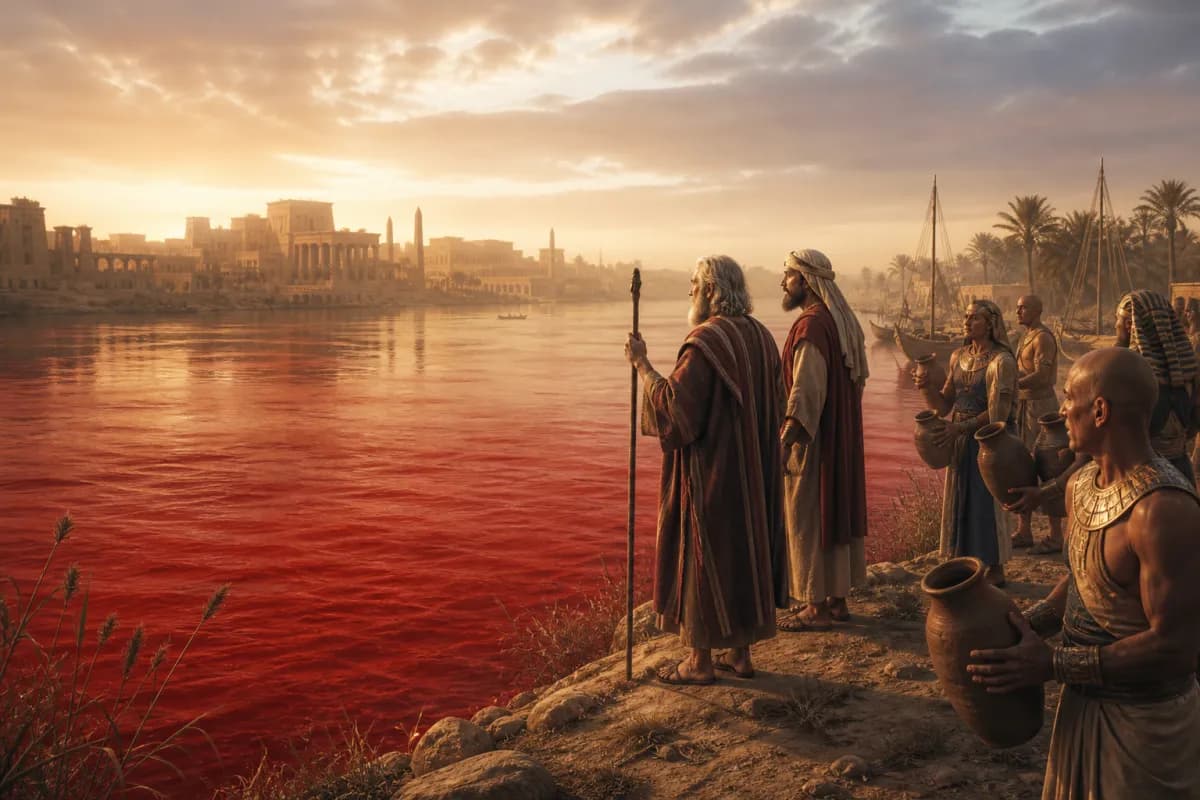
Exodus 7:14–25 begins the plagues by turning the Nile and Egypt’s stored water to blood. The river that sustained Egypt becomes undrinkable, while Pharaoh’s heart remains hard and his magicians only duplicate the sign. God judges the kingdom that used its waters in Israel’s oppression and makes known that He alone is Lord; the passage directs us to Jesus, whose saving blood brings true cleansing and life.
- In this study
- 12 verses · 5 movements
Exodus 7
7:14The LORD said to Moses, “Pharaoh’s heart is stubborn. He refuses to let the people go.
7:15Go to Pharaoh in the morning. Behold, he is going out to the water. You shall stand by the river’s bank to meet him. You shall take the rod which was turned to a serpent in your hand.
7:16You shall tell him, ‘The LORD, the God of the Hebrews, has sent me to you, saying, “Let my people go, that they may serve me in the wilderness. Behold, until now you haven’t listened.”
7:17The LORD says, “In this you shall know that I am the LORD. Behold: I will strike with the rod that is in my hand on the waters which are in the river, and they shall be turned to blood.
7:18The fish that are in the river will die and the river will become foul. The Egyptians will loathe to drink water from the river.”’”
7:19The LORD said to Moses, “Tell Aaron, ‘Take your rod, and stretch out your hand over the waters of Egypt, over their rivers, over their streams, and over their pools, and over all their ponds of water, that they may become blood. There will be blood throughout all the land of Egypt, both in vessels of wood and in vessels of stone.’”
7:20Moses and Aaron did so, as the LORD commanded; and he lifted up the rod, and struck the waters that were in the river, in the sight of Pharaoh, and in the sight of his servants; and all the waters that were in the river were turned to blood.
7:21The fish that were in the river died. The river became foul. The Egyptians couldn’t drink water from the river. The blood was throughout all the land of Egypt.
7:22The magicians of Egypt did the same thing with their enchantments. So Pharaoh’s heart was hardened, and he didn’t listen to them, as the LORD had spoken.
7:23Pharaoh turned and went into his house, and he didn’t even take this to heart.
7:24All the Egyptians dug around the river for water to drink; for they couldn’t drink the river water.
7:25Seven days were fulfilled, after the LORD had struck the river.
CONTEXTUAL OVERVIEW
The first plague strikes Egypt where its daily life depends most visibly: the Nile. Moses meets Pharaoh at the river, likely as the king goes out to it, and repeats the demand to let Israel go. Pharaoh has treated the Lord’s command as disposable; the water that nourishes Egypt will now testify that it belongs to Israel’s God.
The plague also carries moral memory. Pharaoh’s earlier policy had ordered Hebrew sons thrown into the Nile. Exodus does not explicitly explain the blood as a one-to-one repayment, but the connection is hard to miss: the river enlisted in Israel’s death becomes the site where the Lord exposes Egypt’s guilt and helplessness.
HISTORICAL AND LITERARY CONTEXT
The Nile’s annual waters sustained Egyptian agriculture, travel, and settlement. Exodus therefore begins the judgment sequence by showing that Pharaoh’s kingdom cannot control the source it depends upon. The passage makes a theological claim about the Lord’s authority over Egypt’s land and life; it does not require readers to reconstruct the event as an ordinary natural disaster.
The language expands from the Nile to canals, pools, ponds, and water held in wooden and stone containers. The judgment reaches beyond a single stretch of river. Egypt’s magicians can make water become blood, but their imitation cannot provide clean water or relieve the people, revealing the poverty of counterfeit power.
SECTION-BY-SECTION ANALYSIS
- The Nile struck · Exodus 7:20The river that undergirds Egypt’s life is shown to be under the command of the Lord.
- Water everywhere · Exodus 7:19The judgment reaches canals, pools, and stored water, leaving ordinary life without its basic supply.
- Imitation without rescue · Exodus 7:21The magicians can intensify the sign but cannot give Egypt the water it needs.
CHRIST IN THIS PASSAGE
The blood in Egypt’s water is a sign of judgment and death; it should not be confused with the saving blood of Jesus. The contrast is important. Exodus exposes a kingdom’s guilt and the inability of its gods to give life, while Christ willingly sheds His blood to cleanse guilty people and reconcile them to God.
Jesus also speaks of living water for those who come to Him. His saving mission meets the thirst this plague dramatizes: people cannot manufacture life from the systems they trust, but He gives the Spirit and brings them to the Father. The gospel therefore announces both God’s holy judgment and His merciful provision of cleansing in Christ.
REFLECTION
The Nile plague asks where we look for life apart from God: security, resources, public power, competence, or a system that seems permanent. Good gifts become dangerous masters when they are treated as self-sustaining. God’s judgment reveals the false refuge so that people may turn to the One who truly gives life.
Jesus invites thirsty people to come to Him without pretending they can purify themselves. His blood does what Pharaoh’s magicians cannot do: it deals with actual guilt and opens a living relationship with God. His church shares that message with humility, warning against false securities and offering the water of life freely.
Original Hebrew Word Study
Exodus 7:17
דָּם
dam · H1818
Usually translated: blood
Dam is blood, a sign of life. The Nile, Egypt’s source of life, is struck with its opposite image: the Lord can turn the empire’s apparent security into a witness of judgment.
Follow the Scripture trail
Water Turned to Blood: The Lord Judges Egypt’s Source of Life in the larger story
The connection: The Nile plague shows that the Lord judges the powers that enslave and cannot give life. Jesus fulfills God’s saving mission by bearing judgment for sinners, cleansing them by His blood, and giving the living water of the Spirit to all who come to Him.
Respond to the passage
Name the source of security you are tempted to treat as self-sustaining. Turn from that false refuge to Jesus, receive His cleansing, and offer His living-water promise to someone who is exhausted by trying to save themselves.
- Why is the Nile a fitting first target in God’s confrontation with Pharaoh?
- What does the magicians’ inability to provide water reveal about their power and Pharaoh’s response?
- Why must we distinguish the blood of Egypt’s judgment from the saving blood of Jesus?
Prayer
God of life, forgive me for trusting gifts and systems more than You. Thank You that Jesus’ blood cleanses real sin and that His Spirit gives living water. Turn my heart from false securities and make me a faithful witness to Your mercy. Amen.