Passage Study
The Plague of Frogs: A King Who Will Not Yield
Exodus 8:1–8:15
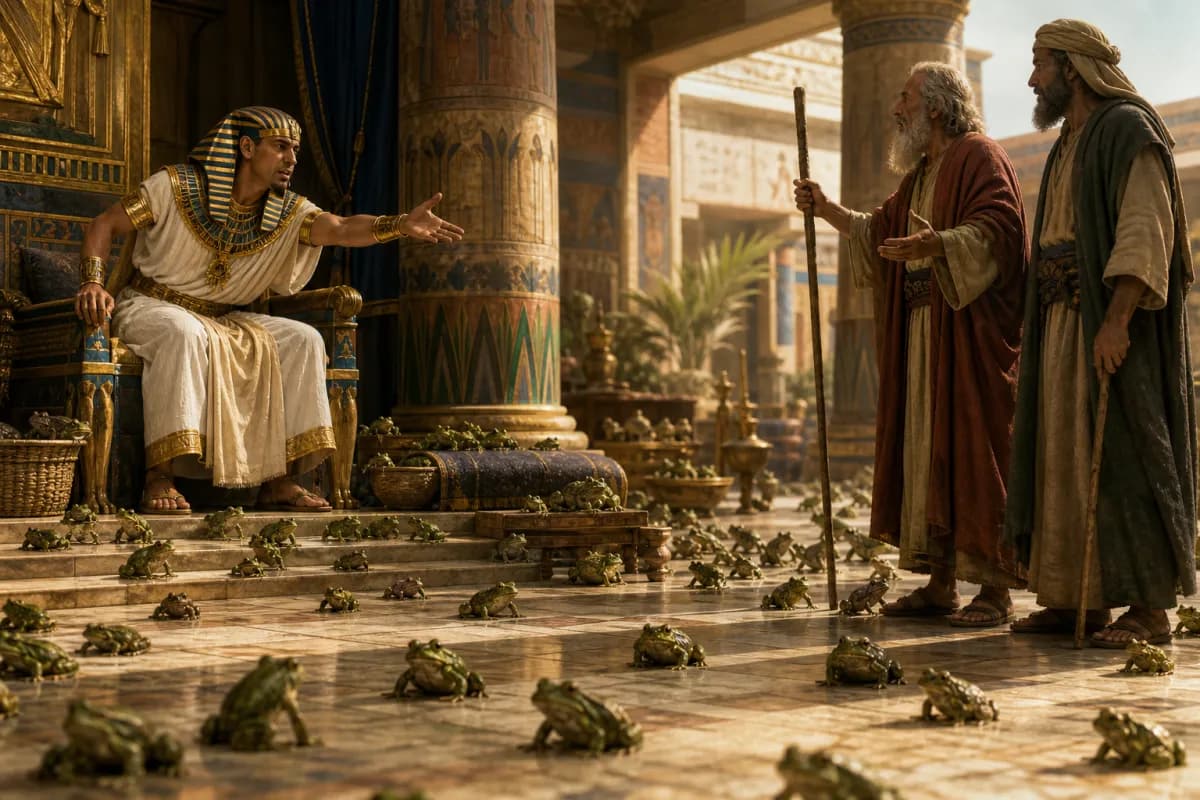
Exodus 8:1–15 shows the Lord sending frogs throughout Egypt after Pharaoh refuses to release Israel for worship. Pharaoh asks Moses to intercede, but hardens his heart once relief comes. The episode exposes repentance that wants pain removed without yielding the heart, and it directs readers to Jesus, who frees people from sin so that they may belong to and worship God.
- In this study
- 15 verses · 5 movements
Exodus 8
8:1The LORD spoke to Moses, “Go in to Pharaoh, and tell him, ‘This is what the LORD says, “Let my people go, that they may serve me.
8:2If you refuse to let them go, behold, I will plague all your borders with frogs.
8:3The river will swarm with frogs, which will go up and come into your house, and into your bedroom, and on your bed, and into the house of your servants, and on your people, and into your ovens, and into your kneading troughs.
8:4The frogs shall come up both on you, and on your people, and on all your servants.”’”
8:5The LORD said to Moses, “Tell Aaron, ‘Stretch out your hand with your rod over the rivers, over the streams, and over the pools, and cause frogs to come up on the land of Egypt.’”
8:6Aaron stretched out his hand over the waters of Egypt; and the frogs came up, and covered the land of Egypt.
8:7The magicians did the same thing with their enchantments, and brought up frogs on the land of Egypt.
8:8Then Pharaoh called for Moses and Aaron, and said, “Entreat the LORD, that he take away the frogs from me and from my people; and I will let the people go, that they may sacrifice to the LORD.”
8:9Moses said to Pharaoh, “I give you the honor of setting the time that I should pray for you, and for your servants, and for your people, that the frogs be destroyed from you and your houses, and remain in the river only.”
8:10Pharaoh said, “Tomorrow.” Moses said, “Let it be according to your word, that you may know that there is no one like the LORD our God.
8:11The frogs shall depart from you, and from your houses, and from your servants, and from your people. They shall remain in the river only.”
8:12Moses and Aaron went out from Pharaoh, and Moses cried to the LORD concerning the frogs which he had brought on Pharaoh.
8:13The LORD did according to the word of Moses, and the frogs died out of the houses, out of the courts, and out of the fields.
8:14They gathered them together in heaps, and the land stank.
8:15But when Pharaoh saw that there was a respite, he hardened his heart, and didn’t listen to them, as the LORD had spoken.
CONTEXTUAL OVERVIEW
The second plague begins with the same central demand heard before: Israel must be released to serve the Lord. The frogs are not a random inconvenience. They enter the places where Egyptian life is most intimate—bedrooms, kitchens, ovens, and food preparation—so that Pharaoh’s refusal becomes impossible to contain behind palace walls.
Pharaoh finally summons Moses and Aaron, not because he has embraced the Lord’s claim, but because he wants the frogs removed. His request for intercession reveals that he recognizes the crisis has come from the God he has resisted. The test comes after relief: will he keep his word when the pressure is gone?
HISTORICAL AND LITERARY CONTEXT
The plague sequence is a sustained contest between Pharaoh’s pretended authority and the Lord who commands creation. The text says the frogs come at God’s word and leave at the time Moses names, leaving no room to treat the event as merely a natural inconvenience beyond anyone’s control.
Egyptian magicians initially reproduce the sign, but their imitation cannot deliver the land from it. That contrast matters within Exodus: a power that can mimic a disaster cannot save from it. Pharaoh needs the servants of the Lord to ask the Lord for mercy.
SECTION-BY-SECTION ANALYSIS
- A demand for worship · Exodus 8:1God’s purpose is not simply to reduce Israel’s suffering; He commands their release so they may serve Him.
- A dated mercy · Exodus 8:10The frogs depart according to the Lord’s word, showing that Pharaoh cannot control either judgment or relief.
- A hardened response · Exodus 8:15Pharaoh seeks escape from consequences without surrendering his will to the God who has confronted him.
CHRIST IN THIS PASSAGE
The frogs do not directly predict Jesus, but the passage establishes a central exodus pattern: God confronts bondage in order to claim a people for His worship. Jesus carries that purpose to its fullest depth. He does not merely lessen the consequences of sin; through His death and resurrection He releases people from sin’s dominion so they may live under the gracious rule of God.
Pharaoh’s reaction warns against treating Jesus as a means of relief while refusing His lordship. Christ receives sinners who come to Him, but His saving mission calls for repentance and faith, not a temporary bargain made only while pain is acute.
REFLECTION
Hardship can make prayer urgent, yet relief can reveal what our hearts actually wanted. Pharaoh wanted the frogs gone while keeping Israel. This passage invites a more honest prayer: not merely “remove this,” but “turn me toward You in this.”
Jesus is merciful to people who have made fearful, partial promises. Bring the pattern into His light. His grace offers more than a cleaner conscience after a crisis; it forms worshipers whose obedience continues when circumstances improve and whose lives point others to the freedom found in Him.
Original Hebrew Word Study
Exodus 8:2
צְפַרְדֵּעַ
tsefardea · H6854
Usually translated: frog
The word names the frogs that invade every part of Egyptian life. What should remain a small creature at the water’s edge becomes a reminder that Pharaoh cannot secure his own house against the Lord’s command.
Follow the Scripture trail
The Plague of Frogs: A King Who Will Not Yield in the larger story
The connection: The plague of frogs reveals that the Lord frees a people from bondage so they may serve Him. Jesus fulfills that saving mission by breaking sin’s claim over those who trust Him and making them worshipers who belong to God.
Respond to the passage
Ask Jesus to show you where you seek relief without surrender. Receive His mercy, then choose one concrete act of obedience that continues after the immediate pressure has passed.
- Why does the plague reach into Egypt’s homes and food preparation rather than remaining at a distance?
- What does Pharaoh’s request for prayer reveal, and what does his later hardening reveal?
- How does Jesus offer a deeper freedom than simply escape from an uncomfortable consequence?
Prayer
Lord Jesus, forgive me for wanting relief while resisting Your rule. Thank You for freeing sinners to belong to God. Make my repentance honest, my worship steady, and my life a witness to Your saving mercy. Amen.