Passage Study
The Plague on Livestock: The Lord’s Hand Against Egypt
Exodus 9:1–9:7
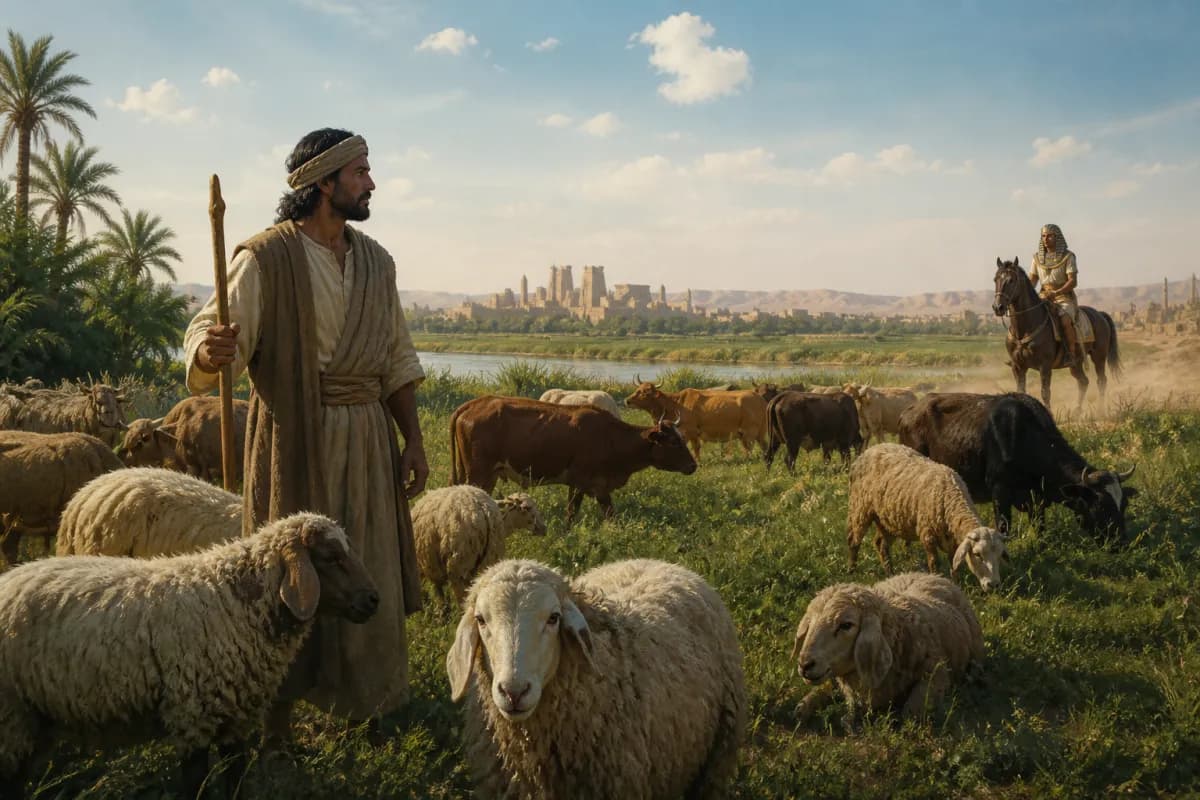
Exodus 9:1–7 announces a severe pestilence on Egypt’s livestock while preserving Israel’s herds. Pharaoh investigates and learns that the Lord’s word has happened exactly as Moses said, yet he hardens his heart. The passage shows that God’s judgments expose false security and that Jesus offers a truer refuge by bringing sinners into the Father’s care through His saving mission.
- In this study
- 7 verses · 5 movements
Exodus 9
9:1Then the LORD said to Moses, “Go in to Pharaoh, and tell him, ‘This is what the LORD, the God of the Hebrews, says: “Let my people go, that they may serve me.
9:2For if you refuse to let them go, and hold them still,
9:3behold, the LORD’s hand is on your livestock which are in the field, on the horses, on the donkeys, on the camels, on the herds, and on the flocks with a very grievous pestilence.
9:4The LORD will make a distinction between the livestock of Israel and the livestock of Egypt; and nothing shall die of all that belongs to the children of Israel.”’”
9:5The LORD appointed a set time, saying, “Tomorrow the LORD shall do this thing in the land.”
9:6The LORD did that thing on the next day; and all the livestock of Egypt died, but of the livestock of the children of Israel, not one died.
9:7Pharaoh sent, and, behold, there was not so much as one of the livestock of the Israelites dead. But the heart of Pharaoh was stubborn, and he didn’t let the people go.
CONTEXTUAL OVERVIEW
The fifth plague strikes Egypt’s livestock in the field: horses, donkeys, camels, herds, and flocks. These animals represent transport, labor, food, wealth, and agricultural stability. The plague therefore reaches into the economic systems by which Pharaoh’s kingdom appears secure.
Again the Lord says that Israel’s livestock will be spared. Pharaoh responds by sending to verify the report, and the investigation confirms it. This detail removes any suggestion that Pharaoh simply lacks evidence; he learns that the Lord’s announced distinction has occurred and still refuses to yield.
HISTORICAL AND LITERARY CONTEXT
In an agrarian society, livestock are woven into household survival and royal power. The list in Exodus emphasizes the breadth of the blow without requiring readers to reconstruct every Egyptian economic practice. God confronts a regime that has treated human lives as material for its projects by showing that its own resources are not autonomous.
The passage also maintains a careful sequence of warning, appointed time, fulfillment, and confirmation. Exodus repeatedly presents the Lord’s acts as intelligible judgments that answer Pharaoh’s defiance, not anonymous calamities from which no moral claim can be drawn.
SECTION-BY-SECTION ANALYSIS
- Resources under judgment · Exodus 9:3The plague reaches the animals on which Egyptian strength and daily provision depend.
- An appointed time · Exodus 9:5God’s stated timing makes the event a public confirmation of His word.
- Verified resistance · Exodus 9:1Pharaoh sends to check the report, receives confirmation, and still refuses the Lord’s command.
CHRIST IN THIS PASSAGE
This plague does not make a direct prediction about Jesus. It does, however, expose the fragility of security built on possessions, power, and control. Jesus warns that a person’s life does not consist in an abundance of possessions and directs people toward the Father whose care reaches beyond what wealth can secure.
Christ’s saving mission offers more than protection of earthly resources. By His death and resurrection He reconciles sinners to God, the true source of life, and teaches His people to hold material goods as gifts for faithful stewardship rather than as guarantees of ultimate safety.
REFLECTION
It is easy to make our own “livestock” into a refuge: savings, tools, reputation, property, or professional capacity. These gifts are good, but Exodus warns that they cannot make us independent of God. Pharaoh’s investigation exposes the danger of seeing clearly and still clinging to self-rule.
Jesus frees us to receive daily provision with gratitude and open hands. That freedom can become visible in generosity, care for neighbors whose livelihood is threatened, and prayerful trust when a resource we depended on proves limited.
Original Hebrew Word Study
Exodus 9:3
מִקְנֶה
miqneh · H4735
Usually translated: livestock or acquired property
Miqneh includes livestock as a person’s acquired wealth. The plague reaches a visible measure of Egypt’s prosperity, showing that Pharaoh’s economy stands under the Lord’s authority.
Follow the Scripture trail
The Plague on Livestock: The Lord’s Hand Against Egypt in the larger story
The connection: The pestilence on Egypt’s livestock exposes the limits of power and wealth when they resist God. Jesus fulfills God’s saving mission by bringing sinners into the Father’s care and teaching them to find life in Him rather than in fragile securities.
Respond to the passage
Thank God for the resources He has given you, then ask Jesus where they have become a substitute for trust. Practice one act of open-handed stewardship that reflects confidence in the Father rather than fear of loss.
- Why does this plague strike livestock, and what forms of security does that touch?
- How does the stated time of the plague strengthen Exodus’s claim about the Lord?
- What is the difference between grateful stewardship and treating resources as a refuge from God?
Prayer
Father, every good provision comes from You. Forgive me for treating Your gifts as if they could secure my life apart from You. Thank You for Jesus, who brings me into Your care. Make me grateful, generous, and steady when earthly security proves fragile. Amen.