Passage Study
The Plague of Hail: Mercy in the Warning
Exodus 9:13–9:35
Exodus 9:13–35 brings devastating hail upon Egypt after Pharaoh refuses to release Israel, yet the Lord first warns Egypt so that servants and livestock can be brought under shelter. Some Egyptians fear the Lord’s word and act on it; Pharaoh admits sin under pressure but hardens again when the storm stops. The passage joins righteous judgment with offered mercy and directs readers to Jesus, who calls people to take refuge in God rather than harden themselves against His saving word.
- In this study
- 23 verses · 5 movements
Exodus 9
9:13The LORD said to Moses, “Rise up early in the morning, and stand before Pharaoh, and tell him, ‘This is what the LORD, the God of the Hebrews, says: “Let my people go, that they may serve me.
9:14For this time I will send all my plagues against your heart, against your officials, and against your people; that you may know that there is no one like me in all the earth.
9:15For now I would have stretched out my hand, and struck you and your people with pestilence, and you would have been cut off from the earth;
9:16but indeed for this cause I have made you stand: to show you my power, and that my name may be declared throughout all the earth,
9:17because you still exalt yourself against my people, that you won’t let them go.
9:18Behold, tomorrow about this time I will cause it to rain a very grievous hail, such as has not been in Egypt since the day it was founded even until now.
9:19Now therefore command that all of your livestock and all that you have in the field be brought into shelter. The hail will come down on every man and animal that is found in the field, and isn’t brought home, and they will die.”’”
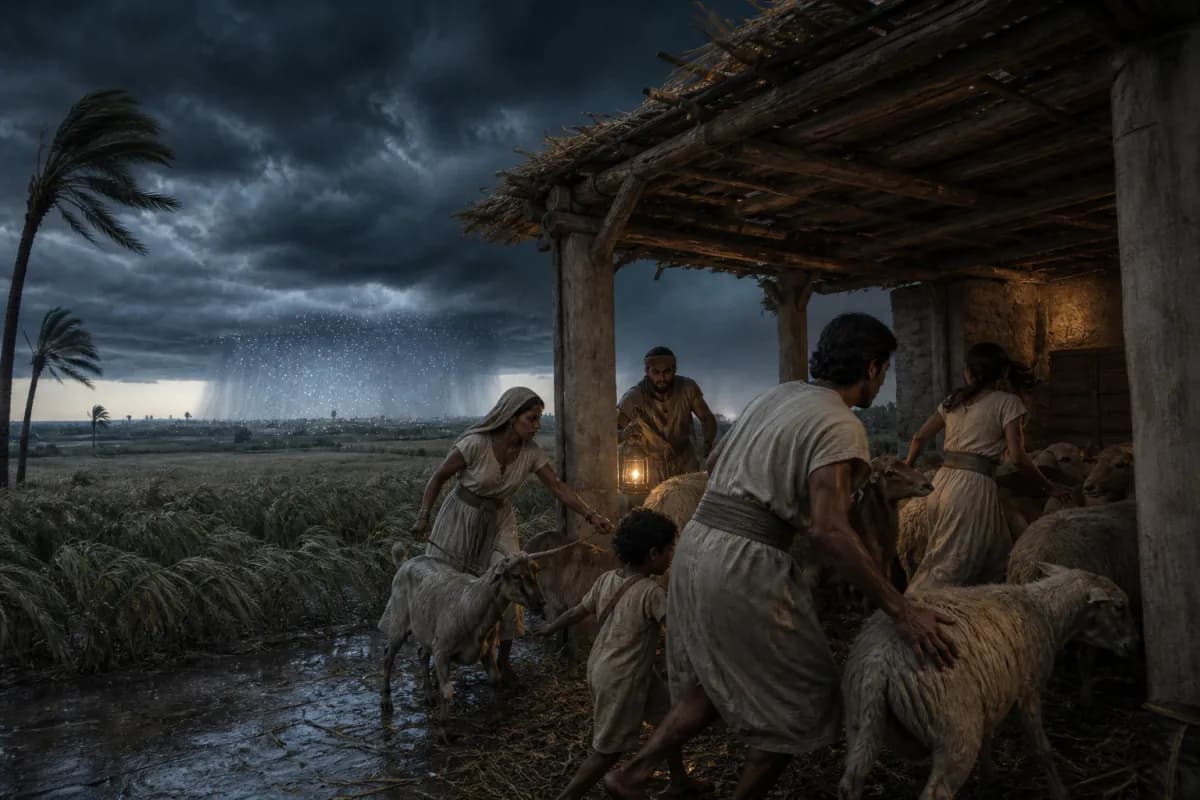
9:20Those who feared the LORD’s word among the servants of Pharaoh made their servants and their livestock flee into the houses.
9:21Whoever didn’t respect the LORD’s word left his servants and his livestock in the field.
9:22The LORD said to Moses, “Stretch out your hand toward the sky, that there may be hail in all the land of Egypt, on man, and on animal, and on every herb of the field, throughout the land of Egypt.”
9:23Moses stretched out his rod toward the heavens, and the LORD sent thunder and hail; and lightning flashed down to the earth. The LORD rained hail on the land of Egypt.
9:24So there was very severe hail, and lightning mixed with the hail, such as had not been in all the land of Egypt since it became a nation.
9:25The hail struck throughout all the land of Egypt all that was in the field, both man and animal; and the hail struck every herb of the field, and broke every tree of the field.
9:26Only in the land of Goshen, where the children of Israel were, there was no hail.
9:27Pharaoh sent and called for Moses and Aaron, and said to them, “I have sinned this time. The LORD is righteous, and I and my people are wicked.
9:28Pray to the LORD; for there has been enough of mighty thunderings and hail. I will let you go, and you shall stay no longer.”
9:29Moses said to him, “As soon as I have gone out of the city, I will spread out my hands to the LORD. The thunders shall cease, and there will not be any more hail; that you may know that the earth is the LORD’s.
9:30But as for you and your servants, I know that you don’t yet fear the LORD God.”
9:31The flax and the barley were struck, for the barley had ripened and the flax was blooming.
9:32But the wheat and the spelt were not struck, for they had not grown up.
9:33Moses went out of the city from Pharaoh, and spread out his hands to the LORD; and the thunders and hail ceased, and the rain was not poured on the earth.
9:34When Pharaoh saw that the rain and the hail and the thunders had ceased, he sinned yet more, and hardened his heart, he and his servants.
9:35The heart of Pharaoh was hardened, and he didn’t let the children of Israel go, just as the LORD had spoken through Moses.
CONTEXTUAL OVERVIEW
The seventh plague comes after Pharaoh has watched Egypt’s waters, homes, bodies, and livestock struck while Israel is set apart. Now the Lord says plainly that Pharaoh has been preserved so that God’s power and name may be known through the earth. The hail is not an unexplained weather event within the story; it is a summons to recognize the Lord whose command Pharaoh keeps refusing.
This judgment contains a striking warning. Moses tells Pharaoh that people and animals left in the open will die, and the text pauses to distinguish two responses among Pharaoh’s servants. Some fear the Lord’s word and bring their households and livestock indoors; others disregard it. Even within judgment, the Lord’s spoken warning opens a concrete path of refuge.
HISTORICAL AND LITERARY CONTEXT
Hail threatens Egypt’s grain, flax, and barley at a vulnerable point in the agricultural year. Exodus names the crops that are ruined and the wheat and spelt that are not yet grown, grounding the plague in the land’s ordinary economic life rather than treating it as a detached spectacle. Egypt’s security, labor, and food supply stand under the Creator’s authority.
The narrative repeatedly distinguishes between acknowledging a crisis and yielding to the Lord. Pharaoh says, “I have sinned this time,” and calls the Lord righteous, but his words are tested when the thunder and hail cease. Exodus thereby teaches readers to watch the direction of a response, not merely its intensity in the moment of danger.
SECTION-BY-SECTION ANALYSIS
- A warned judgment · Exodus 9:13The Lord tells Egypt what is coming and gives a way to protect life before the hail begins.
- Fear that acts · Exodus 9:30Some servants respond to God’s word by taking shelter, showing that reverence becomes visible in obedience.
- A tested confession · Exodus 9:34Pharaoh’s admission under the storm proves hollow when relief lets him recover his old defiance.
CHRIST IN THIS PASSAGE
The hailstorm does not directly predict a single event in Jesus’ life, but it advances Exodus’s pattern of judgment, warning, and refuge. Jesus speaks with the same moral seriousness about refusing God’s kingdom, while also inviting the weary and guilty to come to Him. God’s warnings are not cruelty; they expose danger and call people toward the mercy He provides.
At the cross, Jesus bears the judgment sin deserves so that those who trust Him may be reconciled to God. That does not make every hardship a simple punishment or remove the reality of final accountability. It does mean that Christ’s saving mission offers the refuge Pharaoh repeatedly refused: repentance that receives God’s mercy and learns to live under His rule.
REFLECTION
The officials who moved indoors show that fear of the Lord is more than a feeling. They heard a warning, took it seriously, and changed their actions. When Scripture exposes a destructive pattern, the faithful response is not to wait for a more convenient moment; it is to step into the shelter God provides.
Pharaoh’s pattern is also familiar: urgent prayers while the storm is loud, then old resistance once life settles. Jesus receives the person who comes honestly, and His grace can make repentance durable. Ask Him to turn crisis-prayers into steady obedience and to make your life a gentle invitation for others to seek refuge in Him.
Original Hebrew Word Study
Exodus 9:20
יָרֵא
yare · H3372
Usually translated: to fear
Some of Pharaoh’s servants “feared” the Lord’s word and brought their servants and livestock inside. Fear here becomes a practical response to God’s warning, not an abstract religious feeling.
Follow the Scripture trail
The Plague of Hail: Mercy in the Warning in the larger story
The connection: The hail reveals that the Lord judges proud resistance while warning people to seek refuge in His word. Jesus fulfills God’s saving mission by bearing sin’s judgment and calling people from hard-hearted delay into the mercy and new life God provides.
Respond to the passage
Identify one clear warning from God you have treated as distant or negotiable. Bring it to Jesus today, receive His mercy, and take the concrete step of obedience that puts you under His wise care.
- Why does the passage include a warning before the hail rather than only recording the judgment?
- What separates the servants who feared the Lord from those who ignored His word?
- How does Pharaoh’s response after the storm challenge a temporary, crisis-driven kind of repentance?
Prayer
Lord Jesus, keep me from hearing Your warnings only when I am afraid. Thank You for bearing judgment so that sinners can find refuge in You. Give me repentance that endures after the pressure lifts, and make my obedience a witness to Your mercy. Amen.