Passage Study
The Plague of Boils: Judgment No Court Can Heal
Exodus 9:8–9:12
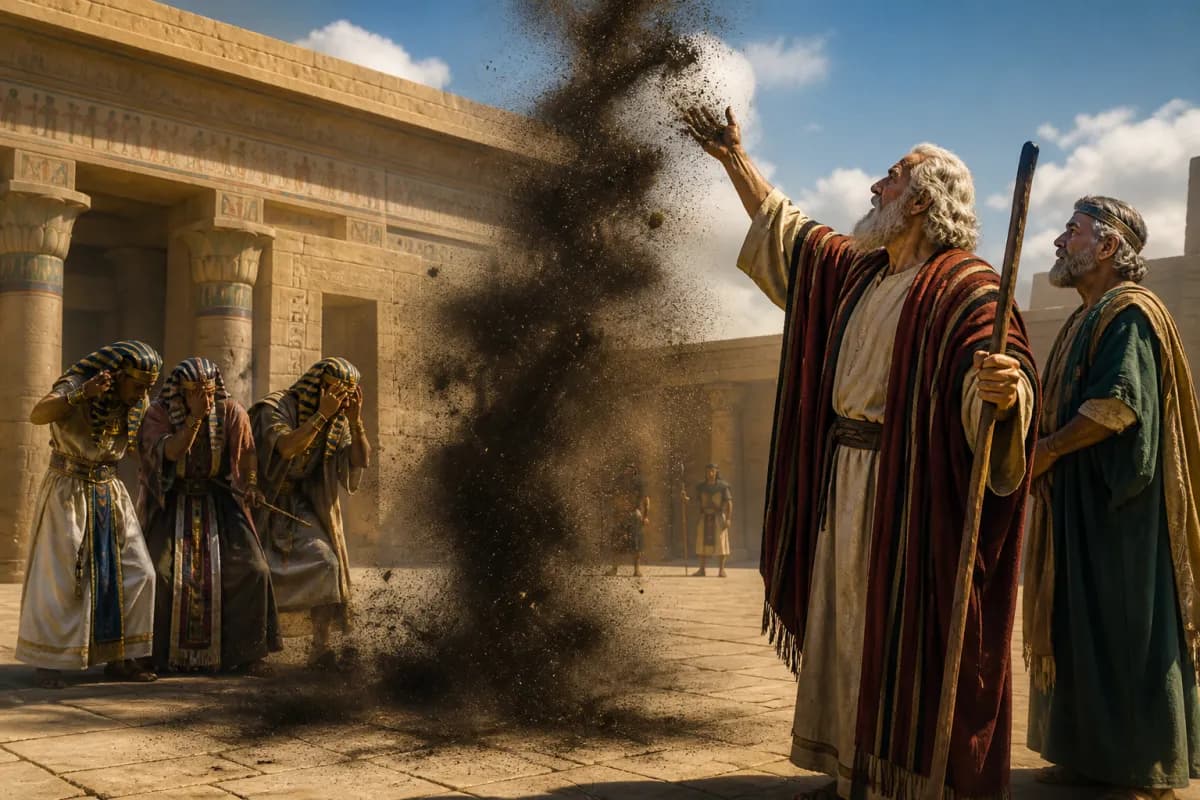
Exodus 9:8–12 records Moses scattering furnace soot toward heaven, after which boils break out on people and animals throughout Egypt. The magicians cannot stand before Moses because they too are afflicted, and Pharaoh’s heart remains hard. The passage exposes the helplessness of a court that cannot heal itself and points to Jesus, who bears human brokenness and brings lasting cleansing and restoration through His saving work.
- In this study
- 5 verses · 5 movements
Exodus 9
9:8The LORD said to Moses and to Aaron, “Take handfuls of ashes of the furnace, and let Moses sprinkle it toward the sky in the sight of Pharaoh.
9:9It shall become small dust over all the land of Egypt, and shall be boils and blisters breaking out on man and on animal, throughout all the land of Egypt.”
9:10They took ashes of the furnace, and stood before Pharaoh; and Moses sprinkled it up toward the sky; and it became boils and blisters breaking out on man and on animal.
9:11The magicians couldn’t stand before Moses because of the boils; for the boils were on the magicians and on all the Egyptians.
9:12The LORD hardened the heart of Pharaoh, and he didn’t listen to them, as the LORD had spoken to Moses.
CONTEXTUAL OVERVIEW
Moses and Aaron take soot from a furnace and scatter it toward heaven in Pharaoh’s sight. The furnace image is piercing in a story where Egypt has made Israel labor under crushing burdens. What Pharaoh’s system has used to afflict others becomes the setting for a judgment that reaches Egyptian bodies and animals.
The boils leave the magicians unable to stand before Moses. Earlier they had tried to match signs or advise Pharaoh; now their own affliction silences them. The court that claimed spiritual and practical expertise cannot shield itself from the Lord’s hand.
HISTORICAL AND LITERARY CONTEXT
The plague sequence now moves with increasing severity. Exodus does not supply a medical diagnosis for the boils, and responsible interpretation should not invent one. Its narrative meaning is plain: the Lord’s judgment reaches people and animals alike, and Egypt’s religious specialists cannot reverse it.
Unlike several earlier plagues, this scene contains no recorded warning. Pharaoh’s persistent refusal has created a setting in which judgment arrives directly. The action is public, performed before Pharaoh, so the king cannot claim ignorance about whose word he has rejected.
SECTION-BY-SECTION ANALYSIS
- Furnace soot · Exodus 9:8The material associated with Egypt’s oppressive labor becomes the instrument of a judgment Pharaoh must watch.
- Silenced magicians · Exodus 9:11Those who once tried to answer Moses cannot even stand before him because they share the affliction.
- An unchanged king · Exodus 9:10The plague reveals Pharaoh’s helplessness without yet producing the repentance he refuses to give.
CHRIST IN THIS PASSAGE
The boils are a judgment on Egypt, not a simple explanation for every illness people experience. Scripture forbids that cruel shortcut. Yet the scene does reveal a world in which bodies are vulnerable and human expertise is limited. Jesus enters that world with compassion, touching the unclean, healing the sick, and refusing to treat sufferers as disposable.
Christ’s healings are signs of His kingdom, while His cross addresses the deeper captivity of sin and death. His saving mission gives hope beyond temporary relief: He reconciles people to God now and promises the final restoration in which suffering and death will not rule.
REFLECTION
This passage should make us humble around sickness. We should not claim to know why a particular person suffers, and we should not turn illness into a verdict on someone’s faith. We can say what Exodus says: human power is limited, God sees bodily pain, and the Lord’s claim cannot be dismissed by those who consider themselves self-sufficient.
Jesus invites afflicted people to come to Him and calls His church to practical compassion. Pray for healing, offer concrete care, and tell the truth that the risen Christ has not abandoned those whose bodies are weak. His final restoration gives endurance a hope stronger than denial.
Original Hebrew Word Study
Exodus 9:9
שְׁחִין
shechin · H7822
Usually translated: inflamed sore or boil
Shechin is an inflamed skin affliction. The plague brings judgment close to the body itself, exposing how powerless Egypt’s priests and rulers are before the Lord.
Follow the Scripture trail
The Plague of Boils: Judgment No Court Can Heal in the larger story
The connection: The plague of boils strips Egypt’s court of its claim to self-sufficiency and reveals bodily vulnerability before God. Jesus fulfills the saving mission of God by drawing near to the suffering, bearing sin and death, and promising a restored creation where pain will not have the last word.
Respond to the passage
Bring your own weakness, or the pain of someone you love, honestly to Jesus. Refuse easy explanations, pray for mercy and healing, and take one practical step of compassionate care for a suffering neighbor.
- Why does the furnace soot matter within the larger story of Israel’s oppression?
- What does the magicians’ inability to stand reveal about Egypt’s claimed power?
- How does Jesus’ compassion for the sick keep us from using this plague to make harsh judgments about suffering?
Prayer
Lord Jesus, You know the frailty of our bodies and the grief that suffering brings. Keep me from harsh explanations and self-sufficient pride. Draw near to those in pain, give wisdom to caregivers, and strengthen our hope in Your promised restoration. Amen.