Passage Study
Babel: A Name without God
Genesis 11:1–11:9
Genesis 11:1–9 portrays a united people using a city and tower to make a name for themselves and prevent their scattering. God confuses their speech and disperses them, exposing the limits of human self-exaltation. The story prepares the way for God’s mission through Abraham and finds its gospel answer in Christ, who gathers divided peoples without making human pride their center.
- In this study
- 9 verses · 5 movements
Genesis 11
11:1The whole earth was of one language and of one speech.
11:2As they traveled east, they found a plain in the land of Shinar, and they lived there.
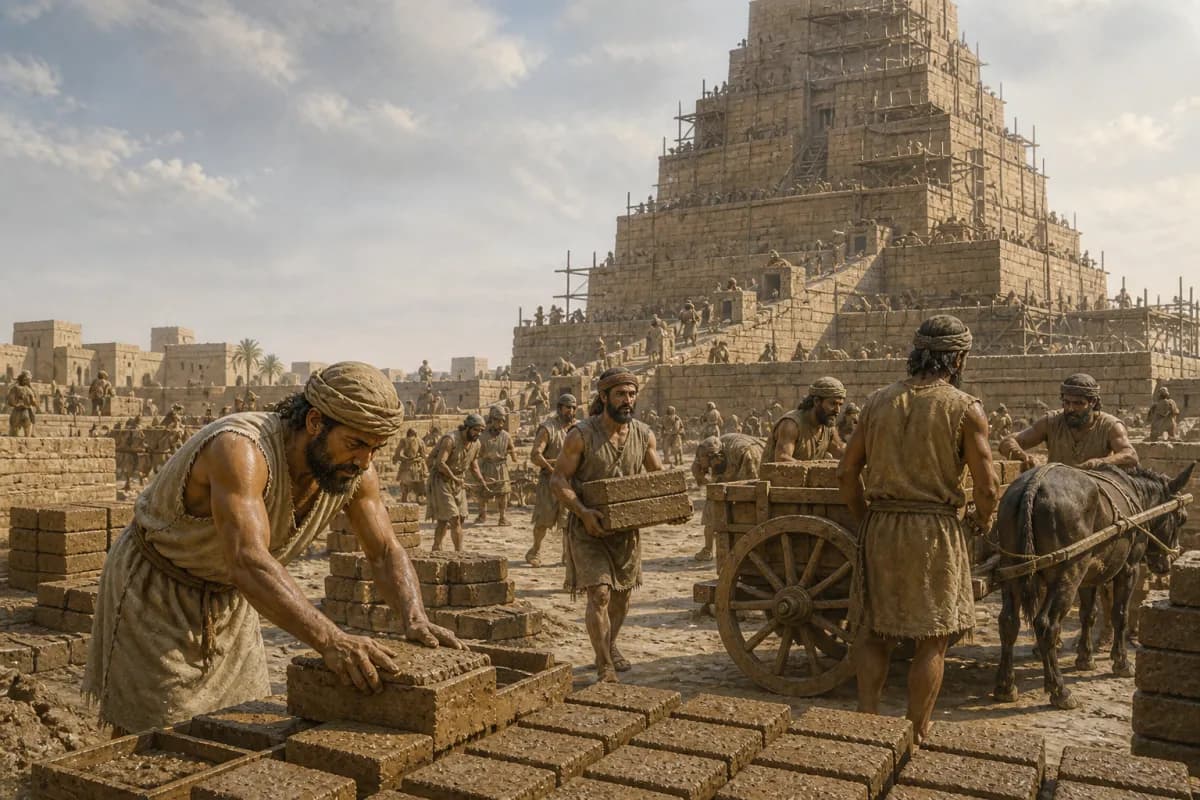
11:3They said to one another, “Come, let’s make bricks, and burn them thoroughly.” They had brick for stone, and they used tar for mortar.
11:4They said, “Come, let’s build ourselves a city, and a tower whose top reaches to the sky, and let’s make a name for ourselves, lest we be scattered abroad on the surface of the whole earth.”
11:5The LORD came down to see the city and the tower, which the children of men built.
11:6The LORD said, “Behold, they are one people, and they all have one language, and this is what they begin to do. Now nothing will be withheld from them, which they intend to do.
11:7Come, let’s go down, and there confuse their language, that they may not understand one another’s speech.”
11:8So the LORD scattered them abroad from there on the surface of all the earth. They stopped building the city.
11:9Therefore its name was called Babel, because there the LORD confused the language of all the earth. From there, the LORD scattered them abroad on the surface of all the earth.
CONTEXTUAL OVERVIEW
Babel follows the flood and the table of nations. Humanity is again multiplying, but instead of receiving God’s purpose for the earth, the builders settle together to secure their own name and prevent the dispersal that God had commanded.
Their unity is real, their technology is effective, and their project is ambitious. Genesis does not condemn bricks or cities. It exposes the heart that treats collective power and reputation as a substitute for humble dependence on God.
HISTORICAL AND LITERARY CONTEXT
The tower likely evokes a monumental temple tower in the ancient Mesopotamian world, but the passage’s main concern is theological rather than archaeological. God “comes down” to see the structure, a deliberate irony that humbles the builders’ attempt to reach heaven by their own achievement.
Babel is the last major scene before God calls Abram in Genesis 12. Human beings seek to make their own great name at Babel; God then promises to make Abram’s name great so that blessing may reach all families of the earth.
Did you know?
One writing system can serve many languages: Mesopotamian cuneiform was adapted for at least fifteen. Its familiar wedge-shaped marks developed from pictures drawn on clay, gradually becoming signs impressed with a writing tool.
Why it matters: Babel’s focus on spoken language invites us to distinguish a language from the script used to record it.
Cuneiform tablet: Atra-hasis, Babylonian flood myth — The Metropolitan Museum of Art
SECTION-BY-SECTION ANALYSIS
- One language · Genesis 11:1Shared speech becomes an instrument of collective pride when it is severed from obedience to God.
- A name · Genesis 11:4The builders seek self-made significance, the very gift God later gives to Abraham for the sake of blessing others.
- The scattering · Genesis 11:3God frustrates rebellion and redirects the nations toward the wider purpose they had resisted.
CHRIST IN THIS PASSAGE
Babel is a strong thematic background for Pentecost, not a simple reversal in which all languages disappear. At Pentecost, the Spirit enables the gospel to be heard across languages, showing that Jesus gathers the nations around His saving work rather than around a human tower or empire.
Christ’s mission also answers Babel’s search for a name. He humbles Himself, receives the name above every name through His resurrection and exaltation, and sends His church to make disciples among all peoples. Unity in Him honors difference and serves God’s glory rather than human self-exaltation.
REFLECTION
Babel asks what kind of name we are trying to make. Work, institutions, churches, and technology can serve neighbors, but they become Babel-like when they exist to protect our importance or keep us from the dependence God requires.
Jesus gathers people who do not need to build a monument to prove they matter. His church can pursue shared work with humility, welcome people across language and culture, and join His mission of blessing the nations rather than using unity for self-protection.
Original Hebrew Word Study
Genesis 11:4
שֵׁם
shem · H8034
Usually translated: name, reputation, or renown
Shem means name or reputation. Babel’s builders seek to make a name for themselves, while the following chapter begins with God promising to make Abraham’s name great for the blessing of the nations.
Follow the Scripture trail
Babel: A Name without God in the larger story
The connection: Babel shows humanity seeking a unified name without God; Abraham’s call begins God’s mission to bless the scattered nations. Jesus fulfills that mission by gathering a multilingual people through His humility, cross, resurrection, and gospel proclamation.
Respond to the passage
Ask whether your work or community is serving God’s mission or quietly serving the need to make a name. Jesus frees you from self-protection and sends you to use gifts, influence, and unity for the blessing of people He came to redeem.
- What do the builders fear, and how does that fear shape their project?
- Why is God’s “coming down” to see the tower an important irony?
- How does Pentecost gather people differently from the unity sought at Babel?
Prayer
Lord Jesus, forgive my desire to make a name for myself. Thank You for gathering people from every language through Your gospel. Make my work and community a humble instrument of Your mission and blessing among the nations. Amen.