Passage Study
From Shem to Abram: The Narrowing Line of Promise
Genesis 11:10–11:32
Genesis 11:10–32 traces ten generations from Shem to Abram, then pauses over Terah’s family and their interrupted journey toward Canaan. The quiet list answers Babel’s scattered ambition with God’s patient preservation of a family through whom He will bless the nations.
- In this study
- 23 verses · 5 movements
Genesis 11
11:10This is the history of the generations of Shem: Shem was one hundred years old when he became the father of Arpachshad two years after the flood.
11:11Shem lived five hundred years after he became the father of Arpachshad, and became the father of more sons and daughters.
11:12Arpachshad lived thirty-five years and became the father of Shelah.
11:13Arpachshad lived four hundred three years after he became the father of Shelah, and became the father of more sons and daughters.
11:14Shelah lived thirty years, and became the father of Eber.
11:15Shelah lived four hundred three years after he became the father of Eber, and became the father of more sons and daughters.
11:16Eber lived thirty-four years, and became the father of Peleg.
11:17Eber lived four hundred thirty years after he became the father of Peleg, and became the father of more sons and daughters.
11:18Peleg lived thirty years, and became the father of Reu.
11:19Peleg lived two hundred nine years after he became the father of Reu, and became the father of more sons and daughters.
11:20Reu lived thirty-two years, and became the father of Serug.
11:21Reu lived two hundred seven years after he became the father of Serug, and became the father of more sons and daughters.
11:22Serug lived thirty years, and became the father of Nahor.
11:23Serug lived two hundred years after he became the father of Nahor, and became the father of more sons and daughters.
11:24Nahor lived twenty-nine years, and became the father of Terah.
11:25Nahor lived one hundred nineteen years after he became the father of Terah, and became the father of more sons and daughters.
11:26Terah lived seventy years, and became the father of Abram, Nahor, and Haran.
11:27Now this is the history of the generations of Terah. Terah became the father of Abram, Nahor, and Haran. Haran became the father of Lot.
11:28Haran died in the land of his birth, in Ur of the Chaldees, while his father Terah was still alive.
11:29Abram and Nahor married wives. The name of Abram’s wife was Sarai, and the name of Nahor’s wife was Milcah, the daughter of Haran, who was also the father of Iscah.
11:30Sarai was barren. She had no child.
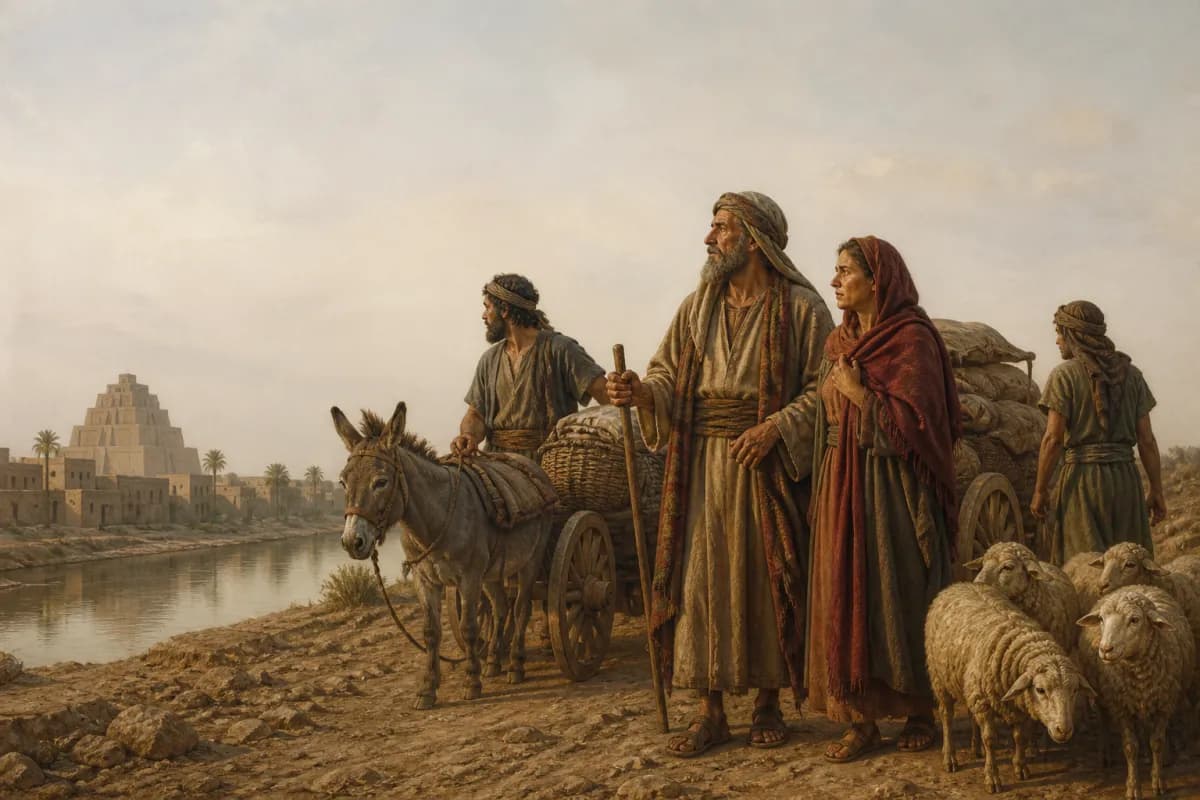
11:31Terah took Abram his son, Lot the son of Haran, his son’s son, and Sarai his daughter-in-law, his son Abram’s wife. They went from Ur of the Chaldees, to go into the land of Canaan. They came to Haran and lived there.
11:32The days of Terah were two hundred five years. Terah died in Haran.
CONTEXTUAL OVERVIEW
After Babel, Genesis does not leave humanity merely scattered under judgment. This genealogy resumes the line of Shem and slows the reader down as it approaches Abram. The repeated births and years can feel uneventful, but they are the bridge between the flood covenant and the call that will begin in Genesis 12.
The final verses introduce several tensions at once: Sarai is unable to bear children, Haran dies before his father, and Terah begins a journey toward Canaan but stops in Haran. God’s promise has not yet been spoken to Abram in this passage, but the narrative has carefully set the stage for a future that human fertility, bereavement, and partial travel cannot secure.
HISTORICAL AND LITERARY CONTEXT
Biblical genealogies do more than preserve family memory. They establish continuity, identity, and the line through which the story advances. Genesis 11 compresses generations in a patterned account, directing attention to the movement from Shem toward Abram rather than supplying a modern-style biography of every name.
Ur and Haran were important centers along ancient Mesopotamian trade routes. The text identifies the family’s movement but does not explain every motive behind it. What it emphasizes is the destination Canaan and the fact that the household stops short before Abram receives God’s decisive call to continue.
SECTION-BY-SECTION ANALYSIS
- Shem to Abram · Genesis 11:10The genealogy narrows the wide table of nations toward one family without denying God’s concern for the nations.
- Sarai was barren · Genesis 11:30The obstacle is named before the promise of descendants, making any future child a gift of God rather than a merely expected outcome.
- They went toward Canaan · Genesis 11:31Terah begins the route but settles in Haran, creating a narrative pause before God summons Abram onward.
CHRIST IN THIS PASSAGE
This passage does not predict Jesus directly, yet it prepares the covenant line through which the Messiah will come. God’s purpose moves through an apparently fragile family, including a barren woman and a journey that has stalled. The gospel later identifies Jesus as Abraham’s descendant through whom the promised blessing reaches the nations.
The contrast with Babel is also significant. Babel seeks a name and security apart from God; Genesis quietly preserves the family to whom God will give a name for the good of others. Jesus fulfills that mission by bringing people from scattered peoples into God’s family through His death and resurrection, not through human self-exaltation.
REFLECTION
God’s work is often hidden in the ordinary faithfulness of generations. A reader who feels anonymous, delayed, or burdened by family loss can see that Genesis does not treat such realities as outside God’s care. He is able to carry His promise through long stretches that look unremarkable from within.
Terah’s stopped journey also invites honesty about unfinished obedience. Jesus meets people who have stalled, but His grace calls them forward. Christian hope rests not in producing a distinguished name, but in belonging to the risen Lord whose mission gathers the nations into His blessing.
Original Hebrew Word Study
Genesis 11:10
יָלַד
yalad · H3205
Usually translated: to beget or bear
Yalad means to beget or bear. The genealogy narrows the line from Shem to Abram, showing that God’s promise moves through ordinary generations and real families.
Follow the Scripture trail
From Shem to Abram: The Narrowing Line of Promise in the larger story
The connection: Genesis 11 preserves the family line that will carry God’s promise into the world. Jesus, the promised descendant of Abraham, fulfills that purpose by bringing God’s blessing and reconciliation to people from every nation.
Respond to the passage
Bring to Jesus the places where your story feels delayed or incomplete. Ask Him to free you from the need to make a name for yourself and to make your ordinary faithfulness part of His work of blessing others.
- Why does Genesis place this genealogy immediately after Babel?
- What tensions does the final family scene introduce before Abram’s call?
- How does Jesus change the way Christians understand a life that seems hidden or unfinished?
Prayer
Lord Jesus, thank You that Your purpose does not depend on my ability to control the future. Carry me through delay and grief, give me courage to follow where You lead, and make my life a channel of Your blessing. Amen.