Passage Study
Abram’s Vision: The God Who Binds Himself to His Promise
Genesis 15:1–15:21
Genesis 15:1–21 meets Abram’s fear and childlessness with God’s word, counts Abram’s trust as righteousness, and seals the land promise through a covenant ceremony in which God alone passes between the divided animals. The passage grounds hope in God’s pledged faithfulness and points forward to Christ, through whom God fulfills His promise and brings sinners into covenant peace.
- In this study
- 21 verses · 5 movements
Genesis 15
15:1After these things the LORD’s word came to Abram in a vision, saying, “Don’t be afraid, Abram. I am your shield, your exceedingly great reward.”
15:2Abram said, “Lord GOD, what will you give me, since I go childless, and he who will inherit my estate is Eliezer of Damascus?”
15:3Abram said, “Behold, you have given no children to me: and, behold, one born in my house is my heir.”
15:4Behold, the LORD’s word came to him, saying, “This man will not be your heir, but he who will come out of your own body will be your heir.”
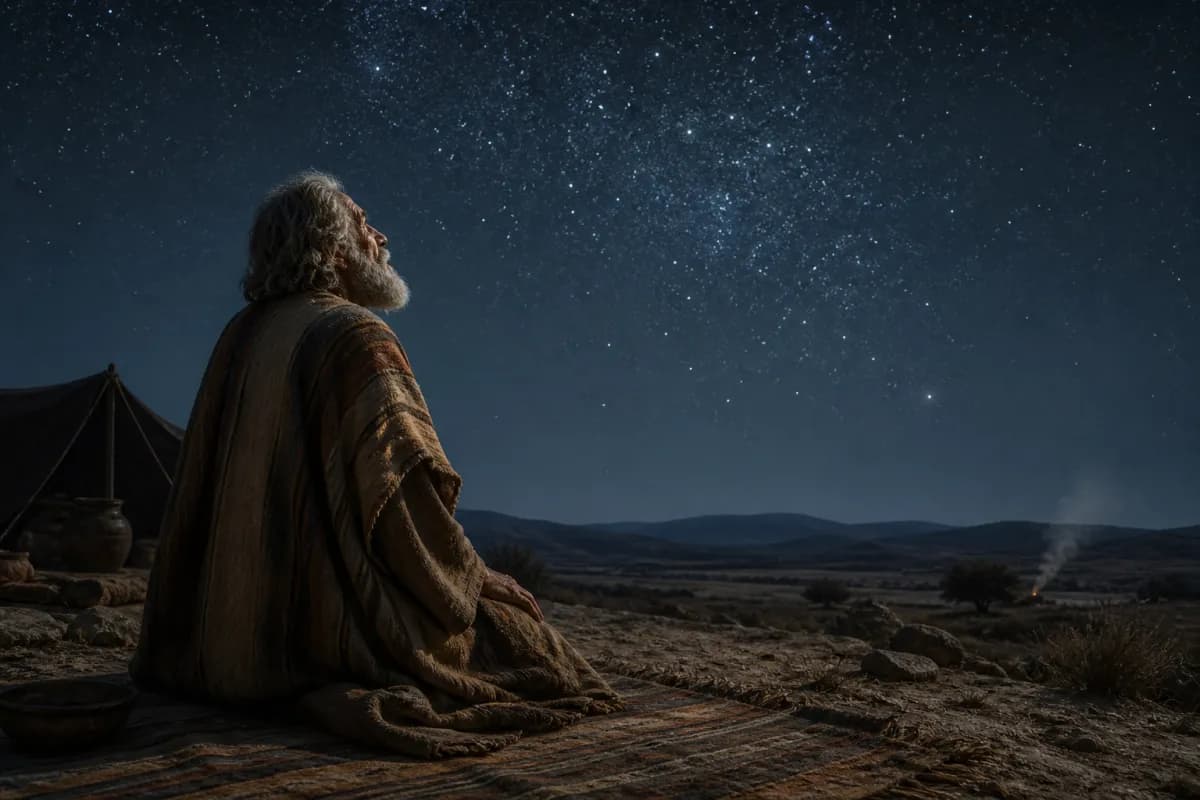
15:5The LORD brought him outside, and said, “Look now toward the sky, and count the stars, if you are able to count them.” He said to Abram, “So your offspring will be.”
15:6He believed in the LORD, who credited it to him for righteousness.
15:7He said to Abram, “I am the LORD who brought you out of Ur of the Chaldees, to give you this land to inherit it.”
15:8He said, “Lord GOD, how will I know that I will inherit it?”
15:9He said to him, “Bring me a heifer three years old, a female goat three years old, a ram three years old, a turtledove, and a young pigeon.”
15:10He brought him all these, and divided them in the middle, and laid each half opposite the other; but he didn’t divide the birds.
15:11The birds of prey came down on the carcasses, and Abram drove them away.
15:12When the sun was going down, a deep sleep fell on Abram. Now terror and great darkness fell on him.
15:13He said to Abram, “Know for sure that your offspring will live as foreigners in a land that is not theirs, and will serve them. They will afflict them four hundred years.
15:14I will also judge that nation, whom they will serve. Afterward they will come out with great wealth;
15:15but you will go to your fathers in peace. You will be buried at a good old age.
15:16In the fourth generation they will come here again, for the iniquity of the Amorite is not yet full.”
15:17It came to pass that, when the sun went down, and it was dark, behold, a smoking furnace and a flaming torch passed between these pieces.
15:18In that day the LORD made a covenant with Abram, saying, “I have given this land to your offspring, from the river of Egypt to the great river, the river Euphrates:
15:19the land of the Kenites, the Kenizzites, the Kadmonites,
15:20the Hittites, the Perizzites, the Rephaim,
15:21the Amorites, the Canaanites, the Girgashites, and the Jebusites.”
CONTEXTUAL OVERVIEW
After the rescue of Lot and Abram’s refusal of the king of Sodom’s wealth, the Lord addresses him in a vision: “Do not fear.” The promise of God Himself as shield and reward meets a man who has land promised to him but no son to inherit it.
Abram does not suppress the tension. He asks how the promise can continue while Eliezer of Damascus appears to be his heir. God answers not with a timetable but with a word: Abram’s own son will come, and his descendants will be as numerous as the stars.
HISTORICAL AND LITERARY CONTEXT
Genesis 15 gathers the central promises of Genesis 12 into a covenant scene: offspring, land, and God’s presence. It comes before Hagar, Ishmael, Isaac, and the later covenant sign of circumcision, showing that God’s promise precedes every attempt to secure it by human strategy.
The divided animals reflect an ancient covenant-making setting in which a solemn oath is enacted with a curse implied upon the covenant-breaker. Genesis’s striking feature is that Abram is put into a deep sleep while the smoking fire pot and flaming torch pass between the pieces. The narrative places the weight of the pledged promise on God.
SECTION-BY-SECTION ANALYSIS
- Shield and reward · Genesis 15:1God does not merely give Abram protection and possessions; He gives His own covenant presence to the fearful man.
- The stars · Genesis 15:5The promise is deliberately beyond Abram’s ability to produce, so faith rests on God’s word rather than visible prospects.
- The passing fire · Genesis 15:2God alone moves through the covenant path while Abram sleeps, underscoring the divine commitment sustaining the promise.
CHRIST IN THIS PASSAGE
The New Testament explicitly returns to Genesis 15:6 to explain justification by faith. Abram is counted righteous because he trusts God’s promise, not because he has earned the covenant. In Christ, that same grace reaches Jews and Gentiles who rely on the God who gives life to the dead.
The covenant ceremony also gives a reverent, thematic line toward the cross. God bears the cost of keeping His redemptive promise; Jesus takes upon Himself the curse of sin to reconcile people to God. Genesis 15 is not a coded prediction of every detail of Calvary, but it establishes the covenant faithfulness that Christ fulfills in His saving mission.
REFLECTION
Faith can speak plainly to God about the gap between His promise and present circumstances. Abram’s question is met with God’s self-revelation, not a rebuke for naming his emptiness. The passage invites believers to bring fear and delay into the presence of the God who pledges Himself to His people.
Jesus gives this hope its decisive ground. His death and resurrection do not erase every long wait, but they show that God has acted for our salvation and will keep His word. The church can therefore wait honestly, trust actively, and witness to the nations that righteousness is received through faith in Christ.
Original Hebrew Word Study
Genesis 15:6
אָמַן
aman · H539
Usually translated: to trust, believe, or be firm
Aman is the verb behind Abram’s believing the Lord. His faith is a settled reliance on God’s promise when the promised future still cannot be seen, and the Lord counts that faith as righteousness.
Follow the Scripture trail
Abram’s Vision: The God Who Binds Himself to His Promise in the larger story
The connection: The God who counts Abram righteous by faith and binds Himself to His covenant promise carries that promise forward through Israel’s exile and return. Jesus fulfills its saving purpose: by His death and resurrection He secures covenant blessing and welcomes all who trust Him into God’s family.
Respond to the passage
Bring the fear or delayed hope you have been carrying into the presence of Jesus. Do not make your ability to solve it the measure of God’s faithfulness. Trust His finished saving work, and take the next obedient step while you wait for what He has promised.
- What fear does God address before Abram raises the question of an heir?
- Why does the story place Abram in a deep sleep while the fire passes between the animals?
- How does Genesis 15:6 shape the New Testament’s message of righteousness through faith in Christ?
Prayer
Covenant-keeping God, thank You for meeting Abram’s fear with Your promise. Thank You that righteousness is received through faith and that Jesus has borne the cost of reconciliation. Strengthen me to trust Your word when the future is still unseen and to live as a witness to Your saving faithfulness. Amen.