Passage Study
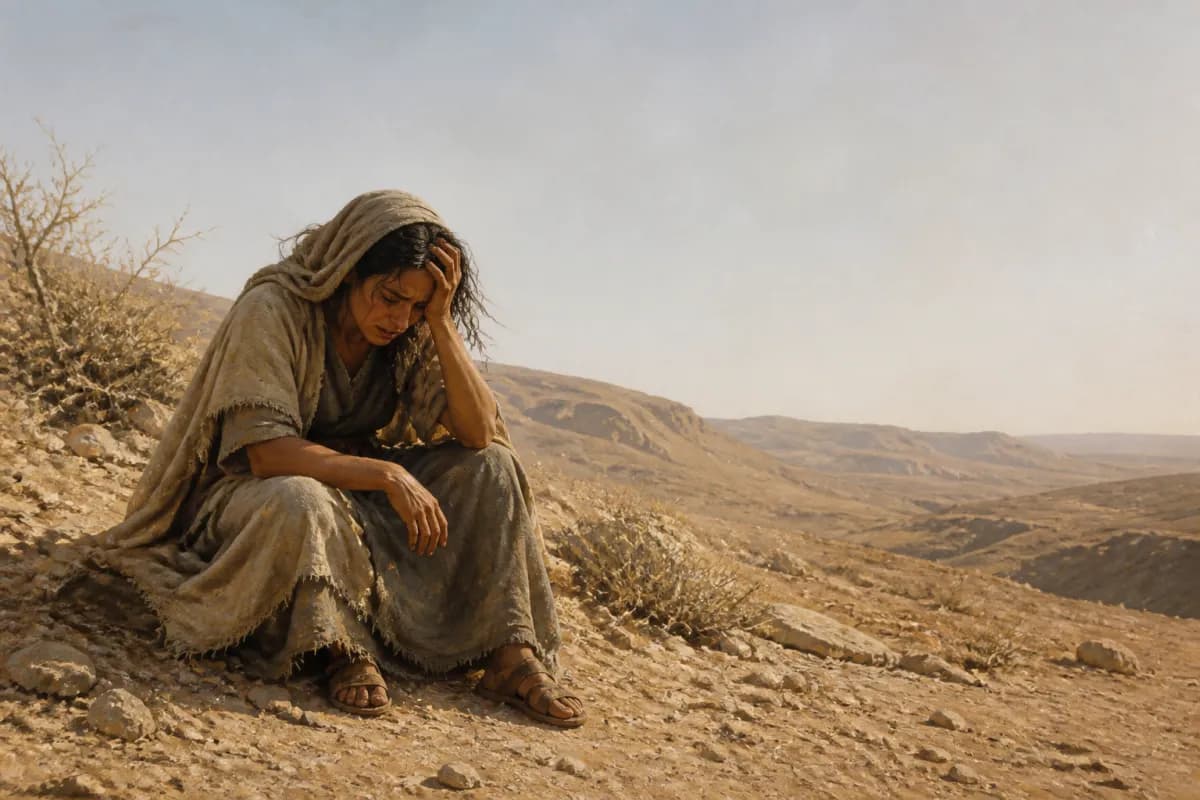
The God Who Sees Hagar in the Wilderness
Genesis 16:1–16:16
Genesis 16:1–16 shows Sarai and Abram trying to obtain the promised family through Hagar, then exposing her to contempt and affliction. The Lord finds Hagar in the wilderness, hears her distress, and promises a future for Ishmael. The passage confronts human control and shows God’s mercy toward the afflicted, fulfilled in Jesus’ saving concern for the overlooked.
- In this study
- 16 verses · 5 movements
Genesis 16
16:1Now Sarai, Abram’s wife, bore him no children. She had a servant, an Egyptian, whose name was Hagar.
16:2Sarai said to Abram, “See now, the LORD has restrained me from bearing. Please go in to my servant. It may be that I will obtain children by her.” Abram listened to the voice of Sarai.
16:3Sarai, Abram’s wife, took Hagar the Egyptian, her servant, after Abram had lived ten years in the land of Canaan, and gave her to Abram her husband to be his wife.
16:4He went in to Hagar, and she conceived. When she saw that she had conceived, her mistress was despised in her eyes.
16:5Sarai said to Abram, “This wrong is your fault. I gave my servant into your bosom, and when she saw that she had conceived, she despised me. May the LORD judge between me and you.”
16:6But Abram said to Sarai, “Behold, your maid is in your hand. Do to her whatever is good in your eyes.” Sarai dealt harshly with her, and she fled from her face.
16:7The LORD’s angel found her by a fountain of water in the wilderness, by the fountain on the way to Shur.
16:8He said, “Hagar, Sarai’s servant, where did you come from? Where are you going?” She said, “I am fleeing from the face of my mistress Sarai.”
16:9The LORD’s angel said to her, “Return to your mistress, and submit yourself under her hands.”
16:10The LORD’s angel said to her, “I will greatly multiply your offspring, that they will not be counted for multitude.”
16:11The LORD’s angel said to her, “Behold, you are with child, and will bear a son. You shall call his name Ishmael, because the LORD has heard your affliction.
16:12He will be like a wild donkey among men. His hand will be against every man, and every man’s hand against him. He will live opposed to all of his brothers.”
16:13She called the name of the LORD who spoke to her, “You are a God who sees,” for she said, “Have I even stayed alive after seeing him?”
16:14Therefore the well was called Beer Lahai Roi. Behold, it is between Kadesh and Bered.
16:15Hagar bore a son for Abram. Abram called the name of his son, whom Hagar bore, Ishmael.
16:16Abram was eighty-six years old when Hagar bore Ishmael to Abram.
CONTEXTUAL OVERVIEW
Sarai’s barrenness remains unresolved after Genesis 15. She gives her Egyptian servant Hagar to Abram in an attempt to build a family, and the arrangement produces conception but not peace. The chapter tells the truth about the unequal power within the household: Hagar is used to solve another couple’s problem, then is harshly treated when resentment rises.
Hagar’s flight takes her into the wilderness on the way toward Shur. There the angel of the Lord asks where she has come from and where she is going, hears her affliction, and gives her son the name Ishmael, “God hears.” The divine attention is personal and specific.
HISTORICAL AND LITERARY CONTEXT
The narrative follows the covenant promise of Genesis 15, making the couple’s attempt to secure an heir through Hagar a contrast with waiting for God’s word. Genesis records the action without calling it a faithful fulfillment of the promise; the next chapter will identify Sarah as the woman through whom the promised son will come.
The chapter includes a difficult command for Hagar to return and submit. It does not sanctify Sarai’s harsh treatment or create a rule that every abused person must remain in danger. The text reports God’s care and promise in Hagar’s constrained situation; wise pastoral application must also take safety, protection, and justice seriously.
SECTION-BY-SECTION ANALYSIS
- The plan · Genesis 16:13The household tries to manufacture what God promised, and the result reveals the damage of using another person to manage fear.
- The spring · Genesis 16:10God meets Hagar on a road of flight, turning an unnoticed servant into the first person in Genesis to name God from her own encounter.
- Ishmael’s name · Genesis 16:11“God hears” keeps Hagar’s affliction inside the story of God’s attentive mercy.
CHRIST IN THIS PASSAGE
This passage gives a thematic connection to Jesus’ mission, not a direct prediction of His incarnation. Hagar’s encounter shows that the covenant God sees the person whom a powerful household has treated as expendable. In the Gospels, Jesus repeatedly draws near to those pushed aside and calls His followers to protect the vulnerable.
Paul later distinguishes Hagar and Sarah within an argument about slavery and promise in Galatians 4. His theological use does not erase Hagar’s personal suffering in Genesis 16. Jesus fulfills the promise’s saving purpose by making people from every background children of God through faith, not by leaving the afflicted unseen.
REFLECTION
Hagar’s story forbids a spirituality that notices only the people with power to make decisions. God hears the servant’s misery, and His people must hear it too. Where relationships use, silence, or expose the vulnerable, Christian repentance includes truthful naming, protection, and practical care.
Jesus sees what fear-driven plans can hide. Bring Him the places where you have tried to control a promise or where you have been treated as a means to someone else’s end. His grace tells the truth about sin and forms a community where the overlooked are welcomed as neighbors, not tools.
Original Hebrew Word Study
Genesis 16:13
רָאָה
raah · H7200
Usually translated: to see
Raah means to see. Hagar names the Lord as the God who sees her, making the wilderness scene a witness that God notices the afflicted person whom others have treated as expendable.
Follow the Scripture trail
The God Who Sees Hagar in the Wilderness in the larger story
The connection: Hagar’s wilderness encounter reveals God’s attentive mercy toward a suffering outsider within Abraham’s household. Jesus brings that mercy to its saving fullness, gathering overlooked people into God’s family by grace and calling His church to embody His protecting love.
Respond to the passage
Bring before Jesus any fear that makes you try to control people or outcomes. If you have been overlooked or used, let Hagar’s encounter remind you that God sees and hears. Seek wise help and concrete protection where harm is present, and extend Christ’s dignity to someone others overlook.
- How does the sequence from Sarai’s plan to Hagar’s flight expose the cost of trying to control God’s promise?
- What does Hagar’s naming of God reveal about the way the Lord meets her at the spring?
- How should Jesus’ concern for the overlooked change the way a church responds to vulnerable people?
Prayer
God who sees and hears, forgive the ways fear has made me control or overlook others. Draw near to those who are afflicted and give Your church courage to protect them. Thank You for Jesus, who welcomes the unseen and brings sinners into Your family. Amen.