Passage Study
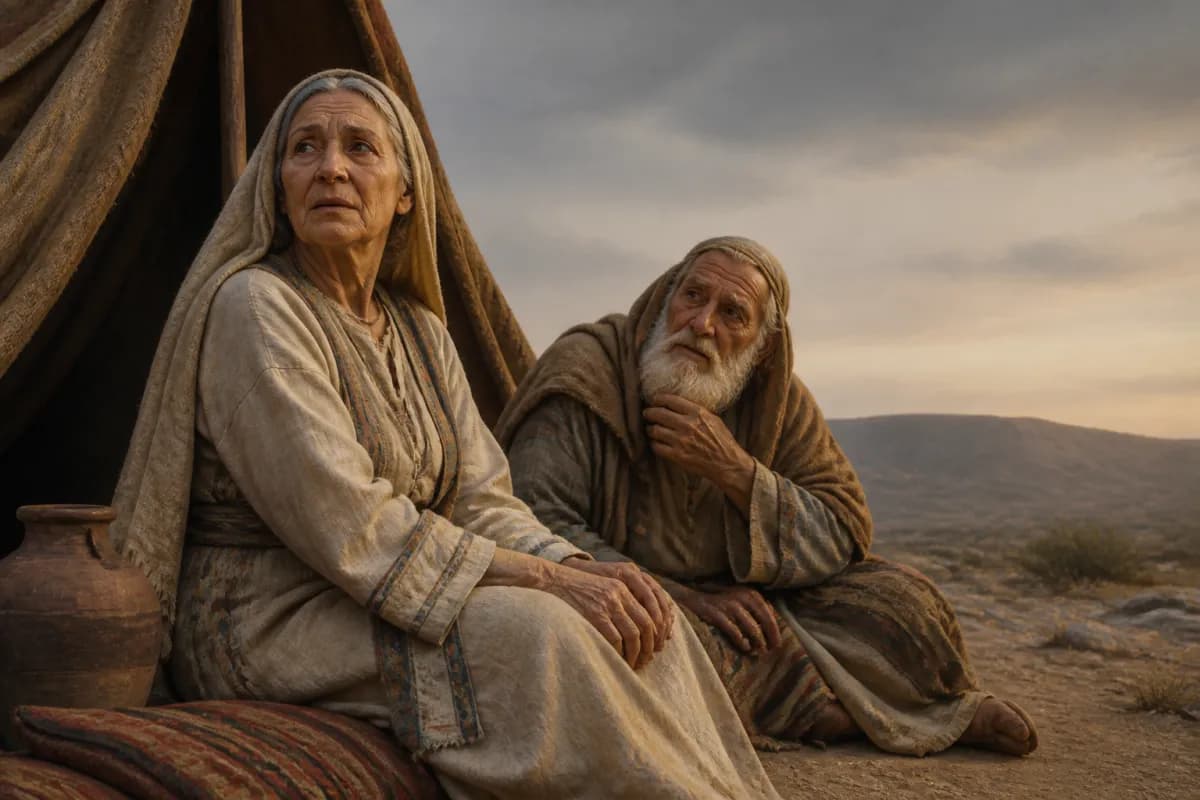
Sarah Named for the Promise
Genesis 17:15–17:22
Genesis 17:15–22 changes Sarai’s name to Sarah and makes her the explicitly named mother of the covenant son. God promises that she will bear Isaac, that nations and kings will come from her, and that His covenant will continue through Isaac. The passage exposes Abraham’s laughter and directs hope to God’s saving promise fulfilled through Jesus.
- In this study
- 8 verses · 5 movements
Genesis 17
17:15God said to Abraham, “As for Sarai your wife, you shall not call her name Sarai, but her name shall be Sarah.
17:16I will bless her, and moreover I will give you a son by her. Yes, I will bless her, and she will be a mother of nations. Kings of peoples will come from her.”
17:17Then Abraham fell on his face, and laughed, and said in his heart, “Will a child be born to him who is one hundred years old? Will Sarah, who is ninety years old, give birth?”
17:18Abraham said to God, “Oh that Ishmael might live before you!”
17:19God said, “No, but Sarah, your wife, will bear you a son. You shall call his name Isaac. I will establish my covenant with him for an everlasting covenant for his offspring after him.
17:20As for Ishmael, I have heard you. Behold, I have blessed him, and will make him fruitful, and will multiply him exceedingly. He will become the father of twelve princes, and I will make him a great nation.
17:21But I will establish my covenant with Isaac, whom Sarah will bear to you at this set time next year.”
17:22When he finished talking with him, God went up from Abraham.
CONTEXTUAL OVERVIEW
God has just renamed Abram Abraham and promised a multitude of nations. Here He names Sarai Sarah and refuses to leave her at the edge of the covenant story: the promised child will come through her. The couple’s long barrenness and advanced age make the promise humanly impossible, which is precisely where the chapter locates God’s power.
Abraham falls facedown and laughs, then pleads that Ishmael might live before God. God receives that plea with a real promise of blessing for Ishmael, yet He does not blur the covenant line. Sarah will bear Isaac, and the covenant will be established with the son God appoints.
HISTORICAL AND LITERARY CONTEXT
These verses complete the name-and-covenant movement begun in Genesis 17:1–8. Sarah’s name is changed before Isaac is conceived, just as Abraham’s was. The promise includes nations and kings through her, demonstrating that God’s covenant purpose is not carried by Abraham alone.
The narrative distinguishes God’s care for Ishmael from the particular covenant promise through Isaac. It gives no warrant for contempt toward Ishmael or his descendants. The point is that God, not Abraham’s household strategy, determines the line through which His covenant promise will advance.
SECTION-BY-SECTION ANALYSIS
- Sarah’s name · Genesis 17:15God’s new name declares her place in the promise before her body gives any visible evidence of it.
- Abraham’s laughter · Genesis 17:17His laughter registers the shock of promise confronting a future neither he nor Sarah can produce.
- Ishmael and Isaac · Genesis 17:19God’s blessing of Ishmael and covenant through Isaac must both be heard; divine election never means divine indifference to the other son.
CHRIST IN THIS PASSAGE
The promised son Isaac belongs to the covenant line through which the Bible’s promise moves toward Jesus. The connection is a strong canonical trajectory, not a claim that Isaac is a one-to-one portrait of Christ. God creates a future through barrenness and keeps His saving word despite human impossibility.
Galatians identifies the promise to Abraham as reaching its goal in Christ, who brings believers into God’s family by faith. Sarah’s named place in the promise therefore helps readers see that God’s mission is neither accidental nor improvised: He keeps His covenant purpose until the Messiah comes.
REFLECTION
Sarah’s name teaches that God sees the person whom a household or culture might treat as secondary. He names her, blesses her, and makes her central to the promise. The Lord’s faithfulness is not limited by the years that seem lost or the circumstances that appear closed.
Jesus invites people to trust God’s promise where they cannot manufacture an outcome. He also calls His people to honor the women and men God includes in His saving work, refusing to make another person’s dignity depend on usefulness, age, or social rank.
Original Hebrew Word Study
Genesis 17:15
שָׂרָה
Sarah · H8283
Usually translated: Sarah; princess
Sarah is related to the word for princess or noblewoman. Her renamed identity belongs to God’s promise that kings and nations will come through her, despite the human impossibility of her barrenness and age.
Follow the Scripture trail
Sarah Named for the Promise in the larger story
The connection: God names Sarah and appoints Isaac as the covenant son, preserving the promise through which the Messiah will come. Jesus fulfills that saving purpose by making people from every background children of God through faith in Him.
Respond to the passage
Bring to Jesus the future you cannot produce and the person you fear He has forgotten. Receive God’s promise with Sarah’s story in view: He sees, names, and acts according to His covenant mercy, then calls His people to honor the dignity of those He includes.
- Why does God explicitly name Sarah as the mother of the covenant son in these verses?
- What does God’s answer to Abraham’s prayer for Ishmael reveal about His care and His covenant purpose?
- How does the promised birth of Isaac prepare readers to trust the greater saving promise fulfilled in Jesus?
Prayer
God of promise, thank You that nothing in my weakness can overturn Your faithful purpose. Thank You for naming Sarah and keeping Your word through her. Teach me to trust Jesus with what I cannot produce and to honor every person You bring into Your work. Amen.