Passage Study
The Guests at Mamre: Promise, Hospitality, and Sarah’s Laughter
Genesis 18:1–18:19
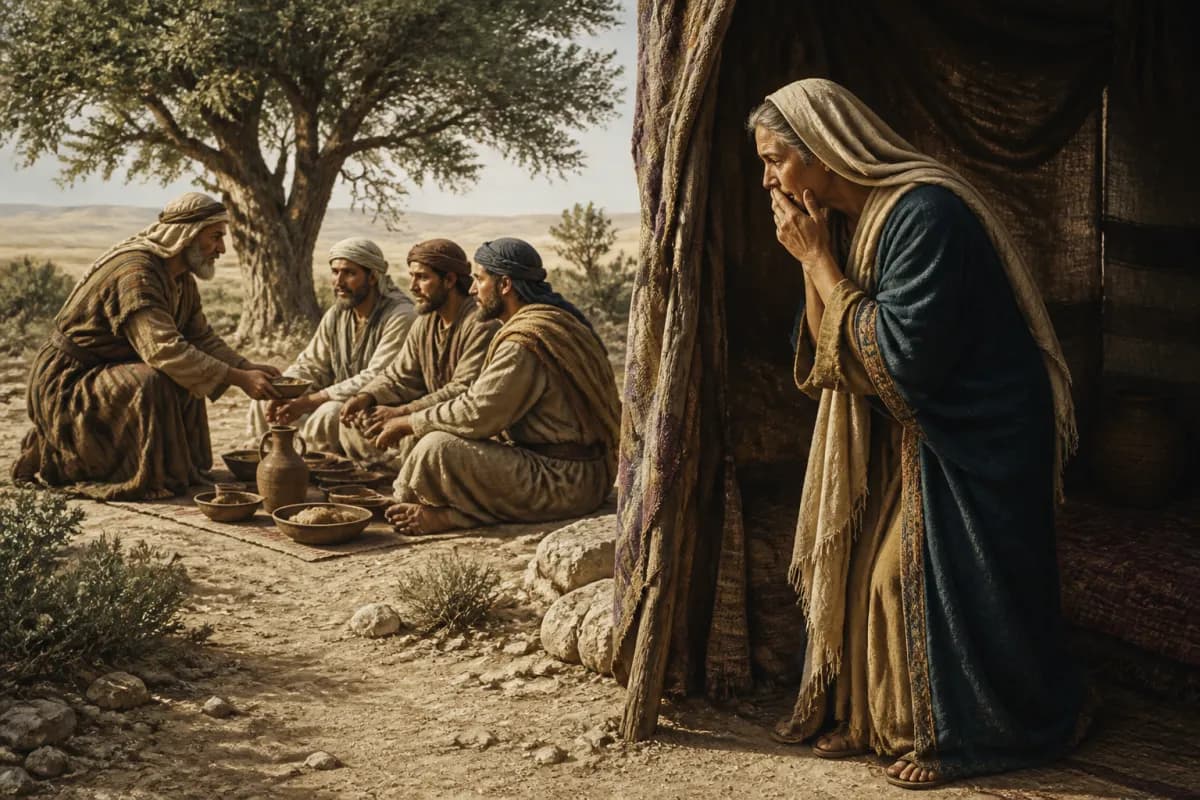
Genesis 18:1–19 brings the Lord’s promise into Abraham’s tent through three visitors. Abraham offers eager hospitality, Sarah hears that she will bear a son despite her age, and the Lord exposes her hidden laughter with the question, “Is anything too wonderful for the Lord?” The passage directs readers to the God who keeps His impossible promise and, in Jesus, brings His saving presence near.
- In this study
- 19 verses · 5 movements
Genesis 18
18:1The LORD appeared to him by the oaks of Mamre, as he sat in the tent door in the heat of the day.
18:2He lifted up his eyes and looked, and saw that three men stood near him. When he saw them, he ran to meet them from the tent door, and bowed himself to the earth,
18:3and said, “My lord, if now I have found favor in your sight, please don’t go away from your servant.
18:4Now let a little water be fetched, wash your feet, and rest yourselves under the tree.
18:5I will get a piece of bread so you can refresh your heart. After that you may go your way, now that you have come to your servant.” They said, “Very well, do as you have said.”
18:6Abraham hurried into the tent to Sarah, and said, “Quickly prepare three seahs of fine meal, knead it, and make cakes.”
18:7Abraham ran to the herd, and fetched a tender and good calf, and gave it to the servant. He hurried to dress it.
18:8He took butter, milk, and the calf which he had dressed, and set it before them. He stood by them under the tree, and they ate.
18:9They asked him, “Where is Sarah, your wife?” He said, “There, in the tent.”
18:10He said, “I will certainly return to you at about this time next year; and behold, Sarah your wife will have a son.” Sarah heard in the tent door, which was behind him.
18:11Now Abraham and Sarah were old, well advanced in age. Sarah had passed the age of childbearing.
18:12Sarah laughed within herself, saying, “After I have grown old will I have pleasure, my lord being old also?”
18:13The LORD said to Abraham, “Why did Sarah laugh, saying, ‘Will I really bear a child when I am old?’
18:14Is anything too hard for the LORD? At the set time I will return to you, when the season comes around, and Sarah will have a son.”
18:15Then Sarah denied it, saying, “I didn’t laugh,” for she was afraid. He said, “No, but you did laugh.”
18:16The men rose up from there, and looked toward Sodom. Abraham went with them to see them on their way.
18:17The LORD said, “Will I hide from Abraham what I do,
18:18since Abraham will surely become a great and mighty nation, and all the nations of the earth will be blessed in him?
18:19For I have known him, to the end that he may command his children and his household after him, that they may keep the way of the LORD, to do righteousness and justice; to the end that the LORD may bring on Abraham that which he has spoken of him.”
CONTEXTUAL OVERVIEW
Genesis places this encounter immediately after God has named Sarah as the mother of Isaac. Abraham is sitting at the entrance of his tent in the heat of the day when he sees three men. He runs to greet them, bows, offers water, bread, and a lavish meal, and stands by while they eat beneath the trees.
The hospitality opens into a promise that reaches Sarah inside the tent. She has already heard that she will bear a son, but the announcement makes the future painfully personal: by the next season she will have a child. Her laughter is not performed for the visitors; the Lord hears what she says within herself and brings her fear into the open.
HISTORICAL AND LITERARY CONTEXT
Hospitality to travelers was a serious obligation in the ancient world, especially in a landscape where a visitor needed food, water, shade, and protection. Abraham’s abundance—cakes from fine flour, a tender calf, curds, and milk—signals more than basic politeness. He receives strangers as honored guests before the narrative makes their identity fully clear.
The passage alternates between “the Lord” and the visitors in a way that gives the encounter unusual weight. Genesis does not provide a developed explanation of how the three are related, so readers should avoid assigning each visitor a later doctrinal role. The text is clear about what matters: the Lord Himself knows Sarah’s inner response and speaks the covenant promise again.
SECTION-BY-SECTION ANALYSIS
- The open tent · Genesis 18:6Abraham’s welcome makes his household a place where strangers receive rest and provision.
- Sarah’s hidden laugh · Genesis 18:13The Lord hears what Sarah says within herself, showing that His promise addresses private fear as well as public speech.
- The appointed time · Genesis 18:10The promised son will come on God’s timetable, making the birth a gift rather than a human achievement.
CHRIST IN THIS PASSAGE
The promised birth of Isaac is a strong pattern of God bringing life where human ability has reached its limit; it is not identical with the virgin birth of Jesus. The New Testament treats Isaac as a child of promise and sees the covenant line continuing toward the Messiah. God’s faithfulness to Sarah preserves the family through which Christ will come.
The Lord’s knowledge of Sarah’s hidden laughter also prepares readers for the saving presence of Jesus, who knows hearts and nevertheless draws near to fearful people. In Christ, God’s promise is no longer merely heard outside a tent: the eternal Son comes among us to bear sin, defeat death, and fulfill the blessing promised to Abraham’s family for the nations.
REFLECTION
Sarah’s laughter gives language to the moment when a promise from God collides with a body, history, or circumstance that seems to rule out hope. The Lord does not ask her to pretend the limitation is unreal. He asks whether the limitation is greater than His power and then commits Himself to act at His appointed time.
Abraham’s table gives the church a second instruction. Faith in the God of promise can make room for strangers, not as a strategy for self-image, but as service offered under His generous care. Jesus receives us as undeserving guests and teaches His people to extend that welcome in His name.
Original Hebrew Word Study
Genesis 18:14
פָּלָא
pala · H6381
Usually translated: to be wonderful, extraordinary, or too difficult
Pala names what is wonderful or beyond ordinary ability. The Lord’s question about Sarah’s promised son makes clear that the obstacle is not age or circumstance but whether anything is beyond the Lord.
Follow the Scripture trail
The Guests at Mamre: Promise, Hospitality, and Sarah’s Laughter in the larger story
The connection: At Mamre, God renews the promise that Sarah will bear the son through whom the covenant line continues. Jesus is the greater fulfillment of that promise-line: through His death and resurrection, God brings saving life where human strength and hope have failed.
Respond to the passage
Tell Jesus where you have laughed inwardly because His grace seems unlikely to reach a particular fear, loss, or person. Ask Him for patient faith, and practice His welcome by making concrete room for someone who needs rest, food, attention, or belonging.
- What do Abraham’s actions reveal about the character of his hospitality?
- Why does the Lord address Sarah’s hidden laughter instead of allowing it to remain private?
- How does Isaac’s promised birth lead carefully, rather than mechanically, toward hope in Jesus?
Prayer
God of promise, nothing is too difficult for You. Meet my hidden fear with Your faithful word, and make my home and church places of generous welcome. Thank You for Jesus, who brings Your saving life near. Amen.