Passage Study
Isaac Is Born: God Keeps His Word
Genesis 21:1–21:21
Genesis 21:1–21 celebrates Isaac’s birth exactly as God had promised, gives Sarah’s laughter a new meaning, and then faces the painful separation of Hagar and Ishmael. God’s promise to Sarah does not erase His compassion for Hagar’s son. The passage teaches that God fulfills His covenant word and sees the vulnerable, directing hope toward Jesus, the promised Son through whom blessing comes to the world.
- In this study
- 21 verses · 5 movements
Genesis 21
21:1The LORD visited Sarah as he had said, and the LORD did to Sarah as he had spoken.
21:2Sarah conceived, and bore Abraham a son in his old age, at the set time of which God had spoken to him.
21:3Abraham called his son who was born to him, whom Sarah bore to him, Isaac.
21:4Abraham circumcised his son, Isaac, when he was eight days old, as God had commanded him.
21:5Abraham was one hundred years old when his son, Isaac, was born to him.
21:6Sarah said, “God has made me laugh. Everyone who hears will laugh with me.”
21:7She said, “Who would have said to Abraham that Sarah would nurse children? For I have borne him a son in his old age.”
21:8The child grew and was weaned. Abraham made a great feast on the day that Isaac was weaned.
21:9Sarah saw the son of Hagar the Egyptian, whom she had borne to Abraham, mocking.
21:10Therefore she said to Abraham, “Cast out this servant and her son! For the son of this servant will not be heir with my son, Isaac.”
21:11The thing was very grievous in Abraham’s sight on account of his son.
21:12God said to Abraham, “Don’t let it be grievous in your sight because of the boy, and because of your servant. In all that Sarah says to you, listen to her voice. For your offspring will be named through Isaac.
21:13I will also make a nation of the son of the servant, because he is your child.”
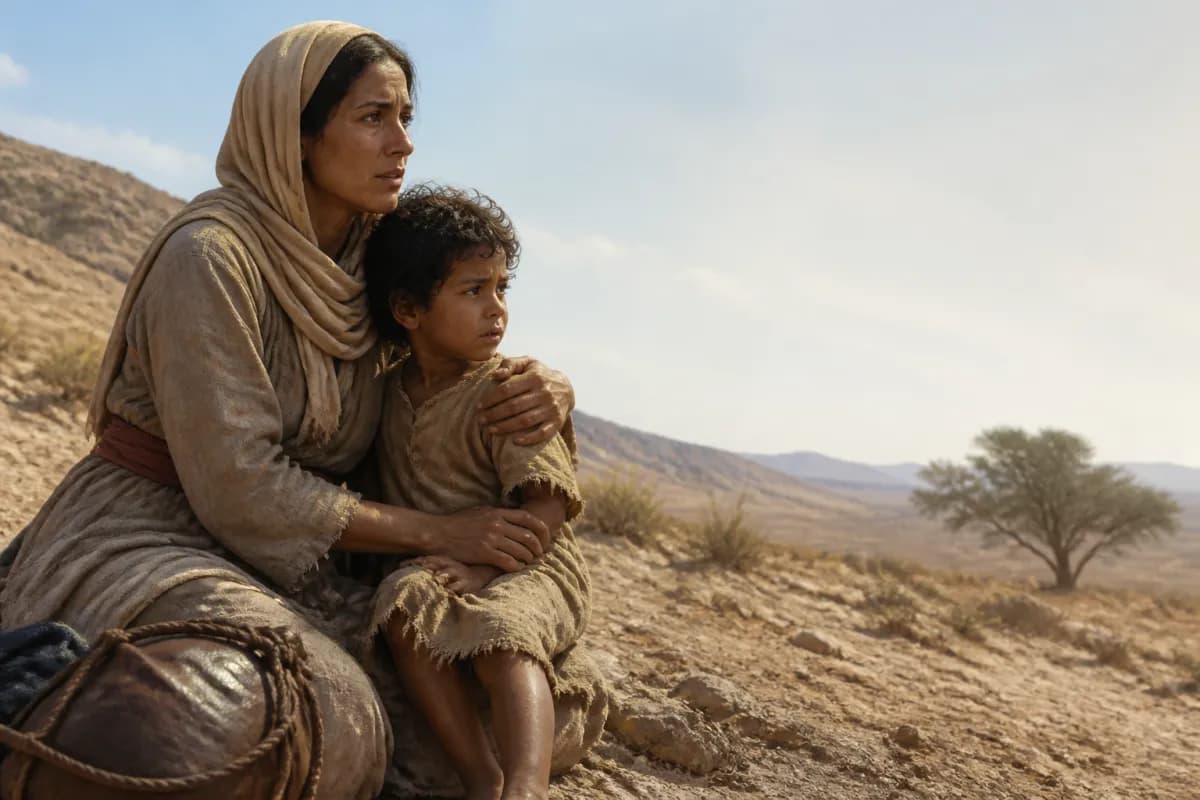
21:14Abraham rose up early in the morning, and took bread and a container of water, and gave it to Hagar, putting it on her shoulder; and gave her the child, and sent her away. She departed, and wandered in the wilderness of Beersheba.
21:15The water in the container was spent, and she put the child under one of the shrubs.
21:16She went and sat down opposite him, a good way off, about a bow shot away. For she said, “Don’t let me see the death of the child.” She sat opposite him, and lifted up her voice, and wept.
21:17God heard the voice of the boy. The angel of God called to Hagar out of the sky, and said to her, “What troubles you, Hagar? Don’t be afraid. For God has heard the voice of the boy where he is.
21:18Get up, lift up the boy, and hold him with your hand. For I will make him a great nation.”
21:19God opened her eyes, and she saw a well of water. She went, filled the container with water, and gave the boy a drink.
21:20God was with the boy, and he grew. He lived in the wilderness, and as he grew up, he became an archer.
21:21He lived in the wilderness of Paran. His mother got a wife for him out of the land of Egypt.
CONTEXTUAL OVERVIEW
The opening words are intentionally emphatic: the Lord visits Sarah “as he had said” and does for her “as he had promised.” After decades of waiting and repeated assurances, Isaac’s arrival turns promise into a crying child in Abraham and Sarah’s tent. The name Isaac, connected with laughter, holds together Sarah’s former incredulity and her astonished joy.
The passage does not end at the celebration. Ishmael and Hagar’s removal brings grief to Abraham and danger in the wilderness. Genesis insists that Isaac is the child through whom the covenant line will be named, while also insisting that God sees, hears, and provides for Ishmael.
HISTORICAL AND LITERARY CONTEXT
Genesis 21 closes the long narrative tension created when Abram and Sarai tried to secure offspring through Hagar in Genesis 16. The son born from that human arrangement is not ignored, but Isaac’s birth through Sarah confirms that God’s covenant promise cannot be manufactured by human impatience.
The chapter also prepares for Genesis 22. Abraham’s love for the long-awaited Isaac will make the command to offer him uniquely piercing. Before that test, Genesis makes clear that Isaac is not merely Abraham’s beloved son; he is the son God gave according to His word and the bearer of the covenant promise.
SECTION-BY-SECTION ANALYSIS
- As promised · Genesis 21:4The repeated language makes Isaac’s birth an act of God’s faithfulness, not an achievement explained by human timing or ability.
- Laughter · Genesis 21:2Sarah’s laughter becomes testimony that God can turn long disbelief and sorrow into astonished joy.
- The wilderness well · Genesis 21:14God’s provision for Hagar and Ishmael shows that His covenant election never authorizes indifference toward the vulnerable.
CHRIST IN THIS PASSAGE
Isaac is the promised son, but he is not the Savior. The New Testament reads the promised offspring and Abraham’s family as part of the covenant story that reaches its fulfillment in Christ. Jesus is the ultimate promised Son, born by God’s initiative, through whom the blessing promised to Abraham reaches people from every nation.
The contrast between relying on human arrangement and receiving God’s promise also sharpens the gospel’s message of grace. Salvation is not secured by human ingenuity, ancestry, or effort. Jesus brings sinners into God’s family through His saving work, creating children of promise who live by faith in what God has done.
REFLECTION
Waiting can tempt believers to treat God’s promise as a problem to solve by any available means. Isaac’s birth teaches patience without passivity: Abraham and Sarah receive what God gives at the time God names. The chapter also warns against celebrating a personal answer to prayer while overlooking someone else’s need.
Jesus teaches His people to trust the Father who knows their needs and to reflect His care for the distressed. Christian hope is not denial of grief; Abraham is genuinely distressed. It is confidence that the God who kept His word to Sarah and heard Ishmael in the wilderness remains faithful and compassionate in Christ.
Original Hebrew Word Study
Genesis 21:6
צָחַק
tsachaq · H6711
Usually translated: to laugh
Tsachaq means to laugh. Isaac’s name keeps the laughter of promise in view: Sarah’s laughter has moved from disbelief and surprise to joy at what God has done.
Follow the Scripture trail
Isaac Is Born: God Keeps His Word in the larger story
The connection: Isaac’s birth proves that God can keep the promise no human scheme could secure. The covenant line carries forward to Jesus, the promised Son whose saving mission brings Abraham’s blessing to the nations and welcomes believers into God’s family by grace.
Respond to the passage
Receive God’s promises with patient trust rather than trying to force outcomes by fear or control. As you rejoice in His provision, look for the person in the wilderness beside you and reflect the compassion Jesus has shown you.
- Why does Genesis repeat that Sarah conceived and gave birth as God had said and promised?
- How does Sarah’s laughter differ from a refusal to trust God?
- What does God’s care for Ishmael and Hagar teach about holding covenant confidence together with compassion?
Prayer
Faithful God, thank You that Your promises do not depend on my ability to manufacture their fulfillment. Teach me to wait with faith, rejoice with humility, and see those who are in need. Thank You for Jesus, Your promised Son, who brings me into Your family by grace. Amen.