Passage Study
Sarah’s Burial: A Grave as a Confession of Promise
Genesis 23:1–23:20
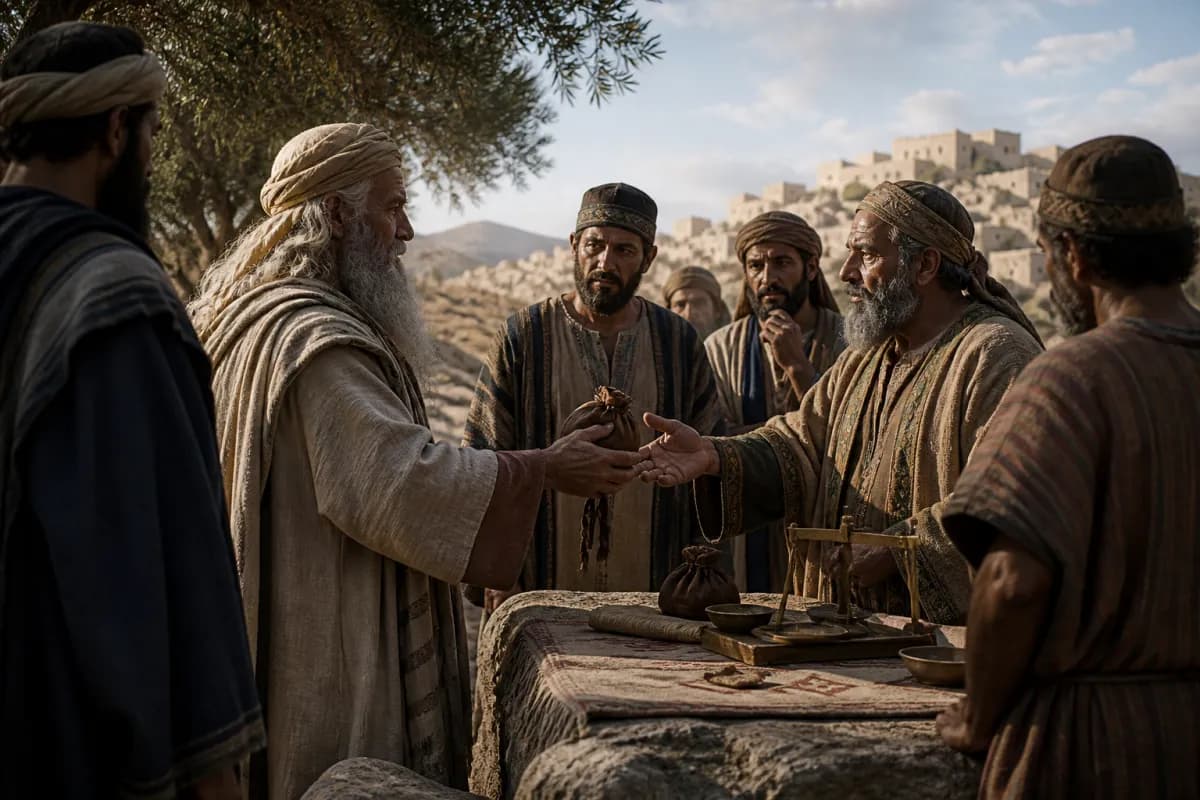
Genesis 23 records Sarah’s death and Abraham’s careful purchase of the cave of Machpelah at Hebron. Though promised the whole land, Abraham owns only a burial place; his costly, public purchase becomes a concrete confession that God’s promise reaches beyond one lifetime and that death will not have the final word.
- In this study
- 20 verses · 5 movements
Genesis 23
23:1Sarah lived one hundred twenty-seven years. This was the length of Sarah’s life.
23:2Sarah died in Kiriath Arba (also called Hebron), in the land of Canaan. Abraham came to mourn for Sarah, and to weep for her.
23:3Abraham rose up from before his dead and spoke to the children of Heth, saying,
23:4“I am a stranger and a foreigner living with you. Give me a possession of a burying-place with you, that I may bury my dead out of my sight.”
23:5The children of Heth answered Abraham, saying to him,
23:6“Hear us, my lord. You are a prince of God among us. Bury your dead in the best of our tombs. None of us will withhold from you his tomb. Bury your dead.”
23:7Abraham rose up, and bowed himself to the people of the land, to the children of Heth.
23:8He talked with them, saying, “If you agree that I should bury my dead out of my sight, hear me, and entreat for me to Ephron the son of Zohar,
23:9that he may sell me the cave of Machpelah, which he has, which is in the end of his field. For the full price let him sell it to me among you as a possession for a burial place.”
23:10Now Ephron was sitting in the middle of the children of Heth. Ephron the Hittite answered Abraham in the hearing of the children of Heth, even of all who went in at the gate of his city, saying,
23:11“No, my lord, hear me. I give you the field, and I give you the cave that is in it. In the presence of the children of my people I give it to you. Bury your dead.”
23:12Abraham bowed himself down before the people of the land.
23:13He spoke to Ephron in the audience of the people of the land, saying, “But if you will, please hear me. I will give the price of the field. Take it from me, and I will bury my dead there.”
23:14Ephron answered Abraham, saying to him,
23:15“My lord, listen to me. What is a piece of land worth four hundred shekels of silver between me and you? Therefore bury your dead.”
23:16Abraham listened to Ephron. Abraham weighed to Ephron the silver which he had named in the hearing of the children of Heth, four hundred shekels of silver, according to the current merchants’ standard.
23:17So the field of Ephron, which was in Machpelah, which was before Mamre, the field, the cave which was in it, and all the trees that were in the field, that were in all of its borders, were deeded
23:18to Abraham for a possession in the presence of the children of Heth, before all who went in at the gate of his city.
23:19After this, Abraham buried Sarah his wife in the cave of the field of Machpelah before Mamre (that is, Hebron), in the land of Canaan.
23:20The field, and the cave that is in it, were deeded to Abraham by the children of Heth as a possession for a burial place.
CONTEXTUAL OVERVIEW
Sarah’s death brings the first burial of a patriarchal family member in Canaan. Abraham has received God’s promise of land, yet he calls himself a resident alien among the Hittites and must ask for a place to bury his wife. The chapter makes grief visible: Abraham comes to mourn and weep for Sarah before he turns to the practical work of burial.
The extended negotiation is not filler. Genesis records the field, cave, trees, boundary, price, witnesses, and transfer because the burial site is Abraham’s first secure possession in the promised land. The scale is small beside the promise, but it is real, public, and permanent.
HISTORICAL AND LITERARY CONTEXT
Burial land carried family, legal, and social importance in the ancient Near East. Transactions at a city gate occurred before recognized witnesses, which explains the repeated public language in the chapter. Ephron’s repeated offer sounds generous, but Abraham refuses a vague gift and pays the stated price so that no one can later contest the holding.
Hebron lies in the hill country of Canaan and will remain important in Israel’s later history. Genesis does not ask readers to treat a property record as a romantic story. Its careful legal detail roots the promise in a particular place while showing that Abraham still waits for the full inheritance God has pledged.
SECTION-BY-SECTION ANALYSIS
- Mourning and weeping · Genesis 23:2Abraham’s grief is neither hidden nor condemned; covenant faith makes room for honest lament.
- Resident alien · Genesis 23:7Although God promised land, Abraham presently lives without political ownership or security.
- The paid field · Genesis 23:20Abraham’s payment establishes a real burial holding and prevents the promise from being reduced to wishful language.
CHRIST IN THIS PASSAGE
The cave of Machpelah does not directly predict Christ, but it embodies Abraham’s faith that God’s promise outlasts death. Hebrews reflects on the patriarchs as people who died in faith without receiving everything promised, looking beyond the visible horizon to the city God prepares. Their burial in the land is a witness of hope rather than a claim that the promise is already complete.
Jesus gives that hope its saving center. He enters death, bears sin, and rises bodily so that His people may grieve without surrendering to despair. The purchased grave points toward a faith that takes death seriously while trusting God’s future; Christ’s resurrection guarantees that future for all who belong to Him.
REFLECTION
Abraham teaches believers how to mourn with faith: he does not minimize Sarah’s death, and he does not act as if God’s promise has failed. Christians can bring real tears to God while confessing that Jesus has defeated death and will raise His people.
The chapter also encourages patient faith. God may give a true beginning without granting complete fulfillment in our lifetime. In Christ, faithful acts of love, burial, remembrance, and hope matter because the future belongs to the risen Lord, not to death or possession.
Original Hebrew Word Study
Genesis 23:20
אֲחֻזָּה
achuzzah · H272
Usually translated: property or permanent holding
Achuzzah is a permanent holding. Abraham’s burial purchase is small compared with the promised land, yet it becomes his first legal possession there and a quiet confession that God’s promise will outlast his lifetime.
Follow the Scripture trail
Sarah’s Burial: A Grave as a Confession of Promise in the larger story
The connection: Sarah’s grave in Canaan declares that God’s promise is larger than Abraham’s present possession and stronger than death. Jesus fulfills that hope through His resurrection, securing life with God for all who trust Him.
Respond to the passage
Bring a grief or fear of death honestly to Jesus. Thank Him for His resurrection, and practice hope in a concrete way by caring for someone who is mourning or by speaking His promise where despair has taken hold.
- Why does Genesis devote so much space to the purchase of one field and cave?
- How do Abraham’s tears and his careful legal action work together?
- How does Jesus’ resurrection change the way Christians face burial and loss?
Prayer
Lord Jesus, You know the sorrow of death and You have conquered its final power. Comfort those who mourn, teach me to grieve truthfully, and anchor my hope in Your resurrection and promised renewal. Amen.