Passage Study
Jacob and Esau: Promise, Struggle, and a Despised Birthright
Genesis 25:21–25:34
Genesis 25:21–34 introduces Jacob and Esau through Rebekah’s barren years, a troubled pregnancy, God’s surprising oracle, and Esau’s sale of his birthright for stew. The passage exposes the danger of trading God’s lasting gift for immediate appetite while showing that the covenant promise advances by God’s mercy, not by human strength or status.
- In this study
- 14 verses · 5 movements
Genesis 25
25:21Isaac entreated the LORD for his wife, because she was barren. The LORD was entreated by him, and Rebekah his wife conceived.
25:22The children struggled together within her. She said, “If it is like this, why do I live?” She went to inquire of the LORD.
25:23The LORD said to her, “Two nations are in your womb. Two peoples will be separated from your body. The one people will be stronger than the other people. The elder will serve the younger.”
25:24When her days to be delivered were fulfilled, behold, there were twins in her womb.
25:25The first came out red all over, like a hairy garment. They named him Esau.
25:26After that, his brother came out, and his hand had hold on Esau’s heel. He was named Jacob. Isaac was sixty years old when she bore them.
25:27The boys grew. Esau was a skillful hunter, a man of the field. Jacob was a quiet man, living in tents.
25:28Now Isaac loved Esau, because he ate his venison. Rebekah loved Jacob.
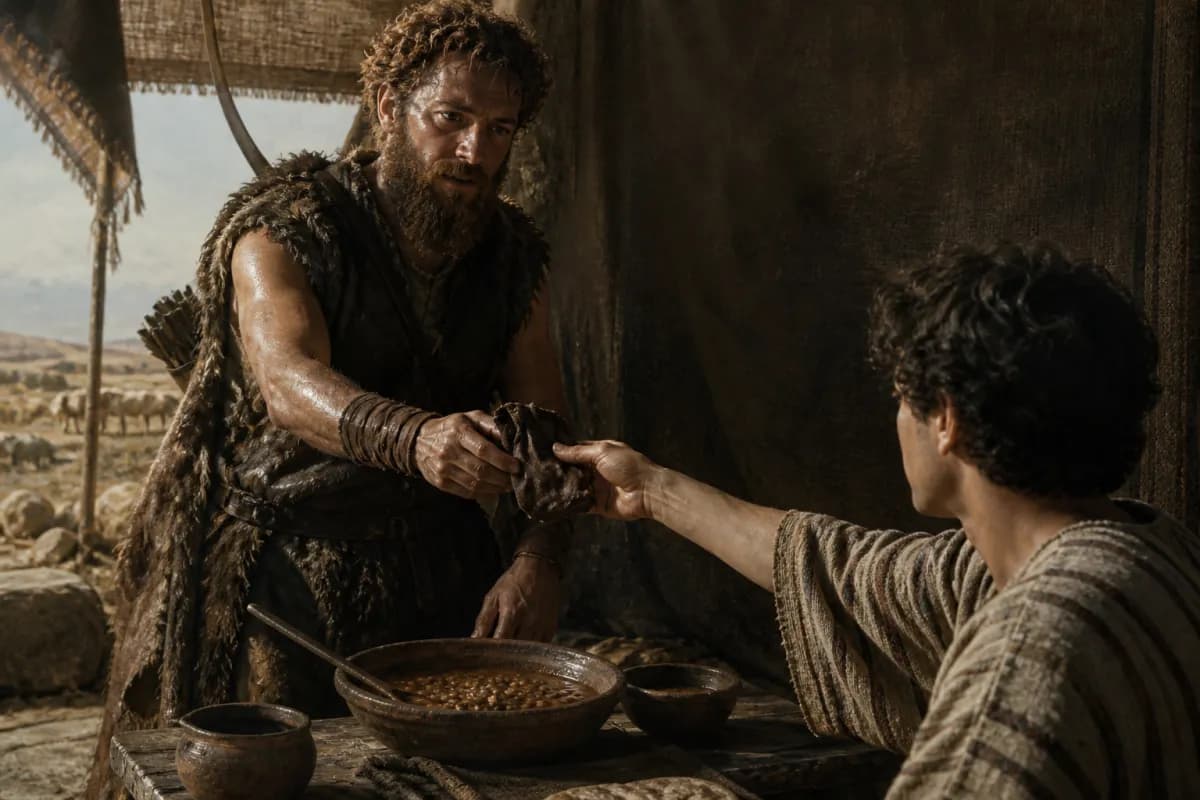
25:29Jacob boiled stew. Esau came in from the field, and he was famished.
25:30Esau said to Jacob, “Please feed me with some of that red stew, for I am famished.” Therefore his name was called Edom.
25:31Jacob said, “First, sell me your birthright.”
25:32Esau said, “Behold, I am about to die. What good is the birthright to me?”
25:33Jacob said, “Swear to me first.” He swore to him. He sold his birthright to Jacob.
25:34Jacob gave Esau bread and lentil stew. He ate and drank, rose up, and went his way. So Esau despised his birthright.
CONTEXTUAL OVERVIEW
Isaac is forty when he marries Rebekah, and the passage says he prays because she is barren. The twenty-year wait before the twins are born makes their conception a gift of God, echoing the earlier births of Isaac and Ishmael. Yet the answered prayer quickly becomes difficult: the children struggle inside Rebekah, and she asks why this is happening to her.
God’s answer establishes the central surprise before either child has acted: two nations are in her womb, and the older will serve the younger. The later stew scene does not make Jacob innocent; it shows Esau’s contempt for a lasting inheritance and begins a family conflict shaped by appetite, favoritism, and God’s sovereign promise.
HISTORICAL AND LITERARY CONTEXT
The birthright normally carried the firstborn’s special inheritance and family responsibility. In this covenant family it is more than property, because God’s promise of descendants, land, and blessing is attached to the line. Esau’s sale of the birthright therefore reveals a spiritual disregard, not merely a poor meal-time bargain.
Genesis presents the oracle before the boys are born so that readers know the covenant outcome is not achieved by Jacob’s deserving behavior. Isaac prefers Esau and Rebekah prefers Jacob, a divided affection that will intensify the household’s wounds. The text records their preferences without commending them.
SECTION-BY-SECTION ANALYSIS
- Isaac prayed · Genesis 25:21The twins arrive through God’s answer to barrenness, not as a guarantee created by human plans.
- The older shall serve the younger · Genesis 25:23God announces a reversal of normal inheritance expectations before either child has earned a claim.
- He despised his birthright · Genesis 25:34Esau’s hunger is real, but the text judges his choice as contempt for a covenant inheritance that mattered beyond the moment.
CHRIST IN THIS PASSAGE
The oracle of the younger over the older shows that God’s covenant purpose rests on His mercy rather than on birth order, human achievement, or parental preference. Paul reflects on Jacob and Esau to make that point about God’s calling purpose. The passage should not be used to excuse manipulation; Jacob’s later life shows that God’s grace does not approve deceit.
Jesus is the true heir who does not trade His mission for immediate relief. In the wilderness He refuses to use His sonship to satisfy hunger apart from the Father’s will. Through His faithful obedience and sacrificial death, He gives a secure inheritance to those who trust Him and calls them to value God’s kingdom above passing appetite.
REFLECTION
Esau’s story asks where immediate desire is making a lasting gift look small. Hunger, exhaustion, fear, and pressure are real; Jesus meets people in weakness with compassion. But they are dangerous moments for deciding what matters most, and believers need prayer, community, and practiced trust so that temporary relief does not become a ruling master.
Jacob’s calculation gives the matching warning. God’s promise does not authorize us to grasp, exploit, or manipulate. Jesus calls His people to receive grace humbly and to seek His kingdom with truthful hands, trusting that the Father’s faithfulness is stronger than our schemes.
Original Hebrew Word Study
Genesis 25:31
בְּכֹרָה
bekhorah · H1062
Usually translated: birthright
Bekhorah is the birthright, the inheritance privilege of the firstborn. Esau exchanges a lasting covenant responsibility for immediate hunger, making the scene a warning about treating God’s gifts as disposable.
Follow the Scripture trail
Jacob and Esau: Promise, Struggle, and a Despised Birthright in the larger story
The connection: Jacob and Esau show that God’s promise advances by mercy rather than human rank, while warning against contempt for His gifts. Jesus, the faithful Son and true heir, completes His saving mission without yielding to temptation and shares His inheritance with believers.
Respond to the passage
Name one immediate appetite or pressure that tempts you to treat Christ’s kingdom as secondary. Bring it honestly to Jesus, ask for His strength, and take one practical step that protects a lasting obedience over a passing relief.
- Why does Genesis tell Rebekah the oracle before the twins are born?
- How does the final sentence interpret Esau’s sale of the birthright?
- What does Jesus’ wilderness temptation teach about facing real need without surrendering to it?
Prayer
Lord Jesus, forgive me for treating Your gifts lightly when I want relief now. Give me Your faithfulness in temptation, protect me from grasping what You have promised, and teach me to value Your kingdom above every passing appetite. Amen.