Passage Study
Wives for Jacob and Esau: Preserving the Covenant Line
Genesis 27:46–28:9
Genesis 27:46–28:9 sends Jacob away from Canaan to seek a wife among Rebekah’s kin, while Esau responds to his parents’ grief by adding a marriage from Ishmael’s line. The passage moves a divided household toward Jacob’s exile and God’s next encounter at Bethel. It shows that God preserves His covenant purpose through flawed family decisions and points to Jesus, who creates a holy people by grace and fulfills the promise of blessing for the nations.
- In this study
- 10 verses · 5 movements
Genesis 27
27:46Rebekah said to Isaac, “I am weary of my life because of the daughters of Heth. If Jacob takes a wife of the daughters of Heth, such as these, of the daughters of the land, what good will my life do me?”
Genesis 28
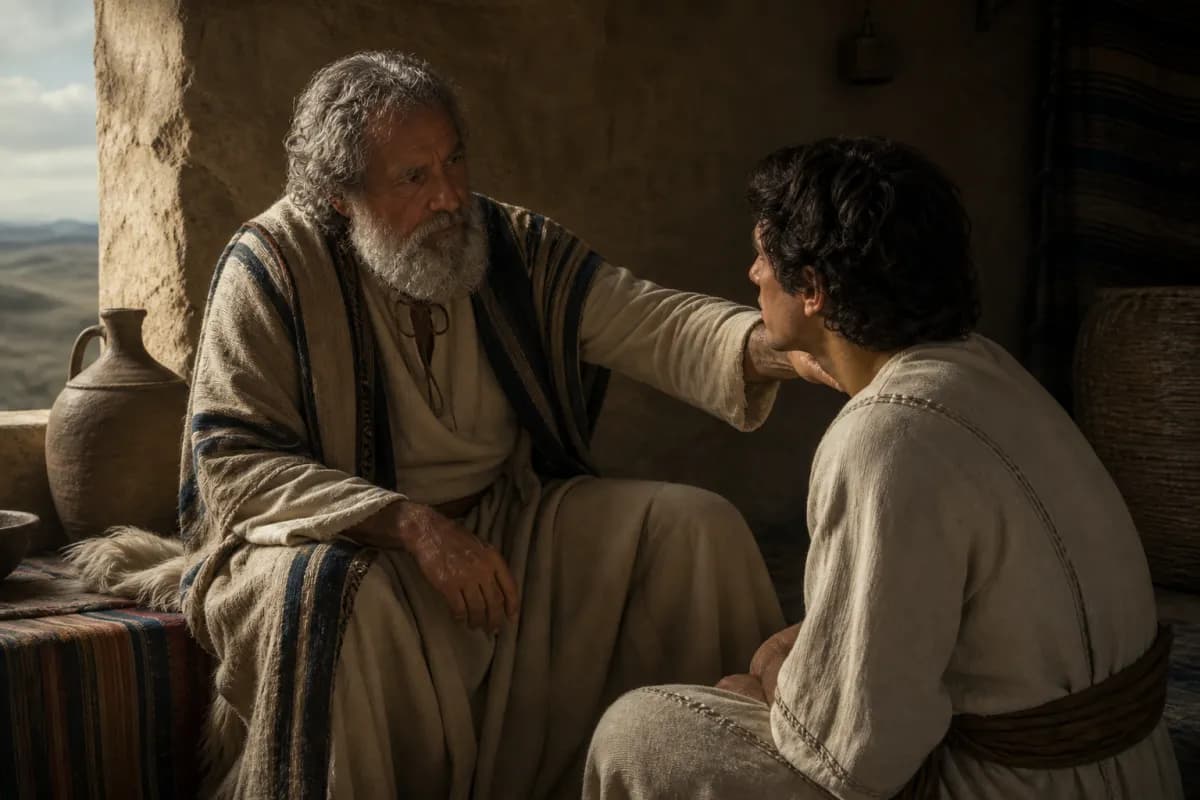
28:1Isaac called Jacob, blessed him, and commanded him, “You shall not take a wife of the daughters of Canaan.
28:2Arise, go to Paddan Aram, to the house of Bethuel your mother’s father. Take a wife from there from the daughters of Laban, your mother’s brother.
28:3May God Almighty bless you, and make you fruitful, and multiply you, that you may be a company of peoples,
28:4and give you the blessing of Abraham, to you and to your offspring with you, that you may inherit the land where you travel, which God gave to Abraham.”
28:5Isaac sent Jacob away. He went to Paddan Aram to Laban, son of Bethuel the Syrian, the brother of Rebekah, Jacob’s and Esau’s mother.
28:6Now Esau saw that Isaac had blessed Jacob and sent him away to Paddan Aram, to take him a wife from there, and that as he blessed him he gave him a command, saying, “You shall not take a wife of the daughters of Canaan;”
28:7and that Jacob obeyed his father and his mother, and was gone to Paddan Aram.
28:8Esau saw that the daughters of Canaan didn’t please Isaac, his father.
28:9So Esau went to Ishmael, and took, in addition to the wives that he had, Mahalath the daughter of Ishmael, Abraham’s son, the sister of Nebaioth, to be his wife.
CONTEXTUAL OVERVIEW
After Esau’s threat against Jacob, Rebekah speaks to Isaac about the grief caused by Esau’s Hittite wives. Her words also provide a way to send Jacob away without placing the immediate danger at the center of the conversation. Isaac responds by blessing Jacob again and directing him not to marry a Canaanite woman but to travel to Paddan-aram, the household of Rebekah’s brother Laban.
The scene is quieter than the deception that precedes it, but its consequences are immense. Jacob is leaving the promised land and the family home; the next major stage of his life will unfold in exile. Isaac’s blessing names the God of Abraham and asks for fruitfulness, many descendants, and possession of the land. God’s promise is being carried forward even as the family bears the damage of its own sin.
HISTORICAL AND LITERARY CONTEXT
Marriage in Genesis involves households, land, worship, and the future of the covenant family. Abraham had earlier sent for a wife for Isaac from his kin rather than taking a Canaanite wife, and Isaac’s instruction follows that pattern. The text’s concern is covenant loyalty in a particular family story; it should not be used as a blanket rule about ethnicity or a license for Christians to treat other peoples as inferior.
Esau notices that his Canaanite wives displease his father and marries Mahalath, a daughter of Ishmael. His action shows awareness of the family’s concern, but the narrative does not present it as a recovery of the blessing. It places his choice beside Jacob’s commissioned journey, continuing the distinction between the covenant promise through Jacob and the wider Abrahamic family lines that Genesis also remembers.
SECTION-BY-SECTION ANALYSIS
- A second blessing · Genesis 28:4Isaac consciously gives Jacob the Abrahamic promise, showing that the earlier blessing obtained by deception is not the whole basis for Jacob’s future.
- A journey into exile · Genesis 27:46Jacob leaves the land under a promise, beginning the road that will lead to Bethel, Laban’s household, and eventual return.
- Esau’s response · Genesis 28:5His additional marriage recognizes parental displeasure but cannot manufacture the covenant inheritance God has assigned.
CHRIST IN THIS PASSAGE
The blessing of Abraham belongs to the promise that Scripture traces to Jesus. Jacob’s journey and marriage are part of the family history through which God preserves the line; they are not a direct prediction of Christ or a model that can be copied without regard to their covenant setting. The clear connection is God’s determination to keep His promise despite a household’s confusion and failure.
Jesus fulfills the blessing as Abraham’s promised offspring, bringing people from the nations into God’s family through faith. His saving mission forms a people set apart for God, not by family pedigree or moral performance, but by His mercy. He gives believers a truer belonging than the approval or disappointment of an earthly household.
REFLECTION
This passage invites a sober view of relationships that shape faith. Marriage and family decisions are never merely private in Genesis, because they can strengthen or weaken a household’s capacity to live under God’s word. Christian readers should make such decisions prayerfully and wisely, seeking shared devotion to Christ while avoiding pride, prejudice, or pressure disguised as spirituality.
Esau’s response also warns against treating repentance as image management. It is possible to notice someone else’s disappointment and make an adjustment without facing the deeper posture that has resisted God’s word. Jesus offers a better way: honest confession, a new identity received by grace, and a life gradually reordered by love for Him rather than fear of losing status.
Original Hebrew Word Study
Genesis 27:46
מָרַר
marar · H4843
Usually translated: to make bitter
Marar means to make bitter. Rebekah’s grief over Esau’s Hittite wives brings the family’s covenant distinctness into view as Jacob is sent toward a marriage within Abraham’s wider household.
Follow the Scripture trail
Wives for Jacob and Esau: Preserving the Covenant Line in the larger story
The connection: Jacob leaves home carrying the Abrahamic promise into an uncertain exile, while Esau cannot recover blessing by managing appearances. Jesus fulfills that promise by bringing people from every nation into God’s family through grace and forming them for faithful life under His rule.
Respond to the passage
Bring your family pressures and hopes for belonging to Jesus. Ask Him to give you wisdom for relationships, freedom from image management, and courage to obey His word with humility and love.
- Why does Isaac deliberately repeat the Abrahamic blessing when he sends Jacob away?
- What is the difference between Esau noticing disapproval and receiving God’s covenant promise?
- How does belonging to Christ reshape the way believers make important family and relationship decisions?
Prayer
Lord Jesus, thank You for bringing me into God’s family by grace. Give me wisdom in the relationships that shape my life, free me from living for appearances, and teach me to seek Your will with humility, courage, and love. Amen.