Passage Study
Jacob Prepares to Meet Esau: Fear Brought Before God
Genesis 32:3–32:22
Genesis 32:3–22 shows Jacob approaching the brother he wronged with fear, gifts, and a prayer that clings to God’s promise. His practical preparation is real, but he cannot engineer reconciliation or secure his future by calculation. The passage points to Jesus, whose saving mission makes true reconciliation possible by dealing with sin rather than merely managing its consequences.
- In this study
- 20 verses · 5 movements
Genesis 32
32:3Jacob sent messengers in front of him to Esau, his brother, to the land of Seir, the field of Edom.
32:4He commanded them, saying, “This is what you shall tell my lord, Esau: ‘This is what your servant, Jacob, says. I have lived as a foreigner with Laban, and stayed until now.
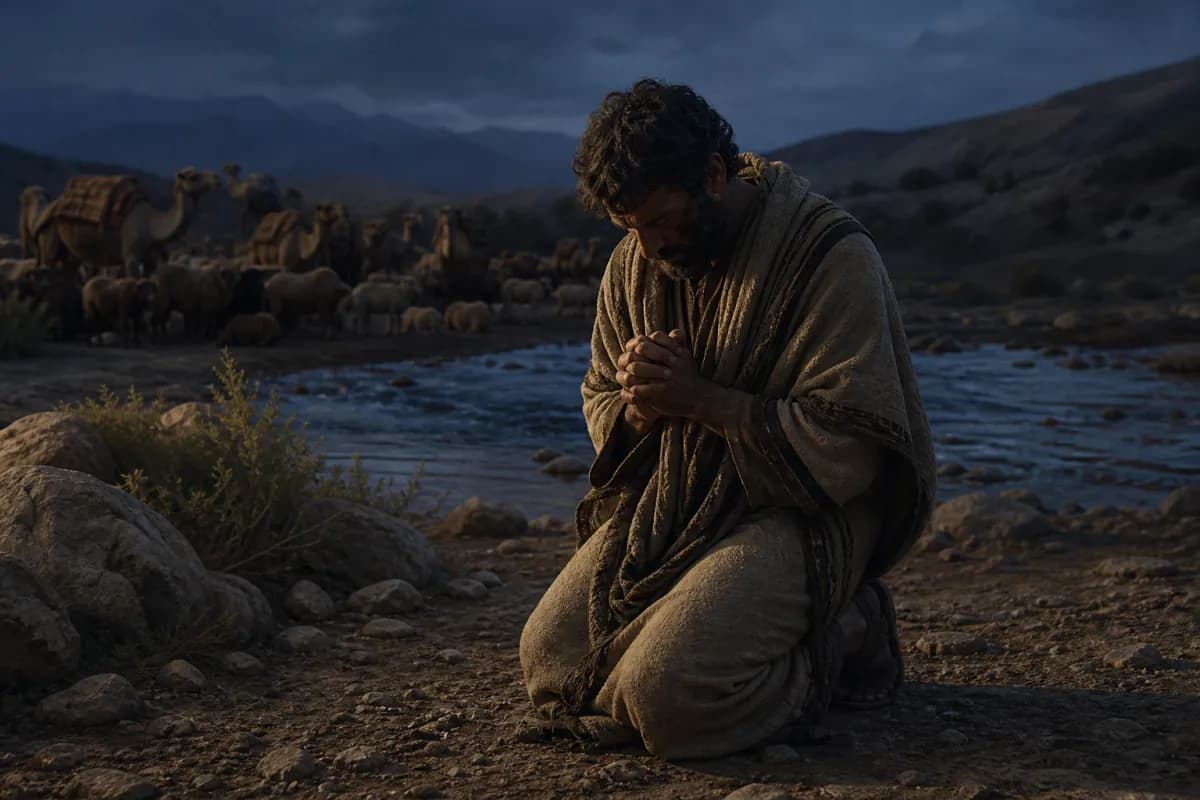
32:5I have cattle, donkeys, flocks, male servants, and female servants. I have sent to tell my lord, that I may find favor in your sight.’”
32:6The messengers returned to Jacob, saying, “We came to your brother Esau. He is coming to meet you, and four hundred men are with him.”
32:7Then Jacob was greatly afraid and was distressed. He divided the people who were with him, along with the flocks, the herds, and the camels, into two companies.
32:8He said, “If Esau comes to the one company, and strikes it, then the company which is left will escape.”
32:9Jacob said, “God of my father Abraham, and God of my father Isaac, the LORD, who said to me, ‘Return to your country, and to your relatives, and I will do you good,’
32:10I am not worthy of the least of all the loving kindnesses, and of all the truth, which you have shown to your servant; for with just my staff I crossed over this Jordan; and now I have become two companies.
32:11Please deliver me from the hand of my brother, from the hand of Esau; for I fear him, lest he come and strike me and the mothers with the children.
32:12You said, ‘I will surely do you good, and make your offspring as the sand of the sea, which can’t be counted because there are so many.’”
32:13He stayed there that night, and took from that which he had with him a present for Esau, his brother:
32:14two hundred female goats and twenty male goats, two hundred ewes and twenty rams,
32:15thirty milk camels and their colts, forty cows, ten bulls, twenty female donkeys and ten foals.
32:16He delivered them into the hands of his servants, every herd by itself, and said to his servants, “Pass over before me, and put a space between herd and herd.”
32:17He commanded the foremost, saying, “When Esau, my brother, meets you, and asks you, saying, ‘Whose are you? Where are you going? Whose are these before you?’
32:18Then you shall say, ‘They are your servant, Jacob’s. It is a present sent to my lord, Esau. Behold, he also is behind us.’”
32:19He commanded also the second, and the third, and all that followed the herds, saying, “This is how you shall speak to Esau, when you find him.
32:20You shall say, ‘Not only that, but behold, your servant, Jacob, is behind us.’” For, he said, “I will appease him with the present that goes before me, and afterward I will see his face. Perhaps he will accept me.”
32:21So the present passed over before him, and he himself stayed that night in the camp.
32:22He rose up that night, and took his two wives, and his two servants, and his eleven sons, and crossed over the ford of the Jabbok.
CONTEXTUAL OVERVIEW
Jacob has left Laban and is moving toward Canaan, but the return requires facing Esau. Years earlier Jacob gained the birthright and blessing through exploitation and deception; now the report that Esau comes with four hundred men makes him deeply afraid. The narrative lets the fear stand. Jacob does not know whether his brother comes to forgive or to destroy.
The passage joins responsible action with dependent prayer. Jacob divides his people and sends gifts, yet he also appeals to the Lord’s own words: God told him to return and promised to do him good. Jacob’s plan cannot turn past guilt into peace; his prayer recognizes that the covenant God must keep the promise He has spoken.
HISTORICAL AND LITERARY CONTEXT
This scene deliberately recalls Jacob’s earlier flight from Esau in Genesis 27–28. He returns with wives, children, servants, and flocks, the very abundance God has given him during his absence. The abundance is not a shield against the moral weight of what he did to his brother, which is why the scene presses toward a meeting rather than allowing Jacob to settle safely before it.
The gifts are called minchah, a term that can denote a gift or tribute. In this setting they communicate deference to Esau and seek favor from him. Their size shows Jacob’s anxiety, but Genesis does not say that the gifts themselves purchase reconciliation. The next chapter will make clear that Esau’s welcome is a surprising act of grace.
SECTION-BY-SECTION ANALYSIS
- The four hundred · Genesis 32:6Esau’s approaching company turns Jacob’s homecoming into an immediate crisis and exposes the limits of his confidence.
- The prayer · Genesis 32:9Jacob does not claim merit; he appeals to God’s command, promise, and steadfast love while naming the danger plainly.
- The tribute · Genesis 32:3The costly gifts acknowledge Esau’s dignity, but they cannot substitute for the reconciliation Jacob cannot control.
CHRIST IN THIS PASSAGE
Jacob’s gifts can express humility, but they cannot remove guilt before God or guarantee a wounded brother’s forgiveness. The gospel answers the deeper need this anxious approach exposes. Jesus does not merely bring a tribute to make sinners acceptable; through His death He removes the hostility created by sin and brings those far off near to God.
The passage therefore offers a wise but limited pattern for human repair: tell the truth about harm, take responsible steps, pray, and leave the outcome with God. Christ’s saving mission supplies what Jacob’s strategy cannot—reconciliation with God that creates the freedom to seek peace with others without trying to control their response.
REFLECTION
Some fears are the return of a past we would rather leave behind. Jacob’s example does not commend denial. He prepares carefully and brings his fear into prayer, admitting that the people with him may suffer because of the conflict he helped create. That is a more honest beginning than spiritual language used to avoid responsibility.
Jesus calls His people to pursue reconciliation where it depends on them. That may include confession, restitution, or a humble request for peace. It does not mean manipulating an injured person into an instant answer. Because Christ has secured our standing with God, we can take truthful steps toward repair and entrust the result to Him.
Original Hebrew Word Study
Genesis 32:13
מִנְחָה
minchah · H4503
Usually translated: gift, tribute, or offering
Minchah is a gift or tribute. Jacob’s elaborate gift to Esau expresses both fear and a desire for favor, preparing the reader to see that reconciliation will require more than his careful management.
Follow the Scripture trail
Jacob Prepares to Meet Esau: Fear Brought Before God in the larger story
The connection: Jacob’s return forces him to face the brother he deceived and to depend on God’s promise rather than his own management. Jesus accomplishes the saving reconciliation Jacob cannot purchase, bringing guilty people to God and sending them to pursue peace with honesty and humility.
Respond to the passage
Name the relationship or harm you are trying to manage without facing. Ask Jesus for the courage to take the truthful next step, and entrust to Him the response you cannot command.
- Why does Jacob combine practical preparation with prayer instead of treating either one as sufficient?
- What does Jacob’s confession of unworthiness add to his appeal for deliverance?
- How does reconciliation through Christ free you to seek repair without trying to control another person?
Prayer
Lord Jesus, forgive the ways I have harmed others and then tried to manage the consequences without truth. Give me Jacob’s humility to pray, prepare wisely, and seek peace. Hold the outcomes I cannot control in Your faithful hands. Amen.