Passage Study
Reconciliation: Esau Runs to Meet Jacob
Genesis 33:1–33:17
Genesis 33:1–17 brings Jacob and Esau face to face after years of estrangement. Jacob bows, expects danger, and is met by an embrace, tears, and peace. The scene displays reconciliation as a costly grace that cannot be controlled or presumed upon, and it directs readers toward Jesus, who makes peace with God and calls His people to pursue peace truthfully with one another.
- In this study
- 17 verses · 5 movements
Genesis 33
33:1Jacob lifted up his eyes, and looked, and, behold, Esau was coming, and with him four hundred men. He divided the children between Leah, Rachel, and the two servants.
33:2He put the servants and their children in front, Leah and her children after, and Rachel and Joseph at the rear.
33:3He himself passed over in front of them, and bowed himself to the ground seven times, until he came near to his brother.
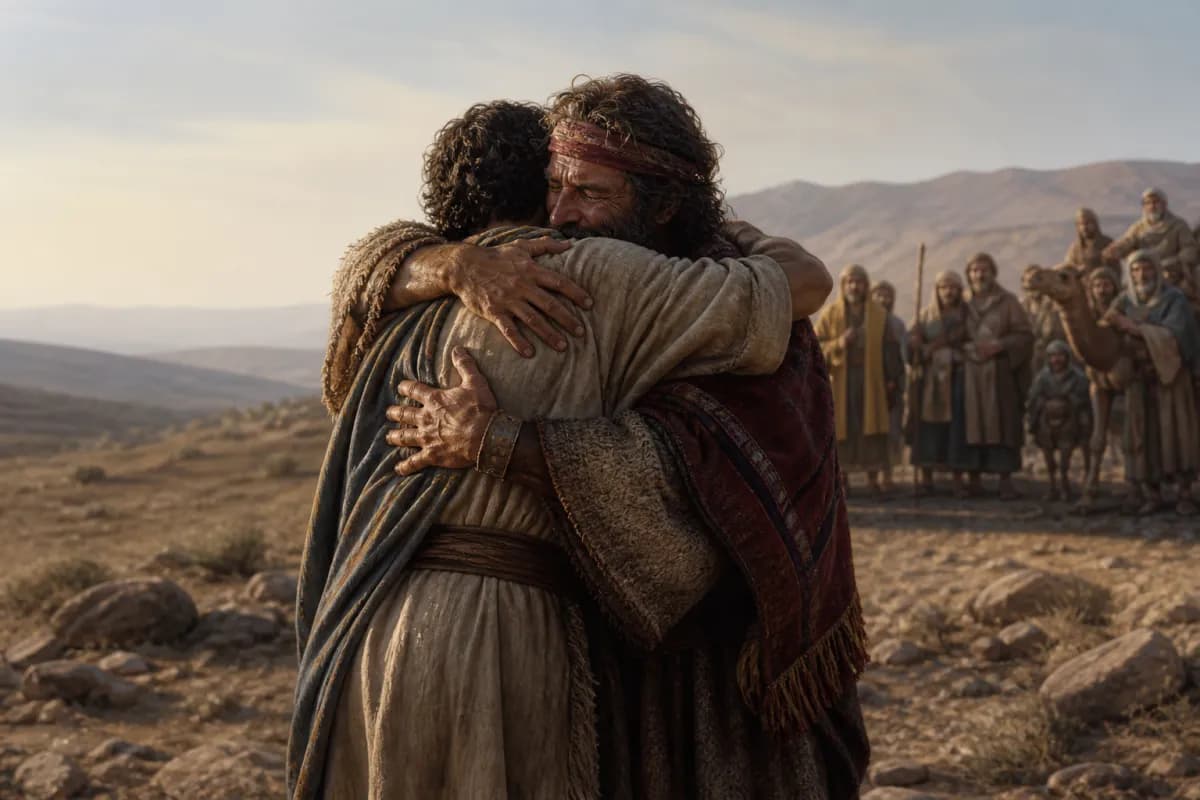
33:4Esau ran to meet him, embraced him, fell on his neck, kissed him, and they wept.
33:5He lifted up his eyes, and saw the women and the children; and said, “Who are these with you?” He said, “The children whom God has graciously given your servant.”
33:6Then the servants came near with their children, and they bowed themselves.
33:7Leah also and her children came near, and bowed themselves. After them, Joseph came near with Rachel, and they bowed themselves.
33:8Esau said, “What do you mean by all this company which I met?” Jacob said, “To find favor in the sight of my lord.”
33:9Esau said, “I have enough, my brother; let that which you have be yours.”
33:10Jacob said, “Please, no, if I have now found favor in your sight, then receive my present at my hand, because I have seen your face, as one sees the face of God, and you were pleased with me.
33:11Please take the gift that I brought to you, because God has dealt graciously with me, and because I have enough.” He urged him, and he took it.
33:12Esau said, “Let’s take our journey, and let’s go, and I will go before you.”
33:13Jacob said to him, “My lord knows that the children are tender, and that the flocks and herds with me have their young, and if they overdrive them one day, all the flocks will die.
33:14Please let my lord pass over before his servant, and I will lead on gently, according to the pace of the livestock that are before me and according to the pace of the children, until I come to my lord to Seir.”
33:15Esau said, “Let me now leave with you some of the people who are with me.” He said, “Why? Let me find favor in the sight of my lord.”
33:16So Esau returned that day on his way to Seir.
33:17Jacob traveled to Succoth, built himself a house, and made shelters for his livestock. Therefore the name of the place is called Succoth.
CONTEXTUAL OVERVIEW
The brother Jacob feared runs toward him, embraces him, falls on his neck, kisses him, and weeps. The speed and tenderness of Esau’s welcome answer the threatening ambiguity of Genesis 32, but they do not erase the wrong that made the meeting necessary. Jacob approaches bowed low, conscious that he is receiving something he could not secure by his gift or predict from Esau’s earlier anger.
The encounter has the shape of a family restoration, not a generic lesson about being pleasant. Jacob introduces wives and children, speaks of God’s gracious provision, and urges Esau to receive the gift. Their peace allows each brother to continue with his household, while Jacob’s delayed route and later settlement preserve the narrative’s attention to wisdom as well as warmth.
HISTORICAL AND LITERARY CONTEXT
Genesis 33 resolves the immediate crisis begun when Esau vowed to kill Jacob after losing the blessing. The preceding night at Peniel has left Jacob limping and newly named Israel; he now walks toward Esau as a man whose confidence has been broken and re-formed by God. The gifts prepared in Genesis 32 are received, but the key action is Esau’s free embrace.
Jacob says that seeing Esau’s face is like seeing the face of God, because Esau has received him favorably. The comparison does not equate Esau with God or soften the seriousness of Jacob’s past. It expresses Jacob’s astonishment that the meeting he expected to bring judgment has become a place of undeserved welcome after his encounter with God at Peniel.
SECTION-BY-SECTION ANALYSIS
- The seven bows · Genesis 33:3Jacob’s posture admits the gravity of the relationship he damaged and abandons the old posture of grasping superiority.
- The embrace · Genesis 33:4Esau’s welcome is an unearned mercy that turns an expected confrontation into peace.
- The gift received · Genesis 33:11The tribute becomes part of Jacob’s humble repair, though it does not buy the forgiveness that Esau freely extends.
CHRIST IN THIS PASSAGE
Esau’s embrace is a real human act of forgiveness, but it cannot by itself resolve the universal estrangement between sinful people and God. Jacob’s language about seeing his brother’s face after seeing God’s face makes the scene a fitting echo of reconciliation as grace: the guilty person is received rather than destroyed. In Jesus, that grace is accomplished at far greater depth through His atoning death and risen life.
Christ makes peace with God and creates one new people across hostile divisions. The story does not promise that every earthly relationship will be restored in the same way or time. It does show why Jesus’ mission matters: reconciliation needs more than good intentions; it needs the mercy, truth, and costly peace God gives in Him.
REFLECTION
Jacob’s approach offers no formula for making another person forgive. He prepares, takes responsibility in posture and speech, and receives a mercy he cannot demand. For people who have done harm, this is a sober hope: repentance seeks repair without treating an injured person’s response as something owed.
For those asked to forgive, Esau’s welcome displays the beauty of mercy without erasing the need for wisdom. Jesus gives believers the security to pursue peace because their deepest reconciliation with God is already a gift. That security can produce courage, confession, patience, and appropriate boundaries in complicated relationships.
Original Hebrew Word Study
Genesis 33:10
פָּנִים
panim · H6440
Usually translated: face or presence
Panim means face or presence. Jacob says seeing Esau’s face is like seeing the face of God, expressing the surprising grace of reconciliation after he expected judgment.
Follow the Scripture trail
Reconciliation: Esau Runs to Meet Jacob in the larger story
The connection: The meeting of Jacob and Esau reveals reconciliation as undeserved mercy after real wrong. Jesus brings that pattern to its saving center by reconciling sinners to God through the cross and making His people ambassadors of the peace they have received.
Respond to the passage
If you have harmed someone, ask Jesus for humility to confess and make repair without demanding an outcome. If you carry a wound, ask Him for wisdom about forgiveness, truth, and boundaries. His peace is strong enough to guide you through what remains difficult.
- Why do Jacob’s bows and Esau’s embrace both matter for understanding this reconciliation?
- What does Jacob mean when he compares seeing Esau’s face with seeing God’s face?
- How does Christ’s reconciliation with God shape both repentance and forgiveness in a damaged relationship?
Prayer
Lord Jesus, thank You for receiving sinners through Your costly peace. Give me courage to confess the harm I have done, grace to forgive as You lead, and wisdom for the boundaries truth requires. Make me an agent of Your reconciliation. Amen.