Passage Study
Joseph Sold into Slavery: Beloved Son, Betrayed Brother
Genesis 37:1–37:36
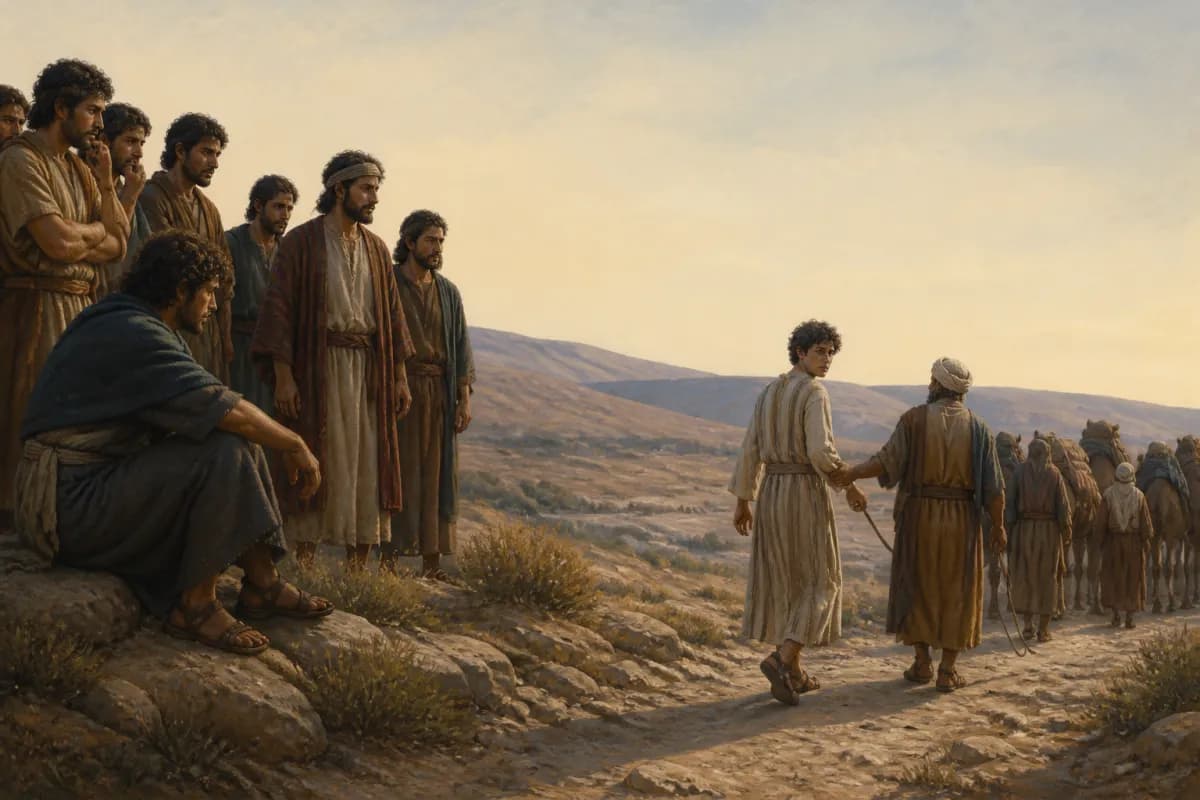
Genesis 37:1–36 begins Joseph’s descent from his father’s beloved son to a slave bound for Egypt. His brothers’ envy turns murderous, and their deception breaks Jacob with grief. Yet the final line quietly places Joseph in Egypt, where God will preserve the family. The story prepares readers for Jesus, the beloved Son who was rejected and whose saving mission turns human evil toward life.
- In this study
- 36 verses · 5 movements
Genesis 37
37:1Jacob lived in the land of his father’s travels, in the land of Canaan.
37:2This is the history of the generations of Jacob. Joseph, being seventeen years old, was feeding the flock with his brothers. He was a boy with the sons of Bilhah and Zilpah, his father’s wives. Joseph brought an evil report of them to their father.
37:3Now Israel loved Joseph more than all his children, because he was the son of his old age, and he made him a tunic of many colors.
37:4His brothers saw that their father loved him more than all his brothers, and they hated him, and couldn’t speak peaceably to him.
37:5Joseph dreamed a dream, and he told it to his brothers, and they hated him all the more.
37:6He said to them, “Please hear this dream which I have dreamed:
37:7for behold, we were binding sheaves in the field, and behold, my sheaf arose and also stood upright; and behold, your sheaves came around, and bowed down to my sheaf.”
37:8His brothers asked him, “Will you indeed reign over us? Will you indeed have dominion over us?” They hated him all the more for his dreams and for his words.
37:9He dreamed yet another dream, and told it to his brothers, and said, “Behold, I have dreamed yet another dream: and behold, the sun and the moon and eleven stars bowed down to me.”
37:10He told it to his father and to his brothers. His father rebuked him, and said to him, “What is this dream that you have dreamed? Will I and your mother and your brothers indeed come to bow ourselves down to the earth before you?”
37:11His brothers envied him, but his father kept this saying in mind.
37:12His brothers went to feed their father’s flock in Shechem.
37:13Israel said to Joseph, “Aren’t your brothers feeding the flock in Shechem? Come, and I will send you to them.” He said to him, “Here I am.”
37:14He said to him, “Go now, see whether it is well with your brothers, and well with the flock; and bring me word again.” So he sent him out of the valley of Hebron, and he came to Shechem.
37:15A certain man found him, and behold, he was wandering in the field. The man asked him, “What are you looking for?”
37:16He said, “I am looking for my brothers. Tell me, please, where they are feeding the flock.”
37:17The man said, “They have left here, for I heard them say, ‘Let’s go to Dothan.’” Joseph went after his brothers, and found them in Dothan.
37:18They saw him afar off, and before he came near to them, they conspired against him to kill him.
37:19They said to one another, “Behold, this dreamer comes.
37:20Come now therefore, and let’s kill him, and cast him into one of the pits, and we will say, ‘An evil animal has devoured him.’ We will see what will become of his dreams.”
37:21Reuben heard it, and delivered him out of their hand, and said, “Let’s not take his life.”
37:22Reuben said to them, “Shed no blood. Throw him into this pit that is in the wilderness, but lay no hand on him”—that he might deliver him out of their hand, to restore him to his father.
37:23When Joseph came to his brothers, they stripped Joseph of his tunic, the tunic of many colors that was on him;
37:24and they took him, and threw him into the pit. The pit was empty. There was no water in it.
37:25They sat down to eat bread, and they lifted up their eyes and looked, and saw a caravan of Ishmaelites coming from Gilead, with their camels bearing spices and balm and myrrh, going to carry it down to Egypt.
37:26Judah said to his brothers, “What profit is it if we kill our brother and conceal his blood?
37:27Come, and let’s sell him to the Ishmaelites, and not let our hand be on him; for he is our brother, our flesh.” His brothers listened to him.
37:28Midianites who were merchants passed by, and they drew and lifted up Joseph out of the pit, and sold Joseph to the Ishmaelites for twenty pieces of silver. The merchants brought Joseph into Egypt.
37:29Reuben returned to the pit, and saw that Joseph wasn’t in the pit; and he tore his clothes.
37:30He returned to his brothers, and said, “The child is no more; and I, where will I go?”
37:31They took Joseph’s tunic, and killed a male goat, and dipped the tunic in the blood.
37:32They took the tunic of many colors, and they brought it to their father, and said, “We have found this. Examine it, now, and see if it is your son’s tunic or not.”
37:33He recognized it, and said, “It is my son’s tunic. An evil animal has devoured him. Joseph is without doubt torn in pieces.”
37:34Jacob tore his clothes, and put sackcloth on his waist, and mourned for his son many days.
37:35All his sons and all his daughters rose up to comfort him, but he refused to be comforted. He said, “For I will go down to Sheol to my son, mourning.” His father wept for him.
37:36The Midianites sold him into Egypt to Potiphar, an officer of Pharaoh’s, the captain of the guard.
CONTEXTUAL OVERVIEW
Genesis moves from Jacob’s troubled household to the next generation. Joseph is seventeen, loved by his father more than his brothers, and marked by the robe Jacob gives him. The brothers already hate him before the dreams intensify the conflict. Their hatred is not a vague family tension; it becomes a decision to remove the brother whose future appears to threaten them.
Jacob sends Joseph from the valley of Hebron to seek the brothers near Shechem and Dothan. The journey matters: Joseph goes as his father’s son, looking for his brothers’ welfare, and arrives where they have already planned against him. The scene invites readers to feel the vulnerability of a loved son walking into a rejection he does not yet understand.
HISTORICAL AND LITERARY CONTEXT
Genesis 37 begins the Joseph narrative after the account of Esau’s descendants. The focus returns to the covenant family and asks how that family will survive famine, internal violence, and eventual migration to Egypt. Joseph’s dreams will later prove true, but at this point the narrative does not use them to excuse the brothers or to make Joseph’s suffering painless.
The caravan is described with merchandise suited for trade toward Egypt, and Joseph is sold through the brothers’ arrangement. The text does not require a reconstruction of every merchant label to make its point: the brothers treat their own flesh and blood as an object of profit. Judah’s proposal spares Joseph from immediate murder, yet it remains a betrayal for money.
Did you know?
An ancient clay contract from Nippur records a person sold for ten shekels of silver, followed by an oath and a list of witnesses. Even a miller and a courtyard sweeper appear among those witnesses.
Why it matters: The contract gives a sobering glimpse of the documented trade in human lives behind Joseph’s sale.
SECTION-BY-SECTION ANALYSIS
- The robe · Genesis 37:2The robe is both a sign of Jacob’s special affection and the object the brothers use to manufacture their lie.
- The pit · Genesis 37:24The empty pit exposes Joseph’s helplessness and the brothers’ willingness to abandon him before they profit from his sale.
- The tears · Genesis 37:28Jacob’s grief shows that sin does not remain inside the hearts of those who choose it; it devastates people who are kept outside the deception.
CHRIST IN THIS PASSAGE
Joseph is not Jesus in every detail, and Genesis 37 does not directly predict the crucifixion. Its canonical pattern is nevertheless strong: a father’s beloved son is sent to his brothers, rejected by them, stripped, and handed over for silver. The Gospels present Jesus as the Father’s beloved Son who comes to His own and is rejected by those He came to serve.
The larger Joseph story shows God using the brothers’ evil to preserve life, while the New Testament declares that Jesus’ death, brought about by sinful human hands, is also God’s saving purpose for forgiveness and resurrection life. Christ’s mission never makes betrayal good; it shows that human evil cannot finally defeat God’s mercy or His purpose to rescue sinners.
REFLECTION
Envy becomes dangerous when another person’s gift, attention, or future is felt as a threat to our own worth. The brothers cannot bear Joseph’s place in the family, so they rewrite the family by violence and falsehood. Genesis asks us to name envy before it grows into contempt, sabotage, or the quiet pleasure of another person’s loss.
Jesus meets both the betrayed and the betrayer with truth. Those wounded by another’s sin may trust that their story is not invisible to God. Those who recognize the brothers’ envy in themselves are called to repent without excuse. The crucified and risen Son offers forgiveness and forms a people who learn to rejoice in another’s good rather than compete for a place God gives by grace.
Original Hebrew Word Study
Genesis 37:5
חֲלוֹם
chalom · H2472
Usually translated: dream
Chalom is a dream. Joseph’s dreams provoke his brothers’ envy, but the narrative later reveals that God’s purpose was at work in the very events meant to destroy him.
Follow the Scripture trail
Joseph Sold into Slavery: Beloved Son, Betrayed Brother in the larger story
The connection: Joseph’s rejection begins the descent through which God will preserve Israel in Egypt. The pattern reaches its saving fullness in Jesus, the beloved Son rejected by His own yet raised to bring forgiveness and life to those who turn to Him.
Respond to the passage
Ask Jesus to expose any envy that has made another person’s blessing feel like your loss. If you carry betrayal, bring its real wound to the Son who was rejected. He calls you to truth, repentance, and hope that evil will not have the final word.
- What do the robe and the dreams reveal about the brothers’ resentment before they act on it?
- Why is it important that Genesis later names both the brothers’ evil and God’s preserving purpose?
- How does Jesus’ rejection give both comfort to the betrayed and a call to repentance for the envious?
Prayer
Father, keep envy from taking root in me. Thank You for sending Jesus, Your beloved Son, who was rejected to bring sinners forgiveness and life. Heal the wounds of betrayal and make me a person who rejoices in Your grace toward others. Amen.