Passage Study
Judah and Tamar: Justice Exposed in a Broken Family
Genesis 38:1–38:30
Genesis 38:1–30 interrupts Joseph’s story to confront Judah’s failure toward Tamar, a widowed woman left without the justice and protection owed to her. Tamar’s carefully preserved evidence brings Judah to confession: she is more in the right than he is. God carries the promise through a grievously disordered family, leading ultimately to Jesus, the King from Judah who brings righteous mercy rather than exploitation.
- In this study
- 30 verses · 5 movements
Genesis 38
38:1At that time, Judah went down from his brothers, and visited a certain Adullamite, whose name was Hirah.
38:2There, Judah saw the daughter of a certain Canaanite man named Shua. He took her, and went in to her.
38:3She conceived, and bore a son; and he named him Er.
38:4She conceived again, and bore a son; and she named him Onan.
38:5She yet again bore a son, and named him Shelah. He was at Chezib when she bore him.
38:6Judah took a wife for Er, his firstborn, and her name was Tamar.
38:7Er, Judah’s firstborn, was wicked in the LORD’s sight. So the LORD killed him.
38:8Judah said to Onan, “Go in to your brother’s wife, and perform the duty of a husband’s brother to her, and raise up offspring for your brother.”
38:9Onan knew that the offspring wouldn’t be his; and when he went in to his brother’s wife, he spilled his semen on the ground, lest he should give offspring to his brother.
38:10The thing which he did was evil in the LORD’s sight, and he killed him also.
38:11Then Judah said to Tamar, his daughter-in-law, “Remain a widow in your father’s house, until Shelah, my son, is grown up;” for he said, “Lest he also die, like his brothers.” Tamar went and lived in her father’s house.
38:12After many days, Shua’s daughter, the wife of Judah, died. Judah was comforted, and went up to his sheep shearers to Timnah, he and his friend Hirah, the Adullamite.
38:13Tamar was told, “Behold, your father-in-law is going up to Timnah to shear his sheep.”
38:14She took off the garments of her widowhood, and covered herself with her veil, and wrapped herself, and sat in the gate of Enaim, which is on the way to Timnah; for she saw that Shelah was grown up, and she wasn’t given to him as a wife.
38:15When Judah saw her, he thought that she was a prostitute, for she had covered her face.
38:16He turned to her by the way, and said, “Please come, let me come in to you,” for he didn’t know that she was his daughter-in-law. She said, “What will you give me, that you may come in to me?”
38:17He said, “I will send you a young goat from the flock.” She said, “Will you give me a pledge, until you send it?”
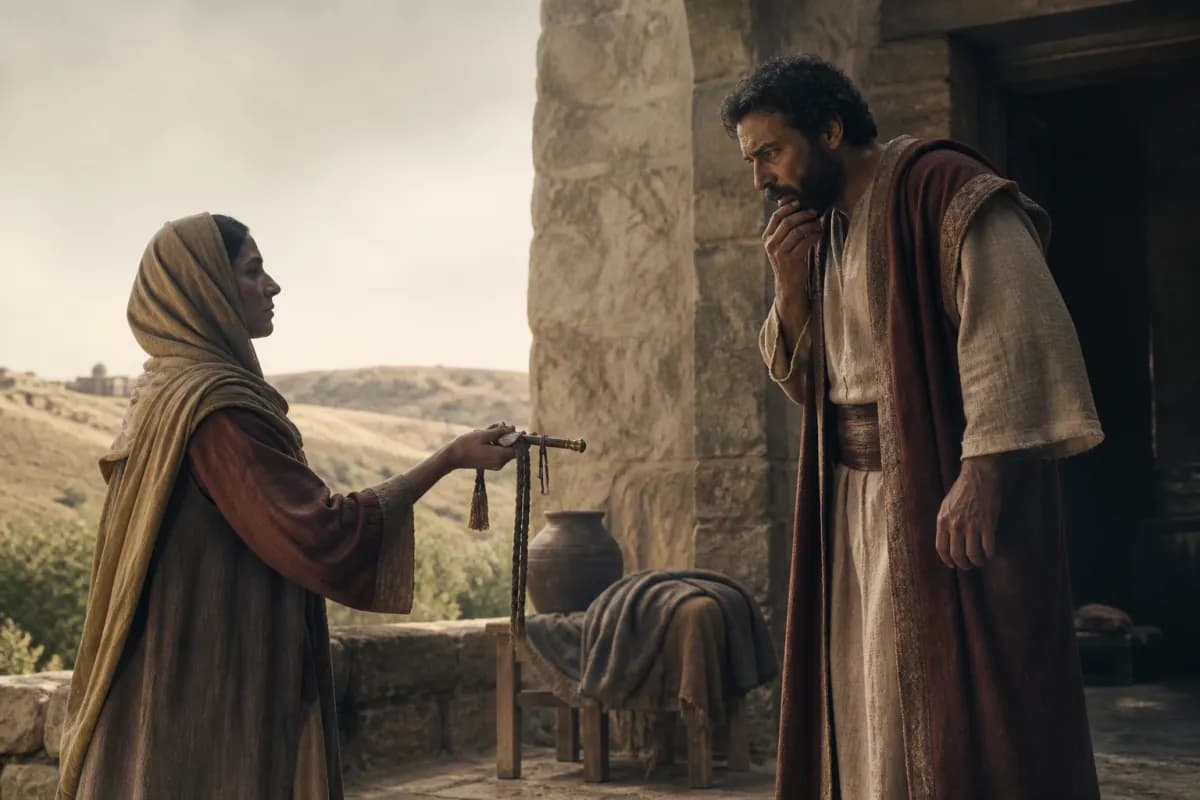
38:18He said, “What pledge will I give you?” She said, “Your signet and your cord, and your staff that is in your hand.” He gave them to her, and came in to her, and she conceived by him.
38:19She arose, and went away, and put off her veil from her, and put on the garments of her widowhood.
38:20Judah sent the young goat by the hand of his friend, the Adullamite, to receive the pledge from the woman’s hand, but he didn’t find her.
38:21Then he asked the men of her place, saying, “Where is the prostitute, that was at Enaim by the road?” They said, “There has been no prostitute here.”
38:22He returned to Judah, and said, “I haven’t found her; and also the men of the place said, ‘There has been no prostitute here.’”
38:23Judah said, “Let her keep it, lest we be shamed. Behold, I sent this young goat, and you haven’t found her.”
38:24About three months later, Judah was told, “Tamar, your daughter-in-law, has played the prostitute. Moreover, behold, she is with child by prostitution.” Judah said, “Bring her out, and let her be burned.”
38:25When she was brought out, she sent to her father-in-law, saying, “I am with child by the man who owns these.” She also said, “Please discern whose these are—the signet, and the cords, and the staff.”
38:26Judah acknowledged them, and said, “She is more righteous than I, because I didn’t give her to Shelah, my son.” He knew her again no more.
38:27In the time of her travail, behold, twins were in her womb.
38:28When she travailed, one put out a hand, and the midwife took and tied a scarlet thread on his hand, saying, “This came out first.”
38:29As he drew back his hand, behold, his brother came out, and she said, “Why have you made a breach for yourself?” Therefore his name was called Perez.
38:30Afterward his brother came out, who had the scarlet thread on his hand, and his name was called Zerah.
CONTEXTUAL OVERVIEW
After helping sell Joseph, Judah separates from his brothers and forms a household among the Canaanites. The chapter slows down over Tamar, first the wife of Judah’s son Er and then the widow of his second son, Onan. Her situation is precarious: she is sent back to her father’s house while Judah promises that his youngest son, Shelah, will be given to her when he is grown.
That promise is never kept. Judah fears losing Shelah and leaves Tamar suspended between households, without the future that the family system was meant to provide. Genesis does not sanitize the means by which Tamar forces the truth into public view, but it makes Judah’s injustice unmistakable and gives Tamar the decisive voice at the point of exposure.
HISTORICAL AND LITERARY CONTEXT
The story belongs within the patriarchal world where a deceased man’s family bore responsibility for preserving a widow’s place and a family line. Later Israelite law regulates a related levirate obligation, but Genesis 38 itself presents a family custom rather than quoting that later law. The central narrative issue is clear: Judah uses his authority to protect himself while denying Tamar the justice he has pledged.
Placed between Joseph’s sale and his life in Egypt, the episode also develops Judah. The brother who proposed selling Joseph for profit is exposed at home as a man who has failed a vulnerable woman. His later willingness to offer himself for Benjamin in Genesis 44 will therefore read as repentance with a history, not as an unexplained change of character.
SECTION-BY-SECTION ANALYSIS
- The withheld promise · Genesis 38:11Judah’s fear of losing Shelah becomes an excuse for leaving Tamar without the protection he has promised.
- The pledge · Genesis 38:18The seal, cord, and staff identify Judah and become the evidence that his hidden conduct cannot remain hidden.
- The confession · Genesis 38:6Judah’s words do not erase the wrong, but they are the chapter’s required turning point: he names Tamar’s greater rightness and his own failure.
CHRIST IN THIS PASSAGE
Genesis 38 does not make Tamar a simple allegory of Christ, and its painful details should not be made decorative. The direct canonical line is Judah: Perez is born in this chapter, and Matthew includes Tamar and Perez in Jesus’ genealogy. The Messiah’s line passes through a family whose sins are exposed rather than hidden beneath a polished religious story.
Jesus is the righteous King from Judah who does not use power to abandon the vulnerable. His saving mission brings sinners into the light, bears judgment for those who repent, and creates a people marked by justice and mercy. The chapter therefore directs readers to Christ without pretending that God’s faithfulness approves Judah’s conduct or turns Tamar’s danger into a moral ideal.
REFLECTION
Judah is quick to judge Tamar while refusing to face his own conduct. The pledge in his hand becomes the evidence he hoped no one would see. This passage calls people with authority—within families, churches, workplaces, and communities—to honor their obligations, especially when another person’s security depends on their integrity.
Jesus does not ask wounded people to pretend injustice is small. He brings hidden sin to light and welcomes repentance that names the truth rather than managing appearances. His church should be a place where the vulnerable are protected, confession is real, and no family’s broken history is beyond the reach of His redeeming mercy.
Original Hebrew Word Study
Genesis 38:26
צָדַק
tsadaq · H6663
Usually translated: to be right or righteous
Tsadaq means to be right or righteous. Judah’s confession that Tamar is more righteous than he is forces him to acknowledge his own failure to provide the justice he owed her.
Follow the Scripture trail
Judah and Tamar: Justice Exposed in a Broken Family in the larger story
The connection: Tamar’s story exposes Judah’s injustice while preserving the line of Perez, from which the royal line advances toward Jesus. Christ fulfills that promise as the righteous King who brings hidden sin into the light and extends mercy that restores the guilty and protects the vulnerable.
Respond to the passage
Ask where you may be protecting your comfort by delaying a responsibility you owe another person. Bring it into the light before Jesus. If you have been wronged, entrust the truth to the King who sees and calls His people to justice, mercy, and honest repair.
- What obligation does Judah evade, and how does fear become his excuse?
- Why does Tamar send the pledge rather than merely accuse Judah in public?
- How does Jesus’ inclusion of broken family histories reshape the way we tell the truth about sin and grace?
Prayer
Lord Jesus, expose the ways I hide self-protection behind delay or judgment of others. Give me courage to confess, repair what I can, and honor those entrusted to my care. Make Your church a refuge of truth, justice, and mercy. Amen.