Passage Study
Joseph in Egypt: Faithfulness in the House and Prison
Genesis 39:1–39:23
Genesis 39:1–23 follows Joseph from Potiphar’s house into prison after he refuses sexual sin and is falsely accused. The repeated declaration that the Lord is with Joseph gives the chapter its center: God’s presence does not exempt him from suffering, yet it sustains his faithful obedience and prepares the next stage of God’s life-preserving purpose. Jesus, the faithful and suffering Son, meets His people in costly obedience and brings them to God.
- In this study
- 23 verses · 5 movements
Genesis 39
39:1Joseph was brought down to Egypt. Potiphar, an officer of Pharaoh’s, the captain of the guard, an Egyptian, bought him from the hand of the Ishmaelites that had brought him down there.
39:2The LORD was with Joseph, and he was a prosperous man. He was in the house of his master the Egyptian.
39:3His master saw that the LORD was with him, and that the LORD made all that he did prosper in his hand.
39:4Joseph found favor in his sight. He ministered to him, and Potiphar made him overseer over his house, and all that he had he put into his hand.
39:5From the time that he made him overseer in his house, and over all that he had, the LORD blessed the Egyptian’s house for Joseph’s sake. The LORD’s blessing was on all that he had, in the house and in the field.
39:6He left all that he had in Joseph’s hand. He didn’t concern himself with anything, except for the food which he ate. Joseph was well-built and handsome.
39:7After these things, his master’s wife set her eyes on Joseph; and she said, “Lie with me.”
39:8But he refused, and said to his master’s wife, “Behold, my master doesn’t know what is with me in the house, and he has put all that he has into my hand.
39:9No one is greater in this house than I am, and he has not kept back anything from me but you, because you are his wife. How then can I do this great wickedness, and sin against God?”
39:10As she spoke to Joseph day by day, he didn’t listen to her, to lie by her, or to be with her.
39:11About this time, he went into the house to do his work, and there were none of the men of the house inside.
39:12She caught him by his garment, saying, “Lie with me!” He left his garment in her hand, and ran outside.
39:13When she saw that he had left his garment in her hand, and had run outside,
39:14she called to the men of her house, and spoke to them, saying, “Behold, he has brought a Hebrew in to us to mock us. He came in to me to lie with me, and I cried with a loud voice.
39:15When he heard that I lifted up my voice and cried, he left his garment by me, and ran outside.”
39:16She laid up his garment by her, until his master came home.
39:17She spoke to him according to these words, saying, “The Hebrew servant, whom you have brought to us, came in to me to mock me,
39:18and as I lifted up my voice and cried, he left his garment by me, and ran outside.”
39:19When his master heard the words of his wife, which she spoke to him, saying, “This is what your servant did to me,” his wrath was kindled.
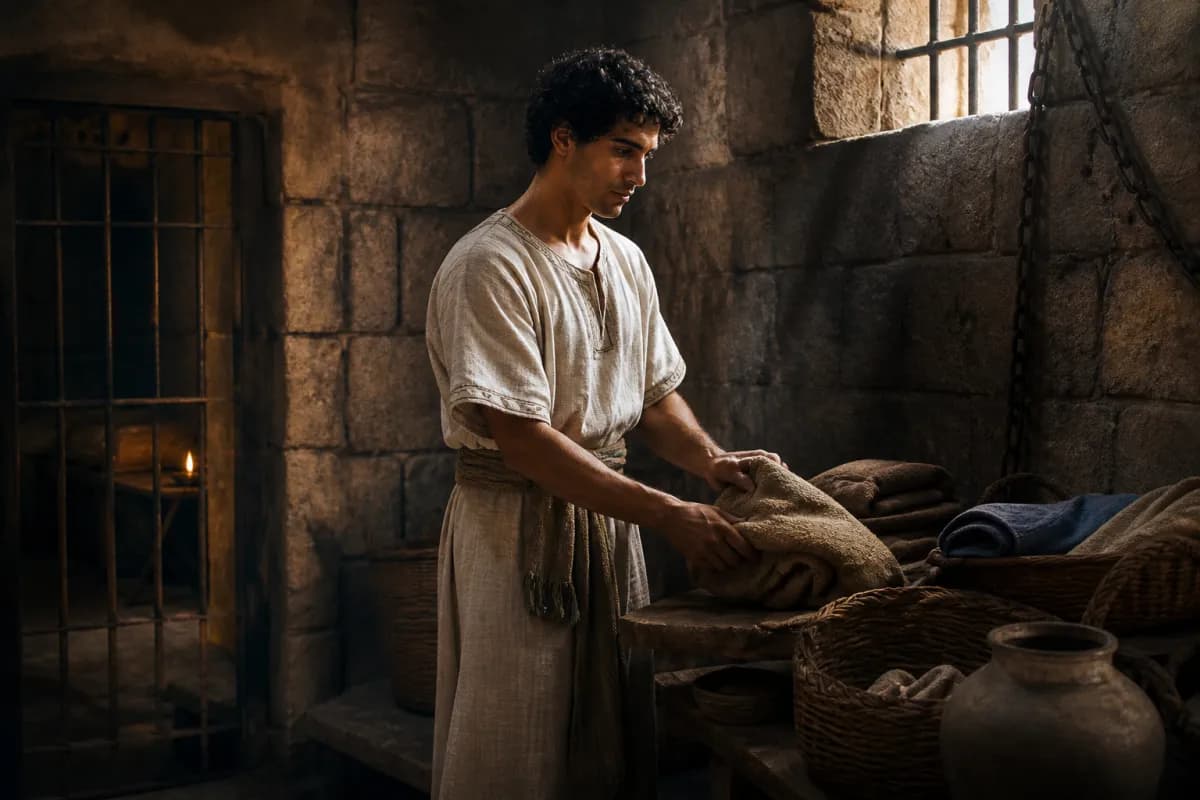
39:20Joseph’s master took him, and put him into the prison, the place where the king’s prisoners were bound, and he was there in custody.
39:21But the LORD was with Joseph, and showed kindness to him, and gave him favor in the sight of the keeper of the prison.
39:22The keeper of the prison committed to Joseph’s hand all the prisoners who were in the prison. Whatever they did there, he was responsible for it.
39:23The keeper of the prison didn’t look after anything that was under his hand, because the LORD was with him; and that which he did, the LORD made it prosper.
CONTEXTUAL OVERVIEW
Joseph enters Egypt as a slave, not as a triumphant dreamer. Yet the chapter repeats that the Lord is with him, and Potiphar sees that Joseph’s work prospers. Joseph becomes trusted over the household, a striking reversal for someone stripped of status by his brothers, but the new responsibility also places him in a setting where faithfulness will cost him dearly.
Potiphar’s wife repeatedly invites Joseph to sleep with her. His refusal is not simply fear of consequences. He names the trust Potiphar has given him and calls the act “great wickedness” against God. When he flees, leaving his garment, that same garment becomes the prop in a false accusation, echoing the robe his brothers used to deceive Jacob.
HISTORICAL AND LITERARY CONTEXT
Genesis 39 resumes Joseph’s story after Judah and Tamar. The narrative moves inside an Egyptian official’s household and then a royal prison, but its primary interest is theological rather than administrative. Joseph’s competence is repeatedly traced to the Lord’s presence, not to an autonomous talent that makes him invulnerable.
The chapter does not provide enough information to adjudicate every legal detail behind Potiphar’s response. It shows the power imbalance clearly: an enslaved foreigner’s truthful refusal cannot protect him from a powerful woman’s accusation. The fact that Joseph lands in prison, rather than being immediately executed, keeps the story moving without making the injustice any less real.
Did you know?
An Egyptian story also tells of a young man falsely accused after refusing a woman’s advances. In the Tale of Two Brothers, the man is Bata; the surviving manuscript comes from Egypt’s Nineteenth Dynasty.
Why it matters: This literary parallel shows that ancient Egyptian storytellers also explored the danger of a false accusation within a household.
The Ancient Near East: The Story of Two Brothers, p.11 — Princeton University Press
SECTION-BY-SECTION ANALYSIS
- Entrusted responsibility · Genesis 39:1Joseph treats Potiphar’s trust as a moral obligation before God, not as an opportunity to take what is forbidden.
- The garment · Genesis 39:12The garment becomes false evidence, linking this unjust accusation to the earlier deception that used Joseph’s robe against Jacob.
- The prison · Genesis 39:21The Lord’s favor in prison does not redefine imprisonment as good; it declares that injustice has not removed Joseph from God’s care.
CHRIST IN THIS PASSAGE
Joseph’s righteous suffering provides a careful pattern rather than a one-to-one prediction of Jesus. Like Joseph, Jesus is faithful under pressure, falsely accused, and handed over despite innocence. The Gospels make clear that Christ’s innocence is essential to His saving mission: He bears sin’s judgment not for His own wrongdoing but to bring sinners to God.
Joseph cannot atone for his accusers, and Genesis does not claim that he does. Jesus alone gives Himself as the righteous one for the unrighteous. Yet Joseph’s story helps readers see that faithful obedience may lead through suffering before God’s purpose is visible, while Christ’s resurrection assures believers that false judgment and death cannot cancel the Father’s saving work.
REFLECTION
Joseph’s escape gives practical wisdom for temptation: some situations require immediate distance rather than extended confidence in our resolve. His words also show that sexual integrity belongs to worship. What is done with the body is not hidden from God, and trust placed in us by another person is never disposable.
The chapter also speaks to people suffering because they did what was right. Faithfulness does not always produce quick vindication, and Christians should never promise that it will. Jesus knows unjust accusation and costly obedience. In Him, believers have a faithful Lord who remains near, calls them to endurance, and will finally judge with truth.
Original Hebrew Word Study
Genesis 39:21
חֶסֶד
chesed · H2617
Usually translated: steadfast love or loyal care
Chesed is steadfast love. The Lord’s loyal care accompanies Joseph even in prison, showing that divine favor is not cancelled by false accusation or confinement.
Follow the Scripture trail
Joseph in Egypt: Faithfulness in the House and Prison in the larger story
The connection: God remains with Joseph in both a trusted household and a false imprisonment, preserving him for the rescue still ahead. Jesus fulfills the pattern of righteous suffering in a greater way: innocent yet condemned, He gives Himself to bring sinners to God and sustains His people in costly faithfulness.
Respond to the passage
Where do you need to flee a temptation rather than debate with it? Where are you discouraged because doing right has been costly? Bring both to Jesus, who knows temptation without sin and unjust suffering without abandoning the Father’s will.
- Why does Joseph describe the proposed sin as a betrayal of both Potiphar’s trust and God’s holiness?
- What does the repeated statement that the Lord is with Joseph mean while he remains a slave and then a prisoner?
- How does Christ’s innocent suffering give hope without turning present injustice into something small?
Prayer
Father, make me faithful in the places where no one else sees and give me wisdom to flee what would dishonor You. Thank You for Jesus, the righteous Savior who suffered for sinners. Stay near to those bearing false accusation and strengthen us to endure in hope. Amen.