Passage Study
Cain and Abel: Sin at the Door
Genesis 4:1–4:16
Genesis 4:1–16 shows worship turned into envy, anger, and murder when Cain refuses God’s warning. Abel’s blood cries from the ground, but the story also displays God confronting the guilty man before judgment. It prepares readers to receive Jesus, whose blood speaks a better word of mercy and reconciliation.
- In this study
- 16 verses · 5 movements
Genesis 4
4:1The man knew Eve his wife. She conceived, and gave birth to Cain, and said, “I have gotten a man with the LORD’s help.”
4:2Again she gave birth, to Cain’s brother Abel. Abel was a keeper of sheep, but Cain was a tiller of the ground.
4:3As time passed, Cain brought an offering to the LORD from the fruit of the ground.
4:4Abel also brought some of the firstborn of his flock and of its fat. The LORD respected Abel and his offering,
4:5but he didn’t respect Cain and his offering. Cain was very angry, and the expression on his face fell.
4:6The LORD said to Cain, “Why are you angry? Why has the expression of your face fallen?
4:7If you do well, won’t it be lifted up? If you don’t do well, sin crouches at the door. Its desire is for you, but you are to rule over it.”
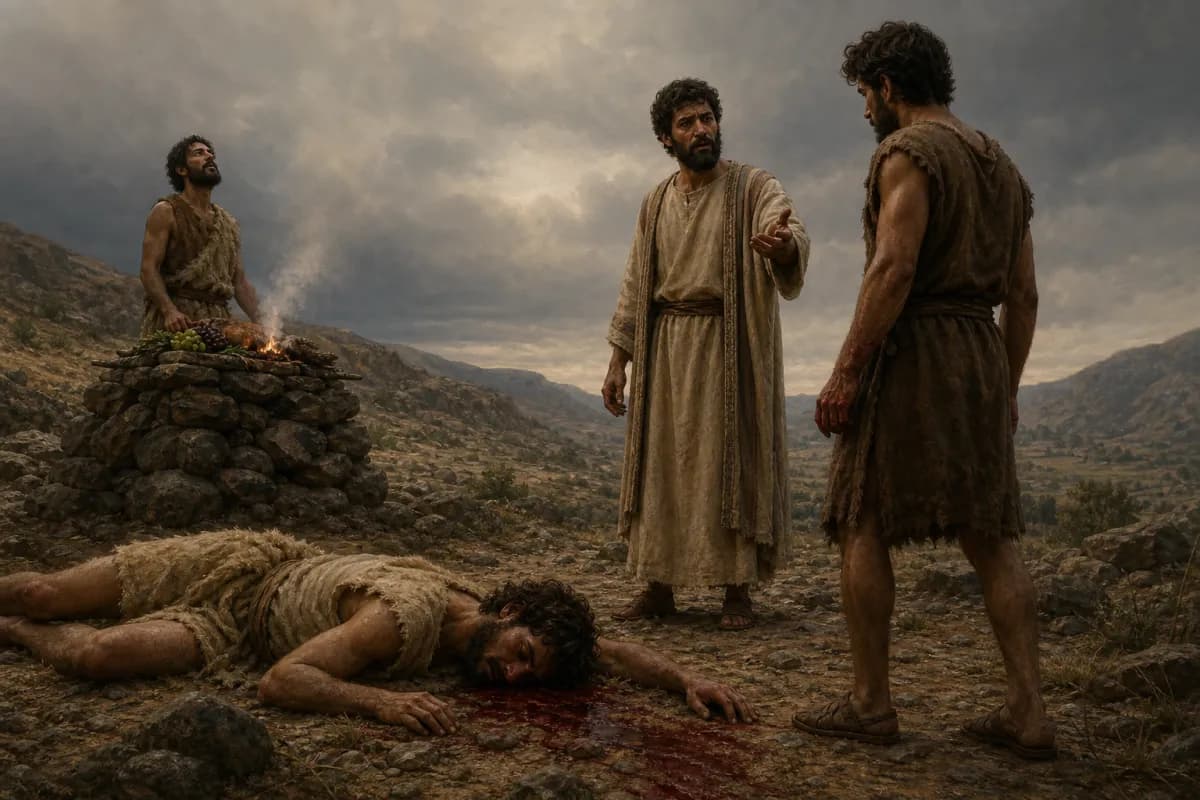
4:8Cain said to Abel, his brother, “Let’s go into the field.” While they were in the field, Cain rose up against Abel, his brother, and killed him.
4:9The LORD said to Cain, “Where is Abel, your brother?” He said, “I don’t know. Am I my brother’s keeper?”
4:10The LORD said, “What have you done? The voice of your brother’s blood cries to me from the ground.
4:11Now you are cursed because of the ground, which has opened its mouth to receive your brother’s blood from your hand.
4:12From now on, when you till the ground, it won’t yield its strength to you. You will be a fugitive and a wanderer in the earth.”
4:13Cain said to the LORD, “My punishment is greater than I can bear.
4:14Behold, you have driven me out today from the surface of the ground. I will be hidden from your face, and I will be a fugitive and a wanderer in the earth. Whoever finds me will kill me.”
4:15The LORD said to him, “Therefore whoever slays Cain, vengeance will be taken on him sevenfold.” The LORD appointed a sign for Cain, so that anyone finding him would not strike him.
4:16Cain left the LORD’s presence, and lived in the land of Nod, east of Eden.
CONTEXTUAL OVERVIEW
The first family outside Eden now brings worship to the Lord, but Genesis quickly shows that exile has not removed the deeper problem of sin. Abel brings from the firstlings of his flock; Cain brings from the fruit of the ground. The text emphasizes God’s regard for Abel and his offering without giving a mechanical formula by which people can manipulate divine favor.
Cain’s face falls, and God addresses the danger before the murder occurs. His anger is not treated as a harmless private mood. It is the threshold at which sin seeks mastery, while Cain is summoned to rule over it by heeding God’s warning.
HISTORICAL AND LITERARY CONTEXT
Genesis 4 is the first expansion of Genesis 3’s rebellion: distrust of God becomes violence against a brother. The ground already cursed because of Adam’s sin now receives Abel’s blood, so the narrative joins worship, neighbor-love, land, and justice in one moral scene.
The story does not allow Cain to hide behind vague religious feeling. God’s question, “Where is your brother?” places responsibility at the center. Cain’s evasive answer reveals the heart of the crime: he has rejected both God’s authority and the obligation to guard his brother’s life.
Did you know?
A Late Uruk cylinder seal from Warka, dated 3300–3000 BCE, depicts a priest-king feeding flowers to two ewes beside reed bundles identified with the goddess Inanna.
Why it matters: Abel brings firstlings from his flock. The seal does not portray Abel or a sacrifice, but it gives readers a concrete ancient image of sheep placed within a cultic scene.
SECTION-BY-SECTION ANALYSIS
- The offering · Genesis 4:3Worship is exposed as a matter of the worshiper’s heart before God, not merely an outward gift.
- The warning · Genesis 4:13God confronts Cain before the murder, making clear that anger must be answered with repentance rather than nurtured.
- The blood · Genesis 4:10The earth itself bears witness that violence against a neighbor is never hidden from the Judge of all the earth.
CHRIST IN THIS PASSAGE
Hebrews names Abel as one who offered by faith and whose witness continues. It then contrasts Abel’s blood with the blood of Jesus, which “speaks a better word.” Abel’s blood rightly cries for God’s justice; Jesus’ sacrificial blood secures forgiveness for enemies who repent and come to Him.
Jesus also identifies hatred as the seedbed of murder and makes reconciliation a matter of worship. His saving mission reaches the very hostility Genesis displays: He creates a reconciled people who refuse revenge, confess anger, and learn to love brothers and enemies through His grace.
REFLECTION
Cain’s story asks what we do when another person’s good exposes our own discontent. Envy can make a brother’s blessing look like a personal threat. God’s warning is mercy: bring the fallen face, the comparison, and the anger into His light before sin gains the mastery it seeks.
Jesus does not minimize the harm anger can do. He bears its violence at the cross and makes peace through His blood, then sends His people to practice reconciliation. The faithful next step may be confession, refusing a resentful story, or seeking peace with someone you have treated as a rival.
Original Hebrew Word Study
Genesis 4:7
חַטָּאת
chatat · H2403
Usually translated: sin
Chatat means sin. In God’s warning to Cain, the text describes sin as crouching at the door—a figure of speech for an active threat seeking mastery. That language gives moral urgency to resentment: sin is not a harmless feeling but a power that must be resisted before God.
Follow the Scripture trail
Cain and Abel: Sin at the Door in the larger story
The connection: Cain’s murder shows the destructive reach of sin after Eden, while Abel’s blood anticipates the Bible’s demand for justice. Jesus fulfills God’s reconciling mission by shedding His blood to forgive repentant sinners and form a people marked by sacrificial love rather than hatred.
Respond to the passage
Do not baptize envy or anger as discernment. Bring it to Christ before it becomes speech, contempt, or harm. His blood gives both forgiveness for real guilt and power to seek reconciliation where rivalry has taken root.
- What does God’s warning to Cain reveal about the danger of unaddressed anger?
- Where are you tempted to interpret another person’s blessing as a threat rather than a reason for gratitude?
- How does the contrast between Abel’s blood and Jesus’ blood reshape the way you seek justice and reconciliation?
Prayer
Lord Jesus, expose the envy and anger I hide from others. Thank You that Your blood speaks forgiveness and peace. Guard my words and actions, give me courage to confess sin, and make me a faithful worker for reconciliation. Amen.